

368
4 Hardware Trojans in Microcircuits
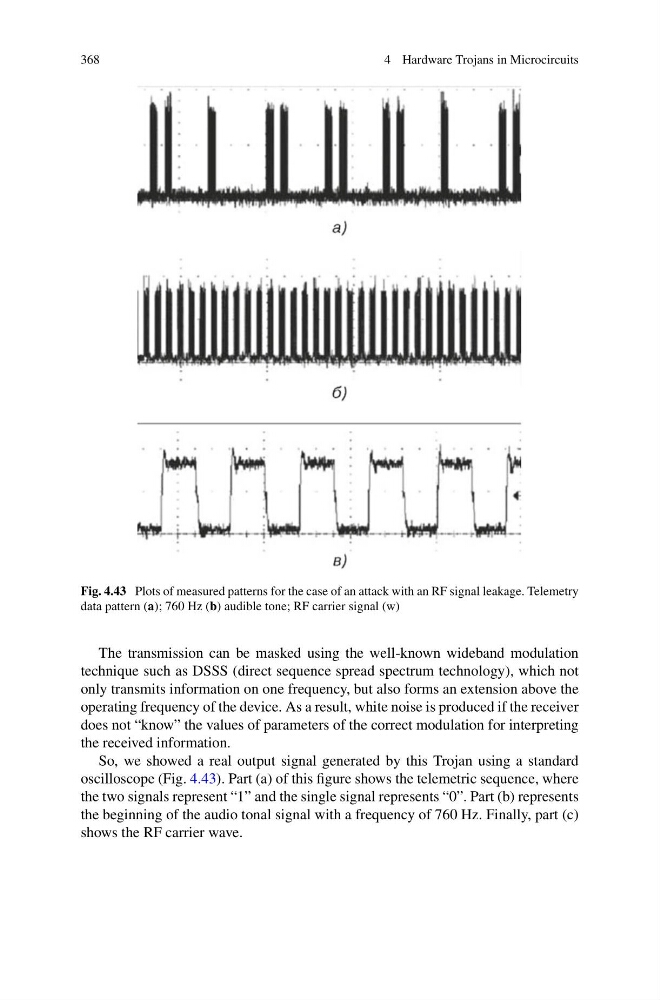
Fig. 4.43 Plots of measured patterns for the case of an attack with an RF signal leakage. Telemetry
data pattern (a); 760 Hz (b) audible tone; RF carrier signal (w)
The transmission can be masked using the well-known wideband modulation
technique such as DSSS (direct sequence spread spectrum technology), which not
only transmits information on one frequency, but also forms an extension above the
operating frequency of the device. As a result, white noise is produced if the receiver
does not “know” the values of parameters of the correct modulation for interpreting
the received information.
So, we showed a real output signal generated by this Trojan using a standard
oscilloscope (Fig. 4.43). Part (a) of this figure shows the telemetric sequence, where
the two signals represent “1” and the single signal represents “0”. Part (b) represents
the beginning of the audio tonal signal with a frequency of 760 Hz. Finally, part (c)
shows the RF carrier wave.
4 Hardware Trojans in Microcircuits
Fig. 4.43 Plots of measured patterns for the case of an attack with an RF signal leakage. Telemetry
data pattern (a); 760 Hz (b) audible tone; RF carrier signal (w)
The transmission can be masked using the well-known wideband modulation
technique such as DSSS (direct sequence spread spectrum technology), which not
only transmits information on one frequency, but also forms an extension above the
operating frequency of the device. As a result, white noise is produced if the receiver
does not “know” the values of parameters of the correct modulation for interpreting
the received information.
So, we showed a real output signal generated by this Trojan using a standard
oscilloscope (Fig. 4.43). Part (a) of this figure shows the telemetric sequence, where
the two signals represent “1” and the single signal represents “0”. Part (b) represents
the beginning of the audio tonal signal with a frequency of 760 Hz. Finally, part (c)
shows the RF carrier wave.