

330
4 Hardware Trojans in Microcircuits
modifications of IC characteristics, the leakage of confidential information, as well
as in the organization of successful denial-of-service-type attacks. For preventing the
potential of such threats, it is necessary to develop complex techniques and effective strategies for dealing with such hardware Trojans, their prevention and timely
detection, as well as effective measures to counteract them.
4.4.2 Hierarchical Levels of Introducing Trojans
into Microcircuits
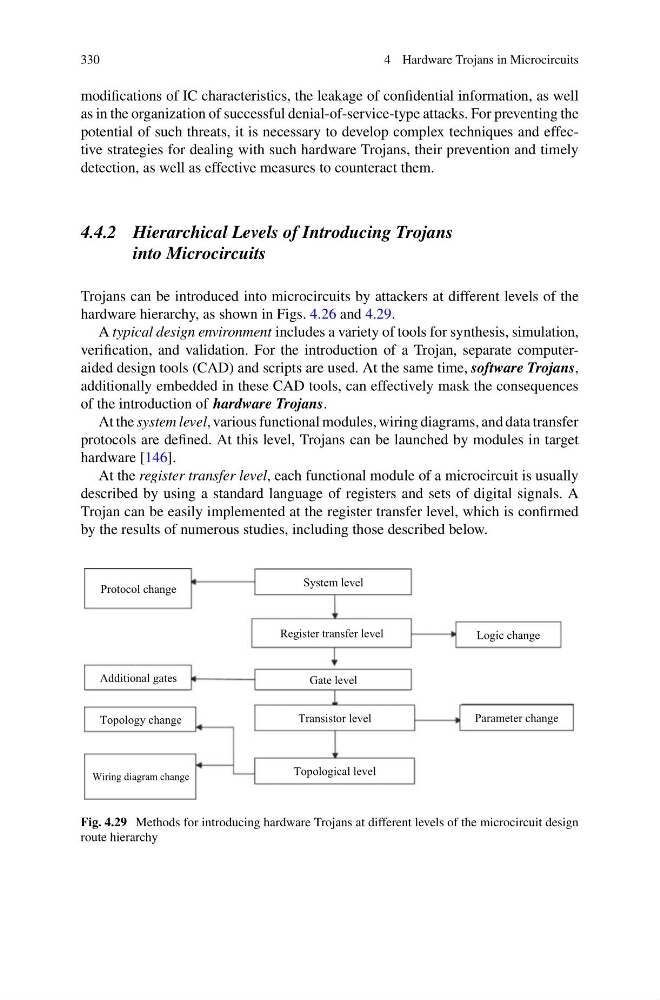
Trojans can be introduced into microcircuits by attackers at different levels of the
hardware hierarchy, as shown in Figs. 4.26 and 4.29.
A typical design environment includes a variety of tools for synthesis, simulation,
verification, and validation. For the introduction of a Trojan, separate computeraided design tools (CAD) and scripts are used. At the same time, software Trojans,
additionally embedded in these CAD tools, can effectively mask the consequences
of the introduction of hardware Trojans.
At the system level, various functional modules, wiring diagrams, and data transfer
protocols are defined. At this level, Trojans can be launched by modules in target
hardware [146].
At the register transfer level, each functional module of a microcircuit is usually
described by using a standard language of registers and sets of digital signals. A
Trojan can be easily implemented at the register transfer level, which is confirmed
by the results of numerous studies, including those described below.
Protocol change
System level
Logic change
Parameter change
Gate level
Transistor level
Topological level
Register transfer level
Additional gates
Topology change
Wiring diagram change
Fig. 4.29 Methods for introducing hardware Trojans at different levels of the microcircuit design
route hierarchy
4 Hardware Trojans in Microcircuits
modifications of IC characteristics, the leakage of confidential information, as well
as in the organization of successful denial-of-service-type attacks. For preventing the
potential of such threats, it is necessary to develop complex techniques and effective strategies for dealing with such hardware Trojans, their prevention and timely
detection, as well as effective measures to counteract them.
4.4.2 Hierarchical Levels of Introducing Trojans
into Microcircuits
Trojans can be introduced into microcircuits by attackers at different levels of the
hardware hierarchy, as shown in Figs. 4.26 and 4.29.
A typical design environment includes a variety of tools for synthesis, simulation,
verification, and validation. For the introduction of a Trojan, separate computeraided design tools (CAD) and scripts are used. At the same time, software Trojans,
additionally embedded in these CAD tools, can effectively mask the consequences
of the introduction of hardware Trojans.
At the system level, various functional modules, wiring diagrams, and data transfer
protocols are defined. At this level, Trojans can be launched by modules in target
hardware [146].
At the register transfer level, each functional module of a microcircuit is usually
described by using a standard language of registers and sets of digital signals. A
Trojan can be easily implemented at the register transfer level, which is confirmed
by the results of numerous studies, including those described below.
Protocol change
System level
Logic change
Parameter change
Gate level
Transistor level
Topological level
Register transfer level
Additional gates
Topology change
Wiring diagram change
Fig. 4.29 Methods for introducing hardware Trojans at different levels of the microcircuit design
route hierarchy