

114
2 Computer Viruses, Malicious Logic, and Spyware
passwords and other confidential information entered by the user using the keyboard.
As a result, an attacker can easily find out codes and account numbers in electronic
payment systems, account passwords in online games, addresses, logins, passwords
to e-mail systems, and much more.
In the so-called criminal case, after receiving user’s confidential data, an attacker
can not only tritely transfer money from his bank account or use a user account in an
online game. Unfortunately, the availability of such data in some cases can lead to
more serious consequences than the loss of a certain amount of money by a specific
person.
The use of keyloggers allows economic and political espionage, access to information constituting not only commercial, but also state secrets, as well as compromising
security systems used by commercial and government structures (for example, by
stealing private keys in cryptographic systems).
Finally, it should be noted that, historically, it turned out that every virus usually
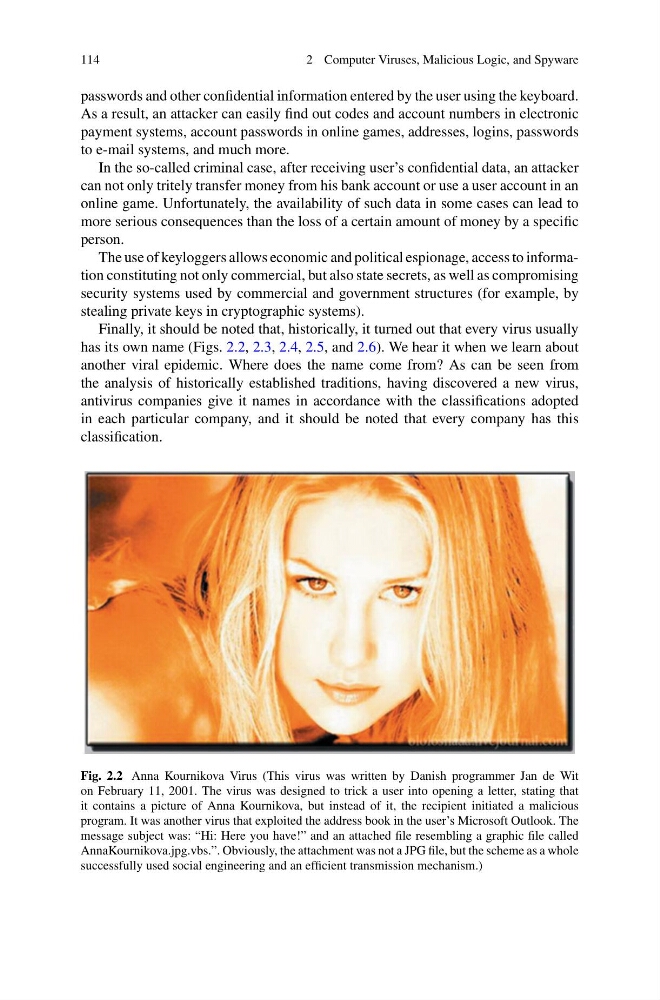
has its own name (Figs. 2.2, 2.3, 2.4, 2.5, and 2.6). We hear it when we learn about
another viral epidemic. Where does the name come from? As can be seen from
the analysis of historically established traditions, having discovered a new virus,
antivirus companies give it names in accordance with the classifications adopted
in each particular company, and it should be noted that every company has this
classification.
Fig. 2.2 Anna Kournikova Virus (This virus was written by Danish programmer Jan de Wit
on February 11, 2001. The virus was designed to trick a user into opening a letter, stating that
it contains a picture of Anna Kournikova, but instead of it, the recipient initiated a malicious
program. It was another virus that exploited the address book in the user’s Microsoft Outlook. The
message subject was: “Hi: Here you have!” and an attached file resembling a graphic file called
AnnaKournikova.jpg.vbs.”. Obviously, the attachment was not a JPG file, but the scheme as a whole
successfully used social engineering and an efficient transmission mechanism.)
2 Computer Viruses, Malicious Logic, and Spyware
passwords and other confidential information entered by the user using the keyboard.
As a result, an attacker can easily find out codes and account numbers in electronic
payment systems, account passwords in online games, addresses, logins, passwords
to e-mail systems, and much more.
In the so-called criminal case, after receiving user’s confidential data, an attacker
can not only tritely transfer money from his bank account or use a user account in an
online game. Unfortunately, the availability of such data in some cases can lead to
more serious consequences than the loss of a certain amount of money by a specific
person.
The use of keyloggers allows economic and political espionage, access to information constituting not only commercial, but also state secrets, as well as compromising
security systems used by commercial and government structures (for example, by
stealing private keys in cryptographic systems).
Finally, it should be noted that, historically, it turned out that every virus usually
has its own name (Figs. 2.2, 2.3, 2.4, 2.5, and 2.6). We hear it when we learn about
another viral epidemic. Where does the name come from? As can be seen from
the analysis of historically established traditions, having discovered a new virus,
antivirus companies give it names in accordance with the classifications adopted
in each particular company, and it should be noted that every company has this
classification.
Fig. 2.2 Anna Kournikova Virus (This virus was written by Danish programmer Jan de Wit
on February 11, 2001. The virus was designed to trick a user into opening a letter, stating that
it contains a picture of Anna Kournikova, but instead of it, the recipient initiated a malicious
program. It was another virus that exploited the address book in the user’s Microsoft Outlook. The
message subject was: “Hi: Here you have!” and an attached file resembling a graphic file called
AnnaKournikova.jpg.vbs.”. Obviously, the attachment was not a JPG file, but the scheme as a whole
successfully used social engineering and an efficient transmission mechanism.)