

70
G. Chakraborty and N. Jani
4.2 Nonlinearity in Actuating System
MEMS resonators are excited by different mechanisms. The most common of which
are
(i) electrostatic actuation and
(ii) piezoelectric actuation.
The forces of actuation in an electrostatically actuated MEMS (also called capacitive
MEMS resonator) is calculated by solving the field equations in an electrostatic
problem. However, under certain assumptions the force can be modelled as
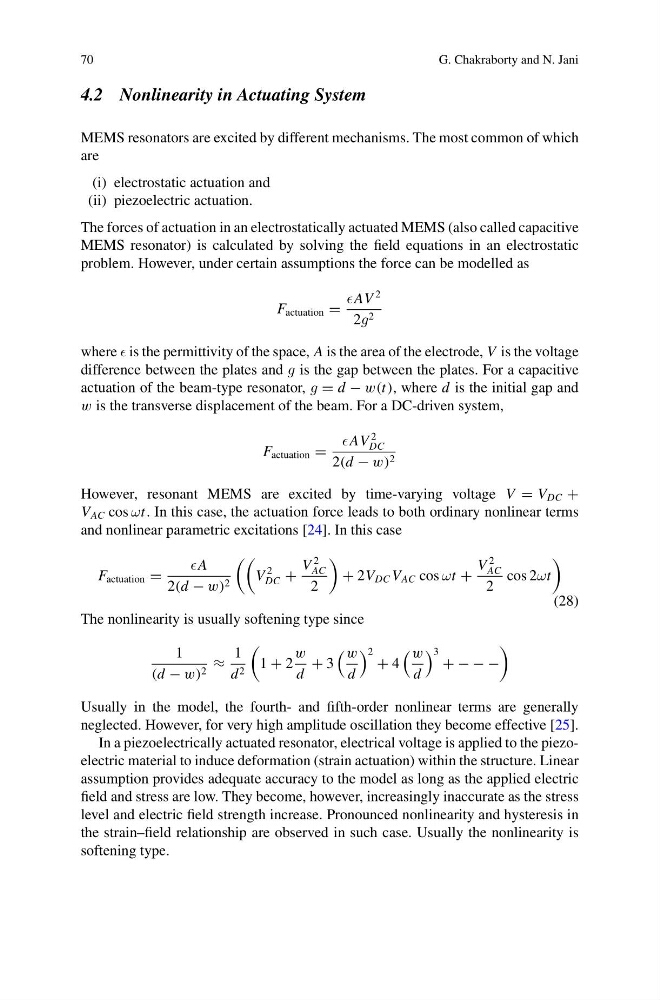
F actuation =
AV
2
2g 2
where is the permittivity of the space, A is the area of the electrode, V is the voltage
difference between the plates and g is the gap between the plates. For a capacitive
actuation of the beam-type resonator, g = d − w(t), where d is the initial gap and
w is the transverse displacement of the beam. For a DC-driven system,
F actuation =
AV
2
DC
2(d − w) 2
However, resonant MEMS are excited by time-varying voltage V = V DC +
V AC cos ωt. In this case, the actuation force leads to both ordinary nonlinear terms
and nonlinear parametric excitations [24]. In this case
F actuation =
A
2(d − w) 2
V
2
DC +
V
2
AC
2
+ 2V DC V AC cos ωt +
V
2
AC
2
cos 2ωt
(28)
The nonlinearity is usually softening type since
1
(d − w) 2 ≈
1
d 2
1 + 2
w
d
+ 3
w
d
2 + 4
w
d
3 + − − −
Usually in the model, the fourth- and fifth-order nonlinear terms are generally
neglected. However, for very high amplitude oscillation they become effective [25].
In a piezoelectrically actuated resonator, electrical voltage is applied to the piezoelectric material to induce deformation (strain actuation) within the structure. Linear
assumption provides adequate accuracy to the model as long as the applied electric
field and stress are low. They become, however, increasingly inaccurate as the stress
level and electric field strength increase. Pronounced nonlinearity and hysteresis in
the strain–field relationship are observed in such case. Usually the nonlinearity is
softening type.
G. Chakraborty and N. Jani
4.2 Nonlinearity in Actuating System
MEMS resonators are excited by different mechanisms. The most common of which
are
(i) electrostatic actuation and
(ii) piezoelectric actuation.
The forces of actuation in an electrostatically actuated MEMS (also called capacitive
MEMS resonator) is calculated by solving the field equations in an electrostatic
problem. However, under certain assumptions the force can be modelled as
F actuation =
AV
2
2g 2
where is the permittivity of the space, A is the area of the electrode, V is the voltage
difference between the plates and g is the gap between the plates. For a capacitive
actuation of the beam-type resonator, g = d − w(t), where d is the initial gap and
w is the transverse displacement of the beam. For a DC-driven system,
F actuation =
AV
2
DC
2(d − w) 2
However, resonant MEMS are excited by time-varying voltage V = V DC +
V AC cos ωt. In this case, the actuation force leads to both ordinary nonlinear terms
and nonlinear parametric excitations [24]. In this case
F actuation =
A
2(d − w) 2
V
2
DC +
V
2
AC
2
+ 2V DC V AC cos ωt +
V
2
AC
2
cos 2ωt
(28)
The nonlinearity is usually softening type since
1
(d − w) 2 ≈
1
d 2
1 + 2
w
d
+ 3
w
d
2 + 4
w
d
3 + − − −
Usually in the model, the fourth- and fifth-order nonlinear terms are generally
neglected. However, for very high amplitude oscillation they become effective [25].
In a piezoelectrically actuated resonator, electrical voltage is applied to the piezoelectric material to induce deformation (strain actuation) within the structure. Linear
assumption provides adequate accuracy to the model as long as the applied electric
field and stress are low. They become, however, increasingly inaccurate as the stress
level and electric field strength increase. Pronounced nonlinearity and hysteresis in
the strain–field relationship are observed in such case. Usually the nonlinearity is
softening type.