

Nonlinear Dynamics of Resonant Microelectromechanical System (MEMS): A Review
65
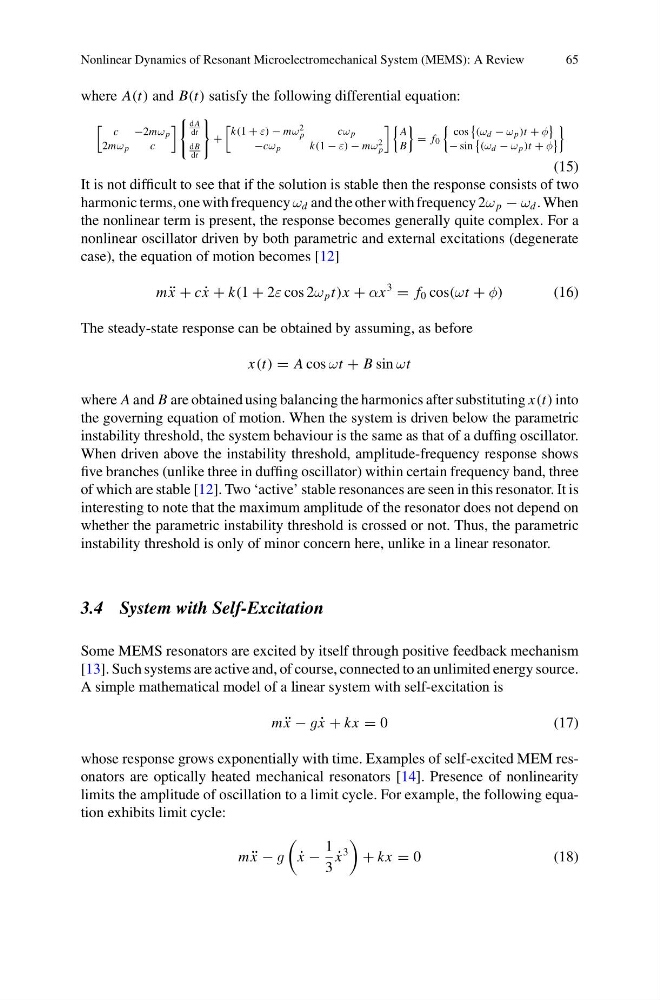
where A(t) and B(t) satisfy the following differential equation:
c −2mω p
2mω p
c
⎧
⎨
⎩
d A
dt
dB
dt
⎫
⎬
⎭
+
k(1 + ε) − mω 2
p
cω p
−cω p
k(1 − ε) − mω 2
p
A
B
= f 0
cos
(ω d − ω p )t + φ
− sin
(ω d − ω p )t + φ
(15)
It is not difficult to see that if the solution is stable then the response consists of two
harmonic terms, one with frequency ω d and the other with frequency 2ω p − ω d . When
the nonlinear term is present, the response becomes generally quite complex. For a
nonlinear oscillator driven by both parametric and external excitations (degenerate
case), the equation of motion becomes [12]
m ¨
x + c ˙
x + k(1 + 2ε cos 2ω p t)x + αx
3
= f 0 cos(ωt + φ)
(16)
The steady-state response can be obtained by assuming, as before
x(t) = A cos ωt + B sin ωt
where A and B are obtained using balancing the harmonics after substituting x(t) into
the governing equation of motion. When the system is driven below the parametric
instability threshold, the system behaviour is the same as that of a duffing oscillator.
When driven above the instability threshold, amplitude-frequency response shows
five branches (unlike three in duffing oscillator) within certain frequency band, three
of which are stable [12]. Two ‘active’ stable resonances are seen in this resonator. It is
interesting to note that the maximum amplitude of the resonator does not depend on
whether the parametric instability threshold is crossed or not. Thus, the parametric
instability threshold is only of minor concern here, unlike in a linear resonator.
3.4 System with Self-Excitation
Some MEMS resonators are excited by itself through positive feedback mechanism
[13]. Such systems are active and, of course, connected to an unlimited energy source.
A simple mathematical model of a linear system with self-excitation is
m ¨
x − g ˙
x + kx = 0
(17)
whose response grows exponentially with time. Examples of self-excited MEM resonators are optically heated mechanical resonators [14]. Presence of nonlinearity
limits the amplitude of oscillation to a limit cycle. For example, the following equation exhibits limit cycle:
m ¨
x − g
˙
x −
1
3
˙
x
3
+ kx = 0
(18)
65
where A(t) and B(t) satisfy the following differential equation:
c −2mω p
2mω p
c
⎧
⎨
⎩
d A
dt
dB
dt
⎫
⎬
⎭
+
k(1 + ε) − mω 2
p
cω p
−cω p
k(1 − ε) − mω 2
p
A
B
= f 0
cos
(ω d − ω p )t + φ
− sin
(ω d − ω p )t + φ
(15)
It is not difficult to see that if the solution is stable then the response consists of two
harmonic terms, one with frequency ω d and the other with frequency 2ω p − ω d . When
the nonlinear term is present, the response becomes generally quite complex. For a
nonlinear oscillator driven by both parametric and external excitations (degenerate
case), the equation of motion becomes [12]
m ¨
x + c ˙
x + k(1 + 2ε cos 2ω p t)x + αx
3
= f 0 cos(ωt + φ)
(16)
The steady-state response can be obtained by assuming, as before
x(t) = A cos ωt + B sin ωt
where A and B are obtained using balancing the harmonics after substituting x(t) into
the governing equation of motion. When the system is driven below the parametric
instability threshold, the system behaviour is the same as that of a duffing oscillator.
When driven above the instability threshold, amplitude-frequency response shows
five branches (unlike three in duffing oscillator) within certain frequency band, three
of which are stable [12]. Two ‘active’ stable resonances are seen in this resonator. It is
interesting to note that the maximum amplitude of the resonator does not depend on
whether the parametric instability threshold is crossed or not. Thus, the parametric
instability threshold is only of minor concern here, unlike in a linear resonator.
3.4 System with Self-Excitation
Some MEMS resonators are excited by itself through positive feedback mechanism
[13]. Such systems are active and, of course, connected to an unlimited energy source.
A simple mathematical model of a linear system with self-excitation is
m ¨
x − g ˙
x + kx = 0
(17)
whose response grows exponentially with time. Examples of self-excited MEM resonators are optically heated mechanical resonators [14]. Presence of nonlinearity
limits the amplitude of oscillation to a limit cycle. For example, the following equation exhibits limit cycle:
m ¨
x − g
˙
x −
1
3
˙
x
3
+ kx = 0
(18)