

64
G. Chakraborty and N. Jani
3.3 System with Combined Direct and Parametric
Resonances
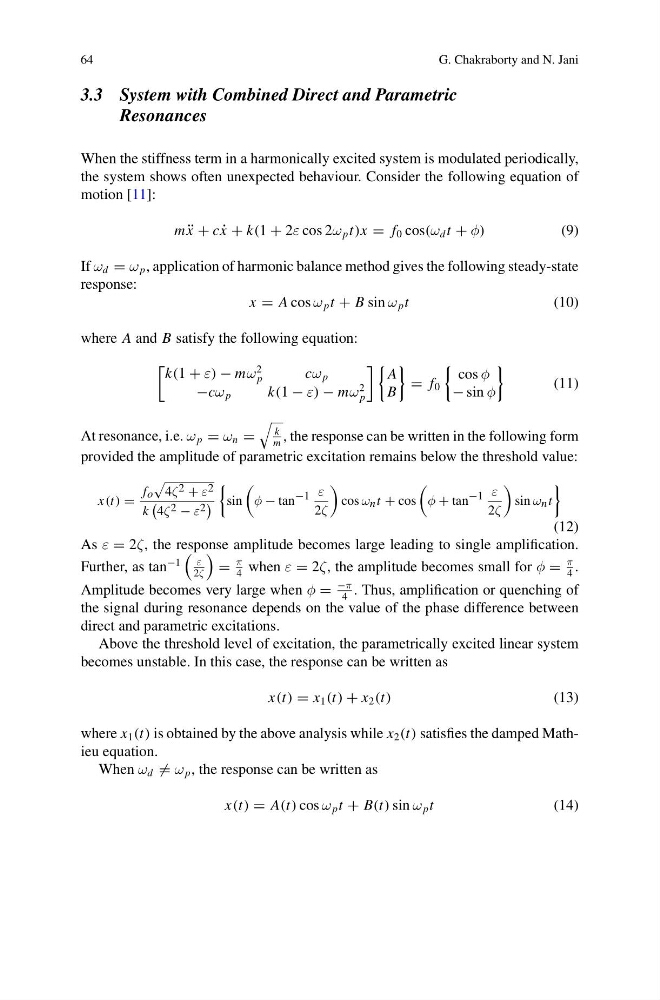
When the stiffness term in a harmonically excited system is modulated periodically,
the system shows often unexpected behaviour. Consider the following equation of
motion [11]:
m ¨
x + c ˙
x + k(1 + 2ε cos 2ω p t)x = f 0 cos(ω d t + φ)
(9)
If ω d = ω p , application of harmonic balance method gives the following steady-state
response:
x = A cos ω p t + B sin ω p t
(10)
where A and B satisfy the following equation:
k(1 + ε) − mω
2
p
cω p
−cω p
k(1 − ε) − mω
2
p
A
B
= f 0
cos φ
− sin φ
(11)
At resonance, i.e. ω p = ω n =
k
m
, the response can be written in the following form
provided the amplitude of parametric excitation remains below the threshold value:
x(t) =
f o
4ζ 2 + ε 2
k
4ζ 2 − ε 2
sin
φ − tan −1 ε
2ζ
cos ω n t + cos
φ + tan −1 ε
2ζ
sin ω n t
(12)
As ε = 2ζ, the response amplitude becomes large leading to single amplification.
Further, as tan
−1
ε
2ζ
=
π
4
when ε = 2ζ, the amplitude becomes small for φ =
π
4
.
Amplitude becomes very large when φ =
−π
4
. Thus, amplification or quenching of
the signal during resonance depends on the value of the phase difference between
direct and parametric excitations.
Above the threshold level of excitation, the parametrically excited linear system
becomes unstable. In this case, the response can be written as
x(t) = x 1 (t) + x 2 (t)
(13)
where x 1 (t) is obtained by the above analysis while x 2 (t) satisfies the damped Mathieu equation.
When ω d = ω p , the response can be written as
x(t) = A(t) cos ω p t + B(t) sin ω p t
(14)
G. Chakraborty and N. Jani
3.3 System with Combined Direct and Parametric
Resonances
When the stiffness term in a harmonically excited system is modulated periodically,
the system shows often unexpected behaviour. Consider the following equation of
motion [11]:
m ¨
x + c ˙
x + k(1 + 2ε cos 2ω p t)x = f 0 cos(ω d t + φ)
(9)
If ω d = ω p , application of harmonic balance method gives the following steady-state
response:
x = A cos ω p t + B sin ω p t
(10)
where A and B satisfy the following equation:
k(1 + ε) − mω
2
p
cω p
−cω p
k(1 − ε) − mω
2
p
A
B
= f 0
cos φ
− sin φ
(11)
At resonance, i.e. ω p = ω n =
k
m
, the response can be written in the following form
provided the amplitude of parametric excitation remains below the threshold value:
x(t) =
f o
4ζ 2 + ε 2
k
4ζ 2 − ε 2
sin
φ − tan −1 ε
2ζ
cos ω n t + cos
φ + tan −1 ε
2ζ
sin ω n t
(12)
As ε = 2ζ, the response amplitude becomes large leading to single amplification.
Further, as tan
−1
ε
2ζ
=
π
4
when ε = 2ζ, the amplitude becomes small for φ =
π
4
.
Amplitude becomes very large when φ =
−π
4
. Thus, amplification or quenching of
the signal during resonance depends on the value of the phase difference between
direct and parametric excitations.
Above the threshold level of excitation, the parametrically excited linear system
becomes unstable. In this case, the response can be written as
x(t) = x 1 (t) + x 2 (t)
(13)
where x 1 (t) is obtained by the above analysis while x 2 (t) satisfies the damped Mathieu equation.
When ω d = ω p , the response can be written as
x(t) = A(t) cos ω p t + B(t) sin ω p t
(14)