

50
G. K. Ananthasuresh
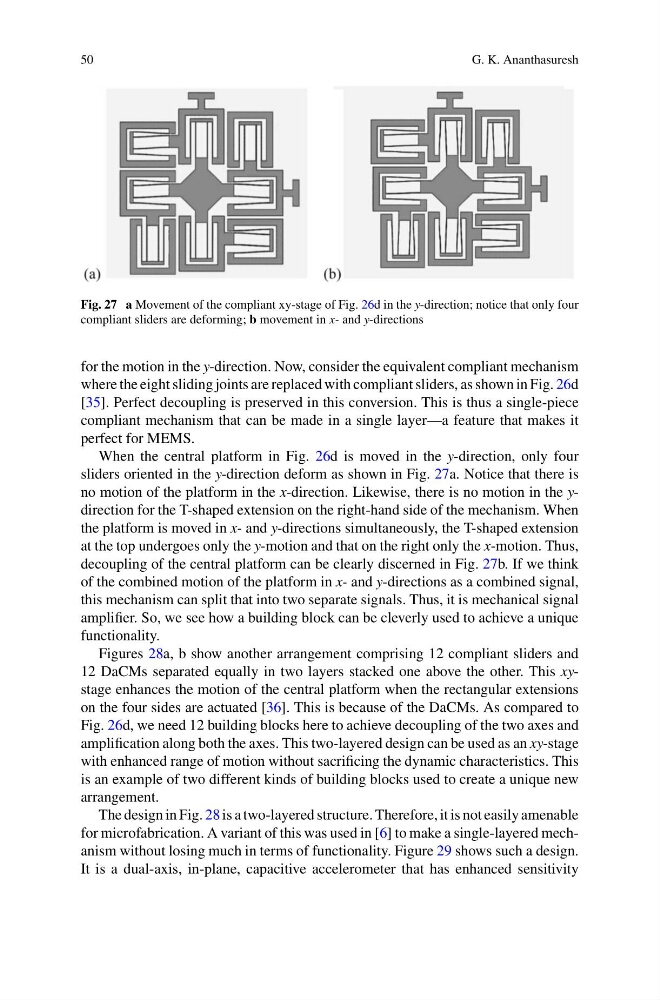
Fig. 27 a Movement of the compliant xy-stage of Fig. 26d in the y-direction; notice that only four
compliant sliders are deforming; b movement in x- and y-directions
for the motion in the y-direction. Now, consider the equivalent compliant mechanism
where the eight sliding joints are replaced with compliant sliders, as shown in Fig. 26d
[35]. Perfect decoupling is preserved in this conversion. This is thus a single-piece
compliant mechanism that can be made in a single layer—a feature that makes it
perfect for MEMS.
When the central platform in Fig. 26d is moved in the y-direction, only four
sliders oriented in the y-direction deform as shown in Fig. 27a. Notice that there is
no motion of the platform in the x-direction. Likewise, there is no motion in the ydirection for the T-shaped extension on the right-hand side of the mechanism. When
the platform is moved in x- and y-directions simultaneously, the T-shaped extension
at the top undergoes only the y-motion and that on the right only the x-motion. Thus,
decoupling of the central platform can be clearly discerned in Fig. 27b. If we think
of the combined motion of the platform in x- and y-directions as a combined signal,
this mechanism can split that into two separate signals. Thus, it is mechanical signal
amplifier. So, we see how a building block can be cleverly used to achieve a unique
functionality.
Figures 28a, b show another arrangement comprising 12 compliant sliders and
12 DaCMs separated equally in two layers stacked one above the other. This xystage enhances the motion of the central platform when the rectangular extensions
on the four sides are actuated [36]. This is because of the DaCMs. As compared to
Fig. 26d, we need 12 building blocks here to achieve decoupling of the two axes and
amplification along both the axes. This two-layered design can be used as an xy-stage
with enhanced range of motion without sacrificing the dynamic characteristics. This
is an example of two different kinds of building blocks used to create a unique new
arrangement.
The design in Fig. 28 is a two-layered structure. Therefore, it is not easily amenable
for microfabrication. A variant of this was used in [6] to make a single-layered mechanism without losing much in terms of functionality. Figure 29 shows such a design.
It is a dual-axis, in-plane, capacitive accelerometer that has enhanced sensitivity
G. K. Ananthasuresh
Fig. 27 a Movement of the compliant xy-stage of Fig. 26d in the y-direction; notice that only four
compliant sliders are deforming; b movement in x- and y-directions
for the motion in the y-direction. Now, consider the equivalent compliant mechanism
where the eight sliding joints are replaced with compliant sliders, as shown in Fig. 26d
[35]. Perfect decoupling is preserved in this conversion. This is thus a single-piece
compliant mechanism that can be made in a single layer—a feature that makes it
perfect for MEMS.
When the central platform in Fig. 26d is moved in the y-direction, only four
sliders oriented in the y-direction deform as shown in Fig. 27a. Notice that there is
no motion of the platform in the x-direction. Likewise, there is no motion in the ydirection for the T-shaped extension on the right-hand side of the mechanism. When
the platform is moved in x- and y-directions simultaneously, the T-shaped extension
at the top undergoes only the y-motion and that on the right only the x-motion. Thus,
decoupling of the central platform can be clearly discerned in Fig. 27b. If we think
of the combined motion of the platform in x- and y-directions as a combined signal,
this mechanism can split that into two separate signals. Thus, it is mechanical signal
amplifier. So, we see how a building block can be cleverly used to achieve a unique
functionality.
Figures 28a, b show another arrangement comprising 12 compliant sliders and
12 DaCMs separated equally in two layers stacked one above the other. This xystage enhances the motion of the central platform when the rectangular extensions
on the four sides are actuated [36]. This is because of the DaCMs. As compared to
Fig. 26d, we need 12 building blocks here to achieve decoupling of the two axes and
amplification along both the axes. This two-layered design can be used as an xy-stage
with enhanced range of motion without sacrificing the dynamic characteristics. This
is an example of two different kinds of building blocks used to create a unique new
arrangement.
The design in Fig. 28 is a two-layered structure. Therefore, it is not easily amenable
for microfabrication. A variant of this was used in [6] to make a single-layered mechanism without losing much in terms of functionality. Figure 29 shows such a design.
It is a dual-axis, in-plane, capacitive accelerometer that has enhanced sensitivity