

The Art and Signs of a Few Good Mechanical Designs in MEMS
47
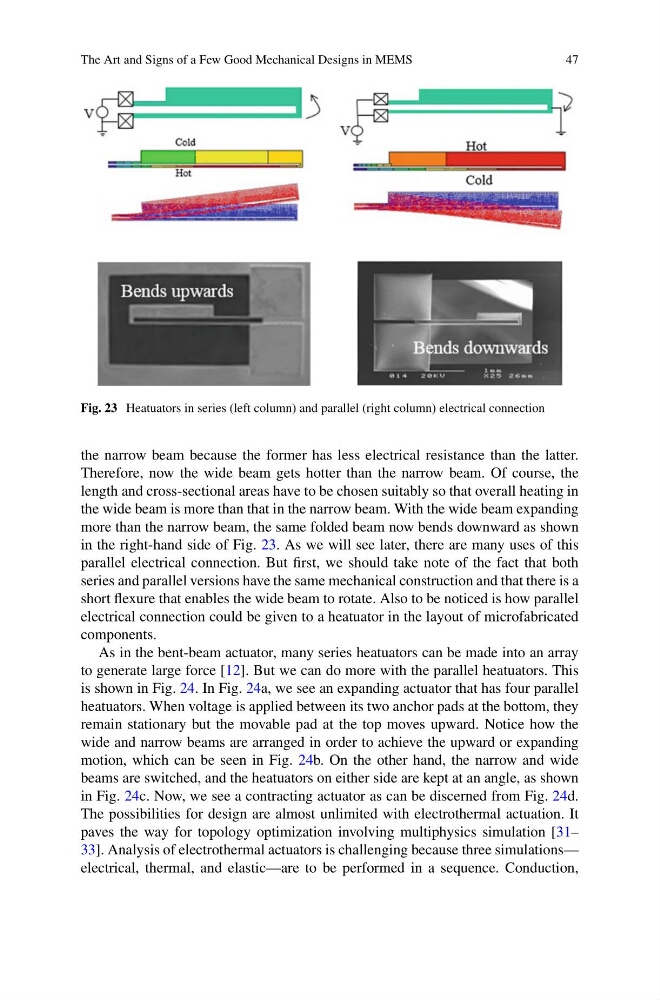
Fig. 23 Heatuators in series (left column) and parallel (right column) electrical connection
the narrow beam because the former has less electrical resistance than the latter.
Therefore, now the wide beam gets hotter than the narrow beam. Of course, the
length and cross-sectional areas have to be chosen suitably so that overall heating in
the wide beam is more than that in the narrow beam. With the wide beam expanding
more than the narrow beam, the same folded beam now bends downward as shown
in the right-hand side of Fig. 23. As we will see later, there are many uses of this
parallel electrical connection. But first, we should take note of the fact that both
series and parallel versions have the same mechanical construction and that there is a
short flexure that enables the wide beam to rotate. Also to be noticed is how parallel
electrical connection could be given to a heatuator in the layout of microfabricated
components.
As in the bent-beam actuator, many series heatuators can be made into an array
to generate large force [12]. But we can do more with the parallel heatuators. This
is shown in Fig. 24. In Fig. 24a, we see an expanding actuator that has four parallel
heatuators. When voltage is applied between its two anchor pads at the bottom, they
remain stationary but the movable pad at the top moves upward. Notice how the
wide and narrow beams are arranged in order to achieve the upward or expanding
motion, which can be seen in Fig. 24b. On the other hand, the narrow and wide
beams are switched, and the heatuators on either side are kept at an angle, as shown
in Fig. 24c. Now, we see a contracting actuator as can be discerned from Fig. 24d.
The possibilities for design are almost unlimited with electrothermal actuation. It
paves the way for topology optimization involving multiphysics simulation [31–
33]. Analysis of electrothermal actuators is challenging because three simulations—
electrical, thermal, and elastic—are to be performed in a sequence. Conduction,
47
Fig. 23 Heatuators in series (left column) and parallel (right column) electrical connection
the narrow beam because the former has less electrical resistance than the latter.
Therefore, now the wide beam gets hotter than the narrow beam. Of course, the
length and cross-sectional areas have to be chosen suitably so that overall heating in
the wide beam is more than that in the narrow beam. With the wide beam expanding
more than the narrow beam, the same folded beam now bends downward as shown
in the right-hand side of Fig. 23. As we will see later, there are many uses of this
parallel electrical connection. But first, we should take note of the fact that both
series and parallel versions have the same mechanical construction and that there is a
short flexure that enables the wide beam to rotate. Also to be noticed is how parallel
electrical connection could be given to a heatuator in the layout of microfabricated
components.
As in the bent-beam actuator, many series heatuators can be made into an array
to generate large force [12]. But we can do more with the parallel heatuators. This
is shown in Fig. 24. In Fig. 24a, we see an expanding actuator that has four parallel
heatuators. When voltage is applied between its two anchor pads at the bottom, they
remain stationary but the movable pad at the top moves upward. Notice how the
wide and narrow beams are arranged in order to achieve the upward or expanding
motion, which can be seen in Fig. 24b. On the other hand, the narrow and wide
beams are switched, and the heatuators on either side are kept at an angle, as shown
in Fig. 24c. Now, we see a contracting actuator as can be discerned from Fig. 24d.
The possibilities for design are almost unlimited with electrothermal actuation. It
paves the way for topology optimization involving multiphysics simulation [31–
33]. Analysis of electrothermal actuators is challenging because three simulations—
electrical, thermal, and elastic—are to be performed in a sequence. Conduction,