

The Art and Signs of a Few Good Mechanical Designs in MEMS
45
Between these two, it is easier to design electrothermal actuators and much simpler to
fabricate. They are increasingly used in MEMS devices where force is needed to move
components other than themselves. The force can be an order of magnitude larger
than that generated by electrostatic force. Hence, they are preferred actuators when
large force is needed, and high speed of actuation is not very important. Common
among them are two building blocks: bent-beam electrothermal actuator [9] and
heatuator [29]. These two designs are ubiquitous in electrothermal actuators.
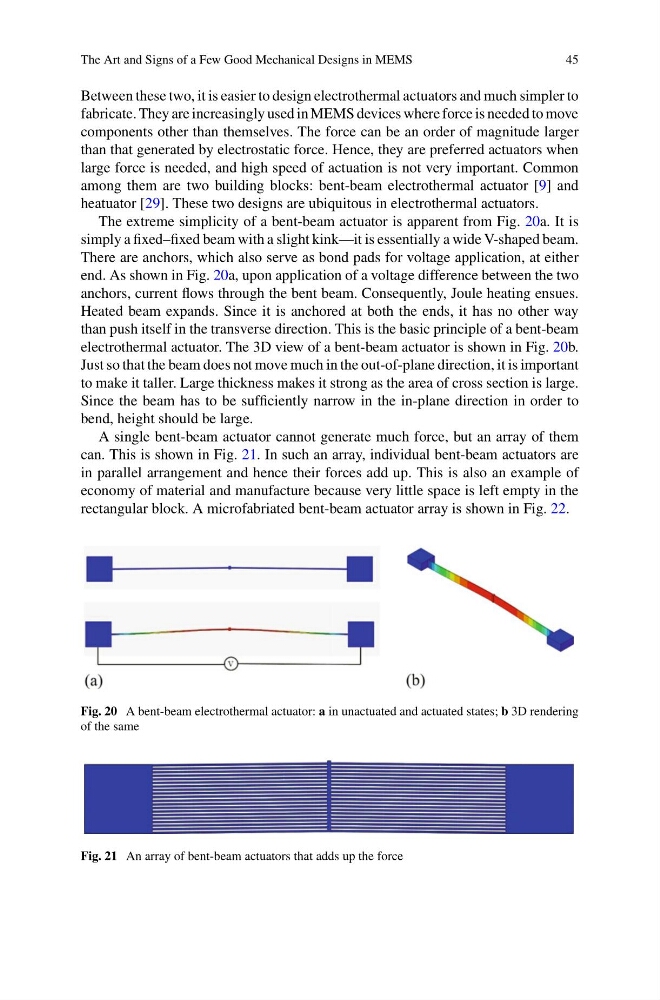
The extreme simplicity of a bent-beam actuator is apparent from Fig. 20a. It is
simply a fixed–fixed beam with a slight kink—it is essentially a wide V-shaped beam.
There are anchors, which also serve as bond pads for voltage application, at either
end. As shown in Fig. 20a, upon application of a voltage difference between the two
anchors, current flows through the bent beam. Consequently, Joule heating ensues.
Heated beam expands. Since it is anchored at both the ends, it has no other way
than push itself in the transverse direction. This is the basic principle of a bent-beam
electrothermal actuator. The 3D view of a bent-beam actuator is shown in Fig. 20b.
Just so that the beam does not move much in the out-of-plane direction, it is important
to make it taller. Large thickness makes it strong as the area of cross section is large.
Since the beam has to be sufficiently narrow in the in-plane direction in order to
bend, height should be large.
A single bent-beam actuator cannot generate much force, but an array of them
can. This is shown in Fig. 21. In such an array, individual bent-beam actuators are
in parallel arrangement and hence their forces add up. This is also an example of
economy of material and manufacture because very little space is left empty in the
rectangular block. A microfabriated bent-beam actuator array is shown in Fig. 22.
Fig. 20 A bent-beam electrothermal actuator: a in unactuated and actuated states; b 3D rendering
of the same
Fig. 21 An array of bent-beam actuators that adds up the force
45
Between these two, it is easier to design electrothermal actuators and much simpler to
fabricate. They are increasingly used in MEMS devices where force is needed to move
components other than themselves. The force can be an order of magnitude larger
than that generated by electrostatic force. Hence, they are preferred actuators when
large force is needed, and high speed of actuation is not very important. Common
among them are two building blocks: bent-beam electrothermal actuator [9] and
heatuator [29]. These two designs are ubiquitous in electrothermal actuators.
The extreme simplicity of a bent-beam actuator is apparent from Fig. 20a. It is
simply a fixed–fixed beam with a slight kink—it is essentially a wide V-shaped beam.
There are anchors, which also serve as bond pads for voltage application, at either
end. As shown in Fig. 20a, upon application of a voltage difference between the two
anchors, current flows through the bent beam. Consequently, Joule heating ensues.
Heated beam expands. Since it is anchored at both the ends, it has no other way
than push itself in the transverse direction. This is the basic principle of a bent-beam
electrothermal actuator. The 3D view of a bent-beam actuator is shown in Fig. 20b.
Just so that the beam does not move much in the out-of-plane direction, it is important
to make it taller. Large thickness makes it strong as the area of cross section is large.
Since the beam has to be sufficiently narrow in the in-plane direction in order to
bend, height should be large.
A single bent-beam actuator cannot generate much force, but an array of them
can. This is shown in Fig. 21. In such an array, individual bent-beam actuators are
in parallel arrangement and hence their forces add up. This is also an example of
economy of material and manufacture because very little space is left empty in the
rectangular block. A microfabriated bent-beam actuator array is shown in Fig. 22.
Fig. 20 A bent-beam electrothermal actuator: a in unactuated and actuated states; b 3D rendering
of the same
Fig. 21 An array of bent-beam actuators that adds up the force