

The Art and Signs of a Few Good Mechanical Designs in MEMS
35
4 Generality of an Electrostatic Comb Drive Actuator
Electrostatic force is a fundamental force. It exists between any pair of conductors
that hold electric charge. It is also a large force as compared to another fundamental
force, the gravitational pull. The magnitude of electrostatic force is large enough
to cause sizeable motion at the micro-scale. It is inversely proportional to the gap
between the conductors and directly proportional to the area of the conductor-surface
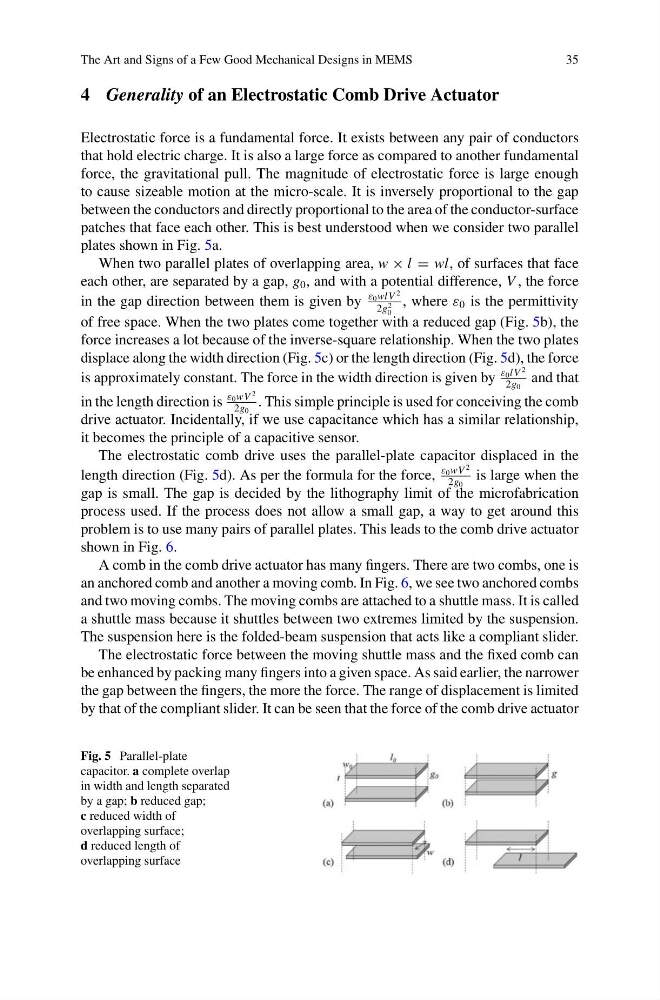
patches that face each other. This is best understood when we consider two parallel
plates shown in Fig. 5a.
When two parallel plates of overlapping area, w × l = wl, of surfaces that face
each other, are separated by a gap, g 0 , and with a potential difference, V , the force
in the gap direction between them is given by
ε 0 wlV
2
2g
2
0
, where ε 0 is the permittivity
of free space. When the two plates come together with a reduced gap (Fig. 5b), the
force increases a lot because of the inverse-square relationship. When the two plates
displace along the width direction (Fig. 5c) or the length direction (Fig. 5d), the force
is approximately constant. The force in the width direction is given by
ε 0 lV
2
2g 0
and that
in the length direction is
ε 0 wV
2
2g 0
. This simple principle is used for conceiving the comb
drive actuator. Incidentally, if we use capacitance which has a similar relationship,
it becomes the principle of a capacitive sensor.
The electrostatic comb drive uses the parallel-plate capacitor displaced in the
length direction (Fig. 5d). As per the formula for the force,
ε 0 wV
2
2g 0
is large when the
gap is small. The gap is decided by the lithography limit of the microfabrication
process used. If the process does not allow a small gap, a way to get around this
problem is to use many pairs of parallel plates. This leads to the comb drive actuator
shown in Fig. 6.
A comb in the comb drive actuator has many fingers. There are two combs, one is
an anchored comb and another a moving comb. In Fig. 6, we see two anchored combs
and two moving combs. The moving combs are attached to a shuttle mass. It is called
a shuttle mass because it shuttles between two extremes limited by the suspension.
The suspension here is the folded-beam suspension that acts like a compliant slider.
The electrostatic force between the moving shuttle mass and the fixed comb can
be enhanced by packing many fingers into a given space. As said earlier, the narrower
the gap between the fingers, the more the force. The range of displacement is limited
by that of the compliant slider. It can be seen that the force of the comb drive actuator
Fig. 5 Parallel-plate
capacitor. a complete overlap
in width and length separated
by a gap; b reduced gap;
c reduced width of
overlapping surface;
d reduced length of
overlapping surface
35
4 Generality of an Electrostatic Comb Drive Actuator
Electrostatic force is a fundamental force. It exists between any pair of conductors
that hold electric charge. It is also a large force as compared to another fundamental
force, the gravitational pull. The magnitude of electrostatic force is large enough
to cause sizeable motion at the micro-scale. It is inversely proportional to the gap
between the conductors and directly proportional to the area of the conductor-surface
patches that face each other. This is best understood when we consider two parallel
plates shown in Fig. 5a.
When two parallel plates of overlapping area, w × l = wl, of surfaces that face
each other, are separated by a gap, g 0 , and with a potential difference, V , the force
in the gap direction between them is given by
ε 0 wlV
2
2g
2
0
, where ε 0 is the permittivity
of free space. When the two plates come together with a reduced gap (Fig. 5b), the
force increases a lot because of the inverse-square relationship. When the two plates
displace along the width direction (Fig. 5c) or the length direction (Fig. 5d), the force
is approximately constant. The force in the width direction is given by
ε 0 lV
2
2g 0
and that
in the length direction is
ε 0 wV
2
2g 0
. This simple principle is used for conceiving the comb
drive actuator. Incidentally, if we use capacitance which has a similar relationship,
it becomes the principle of a capacitive sensor.
The electrostatic comb drive uses the parallel-plate capacitor displaced in the
length direction (Fig. 5d). As per the formula for the force,
ε 0 wV
2
2g 0
is large when the
gap is small. The gap is decided by the lithography limit of the microfabrication
process used. If the process does not allow a small gap, a way to get around this
problem is to use many pairs of parallel plates. This leads to the comb drive actuator
shown in Fig. 6.
A comb in the comb drive actuator has many fingers. There are two combs, one is
an anchored comb and another a moving comb. In Fig. 6, we see two anchored combs
and two moving combs. The moving combs are attached to a shuttle mass. It is called
a shuttle mass because it shuttles between two extremes limited by the suspension.
The suspension here is the folded-beam suspension that acts like a compliant slider.
The electrostatic force between the moving shuttle mass and the fixed comb can
be enhanced by packing many fingers into a given space. As said earlier, the narrower
the gap between the fingers, the more the force. The range of displacement is limited
by that of the compliant slider. It can be seen that the force of the comb drive actuator
Fig. 5 Parallel-plate
capacitor. a complete overlap
in width and length separated
by a gap; b reduced gap;
c reduced width of
overlapping surface;
d reduced length of
overlapping surface