

Birth of Mechanical Engineering and a Glimpse …
25
just increase the information collection ability but to use the advantages of scaling
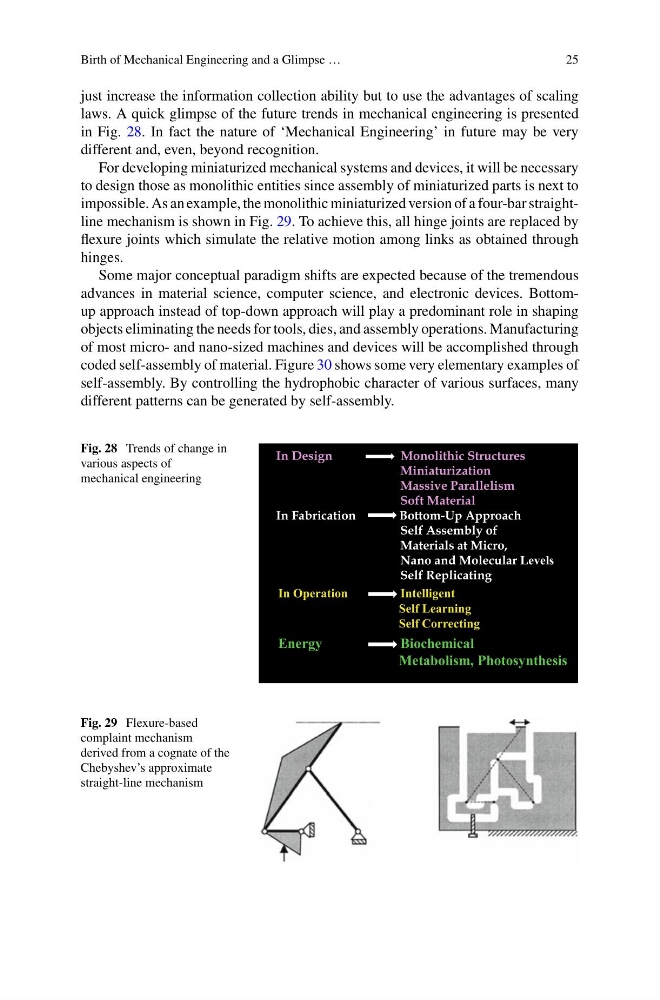
laws. A quick glimpse of the future trends in mechanical engineering is presented
in Fig. 28. In fact the nature of ‘Mechanical Engineering’ in future may be very
different and, even, beyond recognition.
For developing miniaturized mechanical systems and devices, it will be necessary
to design those as monolithic entities since assembly of miniaturized parts is next to
impossible. As an example, the monolithic miniaturized version of a four-bar straightline mechanism is shown in Fig. 29. To achieve this, all hinge joints are replaced by
flexure joints which simulate the relative motion among links as obtained through
hinges.
Some major conceptual paradigm shifts are expected because of the tremendous
advances in material science, computer science, and electronic devices. Bottomup approach instead of top-down approach will play a predominant role in shaping
objects eliminating the needs for tools, dies, and assembly operations. Manufacturing
of most micro- and nano-sized machines and devices will be accomplished through
coded self-assembly of material. Figure 30 shows some very elementary examples of
self-assembly. By controlling the hydrophobic character of various surfaces, many
different patterns can be generated by self-assembly.
Fig. 28 Trends of change in
various aspects of
mechanical engineering
In Design
Monolithic Structures
Miniaturization
Massive Parallelism
Soft Material
In Fabrication
Bottom-Up Approach
Self Assembly of
Materials at Micro,
Nano and Molecular Levels
Self Replicating
In Operation
Intelligent
Self Learning
Self Correcting
Energy
Biochemical
Metabolism, Photosynthesis
Fig. 29 Flexure-based
complaint mechanism
derived from a cognate of the
Chebyshev’s approximate
straight-line mechanism
25
just increase the information collection ability but to use the advantages of scaling
laws. A quick glimpse of the future trends in mechanical engineering is presented
in Fig. 28. In fact the nature of ‘Mechanical Engineering’ in future may be very
different and, even, beyond recognition.
For developing miniaturized mechanical systems and devices, it will be necessary
to design those as monolithic entities since assembly of miniaturized parts is next to
impossible. As an example, the monolithic miniaturized version of a four-bar straightline mechanism is shown in Fig. 29. To achieve this, all hinge joints are replaced by
flexure joints which simulate the relative motion among links as obtained through
hinges.
Some major conceptual paradigm shifts are expected because of the tremendous
advances in material science, computer science, and electronic devices. Bottomup approach instead of top-down approach will play a predominant role in shaping
objects eliminating the needs for tools, dies, and assembly operations. Manufacturing
of most micro- and nano-sized machines and devices will be accomplished through
coded self-assembly of material. Figure 30 shows some very elementary examples of
self-assembly. By controlling the hydrophobic character of various surfaces, many
different patterns can be generated by self-assembly.
Fig. 28 Trends of change in
various aspects of
mechanical engineering
In Design
Monolithic Structures
Miniaturization
Massive Parallelism
Soft Material
In Fabrication
Bottom-Up Approach
Self Assembly of
Materials at Micro,
Nano and Molecular Levels
Self Replicating
In Operation
Intelligent
Self Learning
Self Correcting
Energy
Biochemical
Metabolism, Photosynthesis
Fig. 29 Flexure-based
complaint mechanism
derived from a cognate of the
Chebyshev’s approximate
straight-line mechanism