

20
A. Ghosh
In 1818, the Institution of Civil Engineers (the first professional society) was
founded in Great Britain with Thomas Telford as its first President. In 1847, a group
of railway engineers, who felt that the Institution of Civil Engineers was uninterested
in the new breed of engineers resulting from the development of railways, formed the
Institution of Mechanical Engineers with George Stephenson as the first President.
7 The Trends of Development and the Future Scenario
An attempt to guess the nature of the subject ‘Mechanical Engineering’ in the future
is an interesting exercise. Before taking up the matter it may be desirable to have
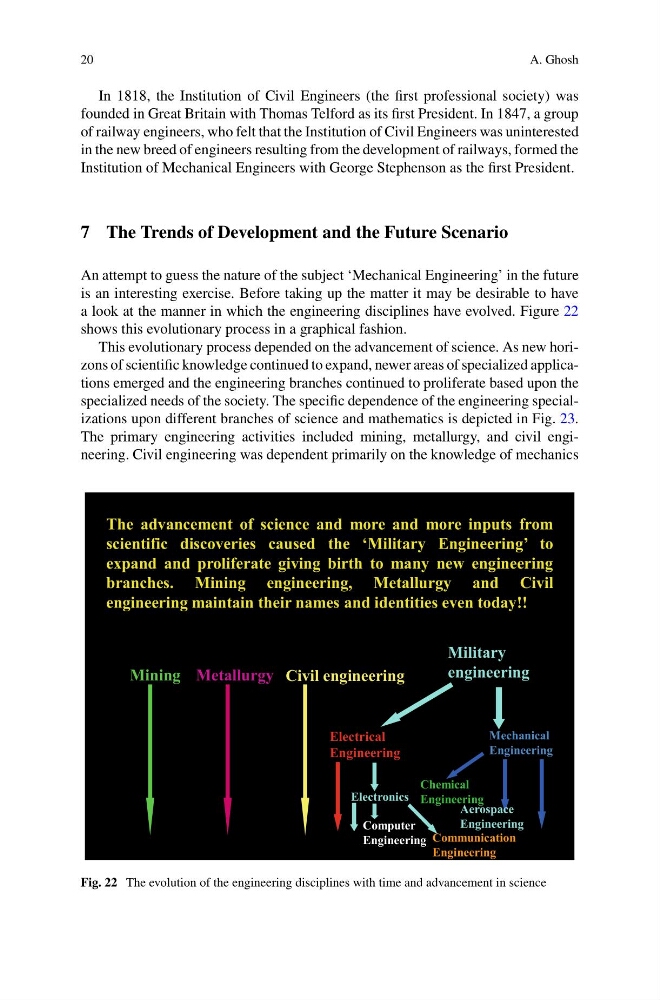
a look at the manner in which the engineering disciplines have evolved. Figure 22
shows this evolutionary process in a graphical fashion.
This evolutionary process depended on the advancement of science. As new horizons of scientific knowledge continued to expand, newer areas of specialized applications emerged and the engineering branches continued to proliferate based upon the
specialized needs of the society. The specific dependence of the engineering specializations upon different branches of science and mathematics is depicted in Fig. 23.
The primary engineering activities included mining, metallurgy, and civil engineering. Civil engineering was dependent primarily on the knowledge of mechanics
The advancement of science and more and more inputs from
scientific discoveries caused the ‘Military Engineering’ to
expand and proliferate giving birth to many new engineering
branches. Mining engineering, Metallurgy and Civil
engineering maintain their names and identities even today!!
Mining Metallurgy Civil engineering
Military
engineering
Electrical
Engineering
Mechanical
Engineering
Electronics
Computer
Engineering Communication
Engineering
Chemical
Engineering
Aerospace
Engineering
Fig. 22 The evolution of the engineering disciplines with time and advancement in science
A. Ghosh
In 1818, the Institution of Civil Engineers (the first professional society) was
founded in Great Britain with Thomas Telford as its first President. In 1847, a group
of railway engineers, who felt that the Institution of Civil Engineers was uninterested
in the new breed of engineers resulting from the development of railways, formed the
Institution of Mechanical Engineers with George Stephenson as the first President.
7 The Trends of Development and the Future Scenario
An attempt to guess the nature of the subject ‘Mechanical Engineering’ in the future
is an interesting exercise. Before taking up the matter it may be desirable to have
a look at the manner in which the engineering disciplines have evolved. Figure 22
shows this evolutionary process in a graphical fashion.
This evolutionary process depended on the advancement of science. As new horizons of scientific knowledge continued to expand, newer areas of specialized applications emerged and the engineering branches continued to proliferate based upon the
specialized needs of the society. The specific dependence of the engineering specializations upon different branches of science and mathematics is depicted in Fig. 23.
The primary engineering activities included mining, metallurgy, and civil engineering. Civil engineering was dependent primarily on the knowledge of mechanics
The advancement of science and more and more inputs from
scientific discoveries caused the ‘Military Engineering’ to
expand and proliferate giving birth to many new engineering
branches. Mining engineering, Metallurgy and Civil
engineering maintain their names and identities even today!!
Mining Metallurgy Civil engineering
Military
engineering
Electrical
Engineering
Mechanical
Engineering
Electronics
Computer
Engineering Communication
Engineering
Chemical
Engineering
Aerospace
Engineering
Fig. 22 The evolution of the engineering disciplines with time and advancement in science