

Laser-Aided Manufacturing: Atom to Application
265
3.7 Laser Drilling
Laser drilling [3] is used for making nipples for baby bottles. Also, it is used to make
electrodes for Li-Ion batteries. Pulsed lasers are more popular for laser drilling. Lasers
with 10
−15 s pulse widths give the cleanest holes but commonly pulse width of 10
−9
s is used for production. Laser drilling has two different modes. One is percussion
drilling where a stationary laser beam evaporates the material to create the whole with
a similar size to beam diameter. Another is called “Trepanning” where a laser beam
is moved to cut a circular hole. Often oxygen is used as assist gas. For oxidation,
sensitive materials like titanium, and inert gas such as argon is used. There are a few
more applications such as laser shock hardening, laser cleaning, and laser marking.
3.8 Laser Shock Hardening or Laser Shock Peening
This technique is extensively used by aerospace industry [19] to provide compressive
residual stress at the surface of aerospace components to increase the hardness and
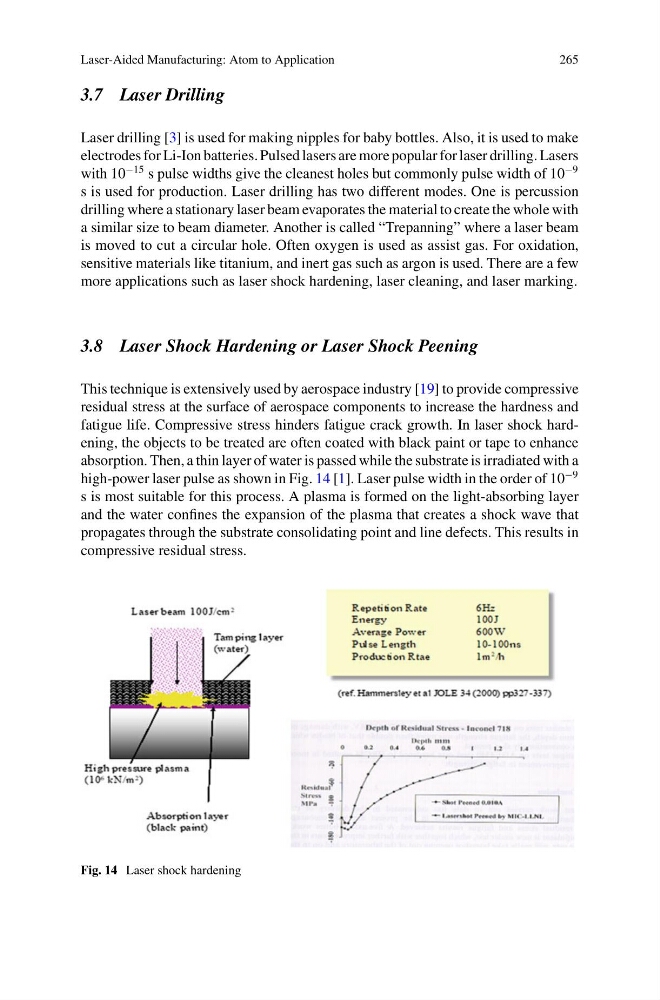
fatigue life. Compressive stress hinders fatigue crack growth. In laser shock hardening, the objects to be treated are often coated with black paint or tape to enhance
absorption. Then, a thin layer of water is passed while the substrate is irradiated with a
high-power laser pulse as shown in Fig. 14 [1]. Laser pulse width in the order of 10
−9
s is most suitable for this process. A plasma is formed on the light-absorbing layer
and the water confines the expansion of the plasma that creates a shock wave that
propagates through the substrate consolidating point and line defects. This results in
compressive residual stress.
Fig. 14 Laser shock hardening
265
3.7 Laser Drilling
Laser drilling [3] is used for making nipples for baby bottles. Also, it is used to make
electrodes for Li-Ion batteries. Pulsed lasers are more popular for laser drilling. Lasers
with 10
−15 s pulse widths give the cleanest holes but commonly pulse width of 10
−9
s is used for production. Laser drilling has two different modes. One is percussion
drilling where a stationary laser beam evaporates the material to create the whole with
a similar size to beam diameter. Another is called “Trepanning” where a laser beam
is moved to cut a circular hole. Often oxygen is used as assist gas. For oxidation,
sensitive materials like titanium, and inert gas such as argon is used. There are a few
more applications such as laser shock hardening, laser cleaning, and laser marking.
3.8 Laser Shock Hardening or Laser Shock Peening
This technique is extensively used by aerospace industry [19] to provide compressive
residual stress at the surface of aerospace components to increase the hardness and
fatigue life. Compressive stress hinders fatigue crack growth. In laser shock hardening, the objects to be treated are often coated with black paint or tape to enhance
absorption. Then, a thin layer of water is passed while the substrate is irradiated with a
high-power laser pulse as shown in Fig. 14 [1]. Laser pulse width in the order of 10
−9
s is most suitable for this process. A plasma is formed on the light-absorbing layer
and the water confines the expansion of the plasma that creates a shock wave that
propagates through the substrate consolidating point and line defects. This results in
compressive residual stress.
Fig. 14 Laser shock hardening