

230
D. George and M. J. Madou
Table 3 (continued)
Field
Applications
Representative figures and related references
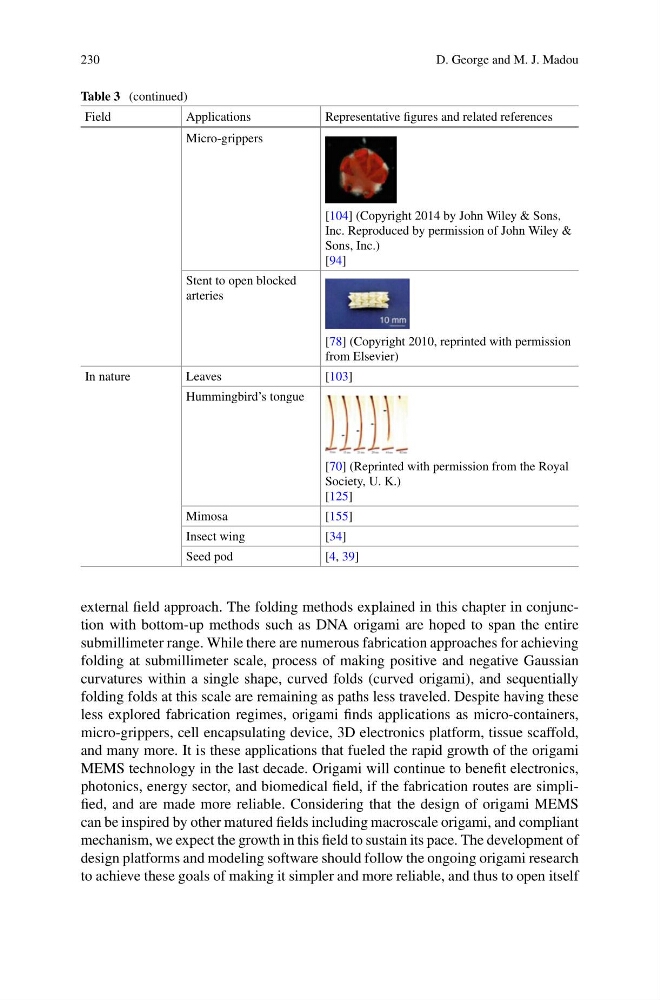
Micro-grippers
[104] (Copyright 2014 by John Wiley & Sons,
Inc. Reproduced by permission of John Wiley &
Sons, Inc.)
[94]
Stent to open blocked
arteries
[78] (Copyright 2010, reprinted with permission
from Elsevier)
In nature
Leaves
[103]
Hummingbird’s tongue
[70] (Reprinted with permission from the Royal
Society, U. K.)
[125]
Mimosa
[155]
Insect wing
[34]
Seed pod
[4, 39]
external field approach. The folding methods explained in this chapter in conjunction with bottom-up methods such as DNA origami are hoped to span the entire
submillimeter range. While there are numerous fabrication approaches for achieving
folding at submillimeter scale, process of making positive and negative Gaussian
curvatures within a single shape, curved folds (curved origami), and sequentially
folding folds at this scale are remaining as paths less traveled. Despite having these
less explored fabrication regimes, origami finds applications as micro-containers,
micro-grippers, cell encapsulating device, 3D electronics platform, tissue scaffold,
and many more. It is these applications that fueled the rapid growth of the origami
MEMS technology in the last decade. Origami will continue to benefit electronics,
photonics, energy sector, and biomedical field, if the fabrication routes are simplified, and are made more reliable. Considering that the design of origami MEMS
can be inspired by other matured fields including macroscale origami, and compliant
mechanism, we expect the growth in this field to sustain its pace. The development of
design platforms and modeling software should follow the ongoing origami research
to achieve these goals of making it simpler and more reliable, and thus to open itself
D. George and M. J. Madou
Table 3 (continued)
Field
Applications
Representative figures and related references
Micro-grippers
[104] (Copyright 2014 by John Wiley & Sons,
Inc. Reproduced by permission of John Wiley &
Sons, Inc.)
[94]
Stent to open blocked
arteries
[78] (Copyright 2010, reprinted with permission
from Elsevier)
In nature
Leaves
[103]
Hummingbird’s tongue
[70] (Reprinted with permission from the Royal
Society, U. K.)
[125]
Mimosa
[155]
Insect wing
[34]
Seed pod
[4, 39]
external field approach. The folding methods explained in this chapter in conjunction with bottom-up methods such as DNA origami are hoped to span the entire
submillimeter range. While there are numerous fabrication approaches for achieving
folding at submillimeter scale, process of making positive and negative Gaussian
curvatures within a single shape, curved folds (curved origami), and sequentially
folding folds at this scale are remaining as paths less traveled. Despite having these
less explored fabrication regimes, origami finds applications as micro-containers,
micro-grippers, cell encapsulating device, 3D electronics platform, tissue scaffold,
and many more. It is these applications that fueled the rapid growth of the origami
MEMS technology in the last decade. Origami will continue to benefit electronics,
photonics, energy sector, and biomedical field, if the fabrication routes are simplified, and are made more reliable. Considering that the design of origami MEMS
can be inspired by other matured fields including macroscale origami, and compliant
mechanism, we expect the growth in this field to sustain its pace. The development of
design platforms and modeling software should follow the ongoing origami research
to achieve these goals of making it simpler and more reliable, and thus to open itself