

Origami MEMS
221
flat plate. Thicker films experience a uniform compression across the cross-section
of the plate. However, as the thickness reduces, the bending of the sheet becomes
energetically more favorable. Therefore, thinner plates experience out of the plane
buckling when compressed.
3.3.1 Fabrication Strategies for Curved Shapes Using External Field
Approach
Researchers from École Polytechnique, France, made complex three-dimensional
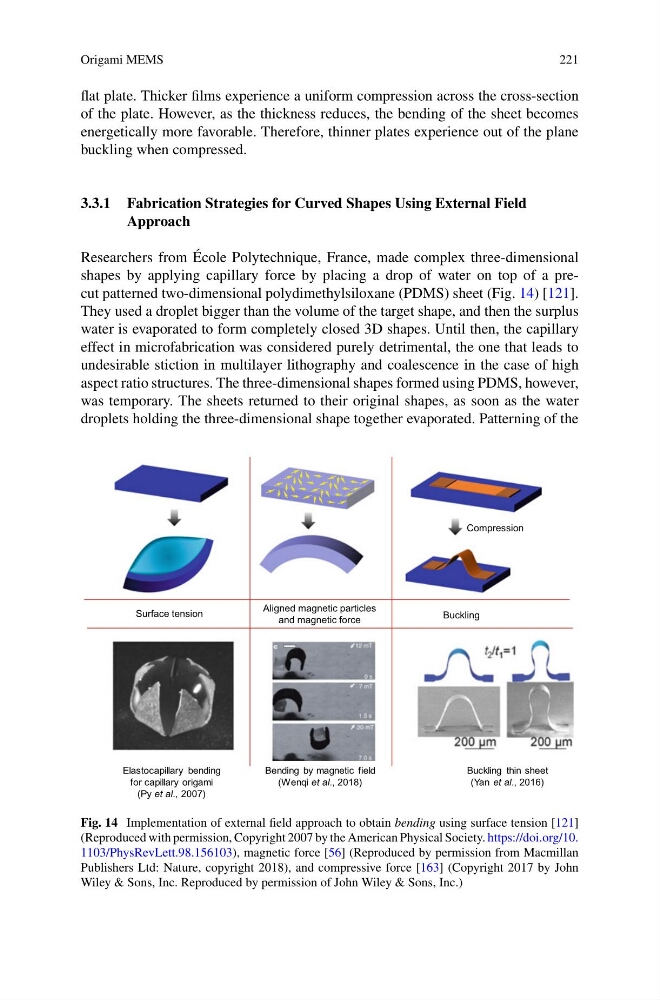
shapes by applying capillary force by placing a drop of water on top of a precut patterned two-dimensional polydimethylsiloxane (PDMS) sheet (Fig. 14) [121].
They used a droplet bigger than the volume of the target shape, and then the surplus
water is evaporated to form completely closed 3D shapes. Until then, the capillary
effect in microfabrication was considered purely detrimental, the one that leads to
undesirable stiction in multilayer lithography and coalescence in the case of high
aspect ratio structures. The three-dimensional shapes formed using PDMS, however,
was temporary. The sheets returned to their original shapes, as soon as the water
droplets holding the three-dimensional shape together evaporated. Patterning of the
Surface tension
Aligned magnetic particles
and magnetic force
Buckling
Compression
Elastocapillary bending
for capillary origami
(Py et al., 2007)
Buckling thin sheet
(Yan et al., 2016)
Bending by magnetic field
(Wenqi et al., 2018)
Fig. 14 Implementation of external field approach to obtain bending using surface tension [121]
(Reproduced with permission, Copyright 2007 by the American Physical Society. https://doi.org/10.
1103/PhysRevLett.98.156103), magnetic force [56] (Reproduced by permission from Macmillan
Publishers Ltd: Nature, copyright 2018), and compressive force [163] (Copyright 2017 by John
Wiley & Sons, Inc. Reproduced by permission of John Wiley & Sons, Inc.)
221
flat plate. Thicker films experience a uniform compression across the cross-section
of the plate. However, as the thickness reduces, the bending of the sheet becomes
energetically more favorable. Therefore, thinner plates experience out of the plane
buckling when compressed.
3.3.1 Fabrication Strategies for Curved Shapes Using External Field
Approach
Researchers from École Polytechnique, France, made complex three-dimensional
shapes by applying capillary force by placing a drop of water on top of a precut patterned two-dimensional polydimethylsiloxane (PDMS) sheet (Fig. 14) [121].
They used a droplet bigger than the volume of the target shape, and then the surplus
water is evaporated to form completely closed 3D shapes. Until then, the capillary
effect in microfabrication was considered purely detrimental, the one that leads to
undesirable stiction in multilayer lithography and coalescence in the case of high
aspect ratio structures. The three-dimensional shapes formed using PDMS, however,
was temporary. The sheets returned to their original shapes, as soon as the water
droplets holding the three-dimensional shape together evaporated. Patterning of the
Surface tension
Aligned magnetic particles
and magnetic force
Buckling
Compression
Elastocapillary bending
for capillary origami
(Py et al., 2007)
Buckling thin sheet
(Yan et al., 2016)
Bending by magnetic field
(Wenqi et al., 2018)
Fig. 14 Implementation of external field approach to obtain bending using surface tension [121]
(Reproduced with permission, Copyright 2007 by the American Physical Society. https://doi.org/10.
1103/PhysRevLett.98.156103), magnetic force [56] (Reproduced by permission from Macmillan
Publishers Ltd: Nature, copyright 2018), and compressive force [163] (Copyright 2017 by John
Wiley & Sons, Inc. Reproduced by permission of John Wiley & Sons, Inc.)