

Origami MEMS
219
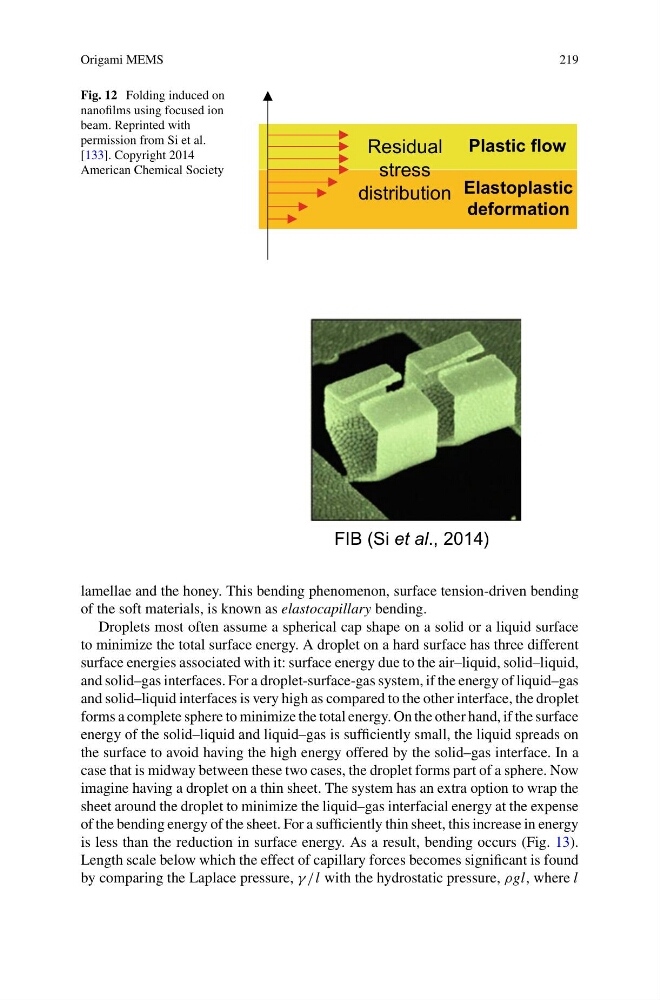
Fig. 12 Folding induced on
nanofilms using focused ion
beam. Reprinted with
permission from Si et al.
[133]. Copyright 2014
American Chemical Society
Residual
stress
distribution
Plastic flow
Elastoplastic
deformation
FIB (Si et al., 2014)
lamellae and the honey. This bending phenomenon, surface tension-driven bending
of the soft materials, is known as elastocapillary bending.
Droplets most often assume a spherical cap shape on a solid or a liquid surface
to minimize the total surface energy. A droplet on a hard surface has three different
surface energies associated with it: surface energy due to the air–liquid, solid–liquid,
and solid–gas interfaces. For a droplet-surface-gas system, if the energy of liquid–gas
and solid–liquid interfaces is very high as compared to the other interface, the droplet
forms a complete sphere to minimize the total energy. On the other hand, if the surface
energy of the solid–liquid and liquid–gas is sufficiently small, the liquid spreads on
the surface to avoid having the high energy offered by the solid–gas interface. In a
case that is midway between these two cases, the droplet forms part of a sphere. Now
imagine having a droplet on a thin sheet. The system has an extra option to wrap the
sheet around the droplet to minimize the liquid–gas interfacial energy at the expense
of the bending energy of the sheet. For a sufficiently thin sheet, this increase in energy
is less than the reduction in surface energy. As a result, bending occurs (Fig. 13).
Length scale below which the effect of capillary forces becomes significant is found
by comparing the Laplace pressure, γ /l with the hydrostatic pressure, ρgl, where l
219
Fig. 12 Folding induced on
nanofilms using focused ion
beam. Reprinted with
permission from Si et al.
[133]. Copyright 2014
American Chemical Society
Residual
stress
distribution
Plastic flow
Elastoplastic
deformation
FIB (Si et al., 2014)
lamellae and the honey. This bending phenomenon, surface tension-driven bending
of the soft materials, is known as elastocapillary bending.
Droplets most often assume a spherical cap shape on a solid or a liquid surface
to minimize the total surface energy. A droplet on a hard surface has three different
surface energies associated with it: surface energy due to the air–liquid, solid–liquid,
and solid–gas interfaces. For a droplet-surface-gas system, if the energy of liquid–gas
and solid–liquid interfaces is very high as compared to the other interface, the droplet
forms a complete sphere to minimize the total energy. On the other hand, if the surface
energy of the solid–liquid and liquid–gas is sufficiently small, the liquid spreads on
the surface to avoid having the high energy offered by the solid–gas interface. In a
case that is midway between these two cases, the droplet forms part of a sphere. Now
imagine having a droplet on a thin sheet. The system has an extra option to wrap the
sheet around the droplet to minimize the liquid–gas interfacial energy at the expense
of the bending energy of the sheet. For a sufficiently thin sheet, this increase in energy
is less than the reduction in surface energy. As a result, bending occurs (Fig. 13).
Length scale below which the effect of capillary forces becomes significant is found
by comparing the Laplace pressure, γ /l with the hydrostatic pressure, ρgl, where l