

Origami MEMS
209
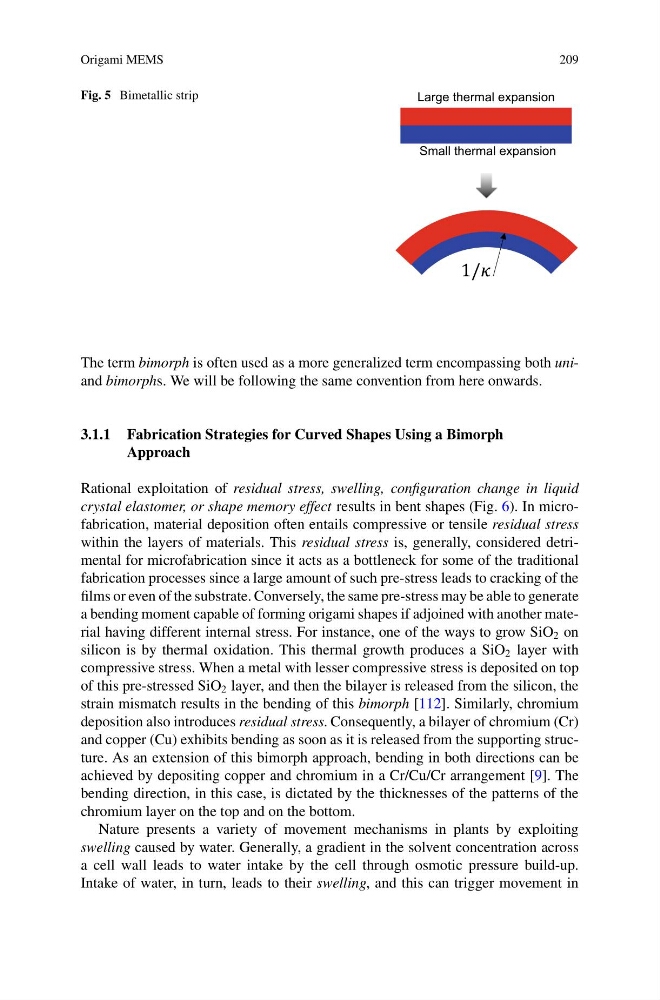
Fig. 5 Bimetallic strip
Large thermal expansion
Small thermal expansion
1/
The term bimorph is often used as a more generalized term encompassing both uniand bimorphs. We will be following the same convention from here onwards.
3.1.1 Fabrication Strategies for Curved Shapes Using a Bimorph
Approach
Rational exploitation of residual stress, swelling, configuration change in liquid
crystal elastomer, or shape memory effect results in bent shapes (Fig. 6). In microfabrication, material deposition often entails compressive or tensile residual stress
within the layers of materials. This residual stress is, generally, considered detrimental for microfabrication since it acts as a bottleneck for some of the traditional
fabrication processes since a large amount of such pre-stress leads to cracking of the
films or even of the substrate. Conversely, the same pre-stress may be able to generate
a bending moment capable of forming origami shapes if adjoined with another material having different internal stress. For instance, one of the ways to grow SiO 2 on
silicon is by thermal oxidation. This thermal growth produces a SiO 2 layer with
compressive stress. When a metal with lesser compressive stress is deposited on top
of this pre-stressed SiO 2 layer, and then the bilayer is released from the silicon, the
strain mismatch results in the bending of this bimorph [112]. Similarly, chromium
deposition also introduces residual stress. Consequently, a bilayer of chromium (Cr)
and copper (Cu) exhibits bending as soon as it is released from the supporting structure. As an extension of this bimorph approach, bending in both directions can be
achieved by depositing copper and chromium in a Cr/Cu/Cr arrangement [9]. The
bending direction, in this case, is dictated by the thicknesses of the patterns of the
chromium layer on the top and on the bottom.
Nature presents a variety of movement mechanisms in plants by exploiting
swelling caused by water. Generally, a gradient in the solvent concentration across
a cell wall leads to water intake by the cell through osmotic pressure build-up.
Intake of water, in turn, leads to their swelling, and this can trigger movement in
209
Fig. 5 Bimetallic strip
Large thermal expansion
Small thermal expansion
1/
The term bimorph is often used as a more generalized term encompassing both uniand bimorphs. We will be following the same convention from here onwards.
3.1.1 Fabrication Strategies for Curved Shapes Using a Bimorph
Approach
Rational exploitation of residual stress, swelling, configuration change in liquid
crystal elastomer, or shape memory effect results in bent shapes (Fig. 6). In microfabrication, material deposition often entails compressive or tensile residual stress
within the layers of materials. This residual stress is, generally, considered detrimental for microfabrication since it acts as a bottleneck for some of the traditional
fabrication processes since a large amount of such pre-stress leads to cracking of the
films or even of the substrate. Conversely, the same pre-stress may be able to generate
a bending moment capable of forming origami shapes if adjoined with another material having different internal stress. For instance, one of the ways to grow SiO 2 on
silicon is by thermal oxidation. This thermal growth produces a SiO 2 layer with
compressive stress. When a metal with lesser compressive stress is deposited on top
of this pre-stressed SiO 2 layer, and then the bilayer is released from the silicon, the
strain mismatch results in the bending of this bimorph [112]. Similarly, chromium
deposition also introduces residual stress. Consequently, a bilayer of chromium (Cr)
and copper (Cu) exhibits bending as soon as it is released from the supporting structure. As an extension of this bimorph approach, bending in both directions can be
achieved by depositing copper and chromium in a Cr/Cu/Cr arrangement [9]. The
bending direction, in this case, is dictated by the thicknesses of the patterns of the
chromium layer on the top and on the bottom.
Nature presents a variety of movement mechanisms in plants by exploiting
swelling caused by water. Generally, a gradient in the solvent concentration across
a cell wall leads to water intake by the cell through osmotic pressure build-up.
Intake of water, in turn, leads to their swelling, and this can trigger movement in