

6
A. Ghosh
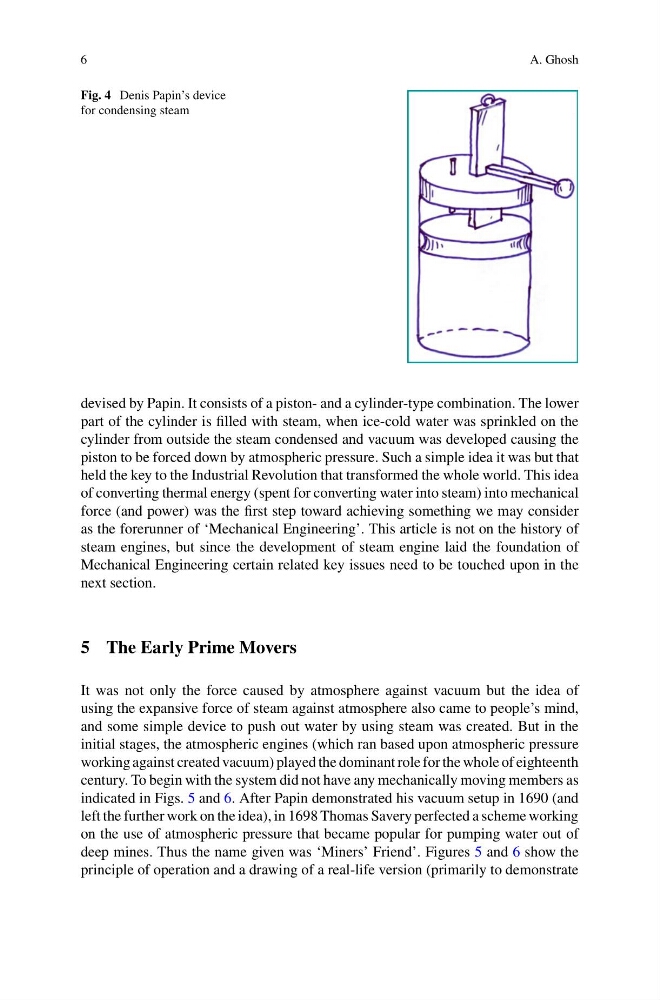
Fig. 4 Denis Papin’s device
for condensing steam
devised by Papin. It consists of a piston- and a cylinder-type combination. The lower
part of the cylinder is filled with steam, when ice-cold water was sprinkled on the
cylinder from outside the steam condensed and vacuum was developed causing the
piston to be forced down by atmospheric pressure. Such a simple idea it was but that
held the key to the Industrial Revolution that transformed the whole world. This idea
of converting thermal energy (spent for converting water into steam) into mechanical
force (and power) was the first step toward achieving something we may consider
as the forerunner of ‘Mechanical Engineering’. This article is not on the history of
steam engines, but since the development of steam engine laid the foundation of
Mechanical Engineering certain related key issues need to be touched upon in the
next section.
5 The Early Prime Movers
It was not only the force caused by atmosphere against vacuum but the idea of
using the expansive force of steam against atmosphere also came to people’s mind,
and some simple device to push out water by using steam was created. But in the
initial stages, the atmospheric engines (which ran based upon atmospheric pressure
working against created vacuum) played the dominant role for the whole of eighteenth
century. To begin with the system did not have any mechanically moving members as
indicated in Figs. 5 and 6. After Papin demonstrated his vacuum setup in 1690 (and
left the further work on the idea), in 1698 Thomas Savery perfected a scheme working
on the use of atmospheric pressure that became popular for pumping water out of
deep mines. Thus the name given was ‘Miners’ Friend’. Figures 5 and 6 show the
principle of operation and a drawing of a real-life version (primarily to demonstrate
A. Ghosh
Fig. 4 Denis Papin’s device
for condensing steam
devised by Papin. It consists of a piston- and a cylinder-type combination. The lower
part of the cylinder is filled with steam, when ice-cold water was sprinkled on the
cylinder from outside the steam condensed and vacuum was developed causing the
piston to be forced down by atmospheric pressure. Such a simple idea it was but that
held the key to the Industrial Revolution that transformed the whole world. This idea
of converting thermal energy (spent for converting water into steam) into mechanical
force (and power) was the first step toward achieving something we may consider
as the forerunner of ‘Mechanical Engineering’. This article is not on the history of
steam engines, but since the development of steam engine laid the foundation of
Mechanical Engineering certain related key issues need to be touched upon in the
next section.
5 The Early Prime Movers
It was not only the force caused by atmosphere against vacuum but the idea of
using the expansive force of steam against atmosphere also came to people’s mind,
and some simple device to push out water by using steam was created. But in the
initial stages, the atmospheric engines (which ran based upon atmospheric pressure
working against created vacuum) played the dominant role for the whole of eighteenth
century. To begin with the system did not have any mechanically moving members as
indicated in Figs. 5 and 6. After Papin demonstrated his vacuum setup in 1690 (and
left the further work on the idea), in 1698 Thomas Savery perfected a scheme working
on the use of atmospheric pressure that became popular for pumping water out of
deep mines. Thus the name given was ‘Miners’ Friend’. Figures 5 and 6 show the
principle of operation and a drawing of a real-life version (primarily to demonstrate