

182
V. Laxmi et al.
Choi et al. [88] reported a microfluidic device which can separate leukocytes and
extract intracellular proteins and nucleic acid for detection purposes using deterministic lateral displacement principle. The device design constitutes inlet ports,
serpentine channel with microposts, and mechanical lysis structures with outlets as
shown in Fig. 8B, whole blood and buffer are injected from the inlets and the lateral
displacement of WBCs takes place due to the micropost arrays. Enrichment of WBCs
is achieved by controlling the width ratios at the outlet and the intracellular components within the WBCs are released with the help of the mechanical nanoblade arrays
having ultra-sharp edges. Quantitative analysis of the intracellular protein concentration and gDNA (Genomic deoxyribonucleic acid) levels was carried out using protein
assay kit and UV-V spectrophotometer. The device was able to extract detectable HIV
DNA at the cell population of 10
2 /μl of the blood sample. With further upgradation
and usage with microdiagnostic tool kits, the device can be used as a point-of-care
microdevice in resource-limited settings.
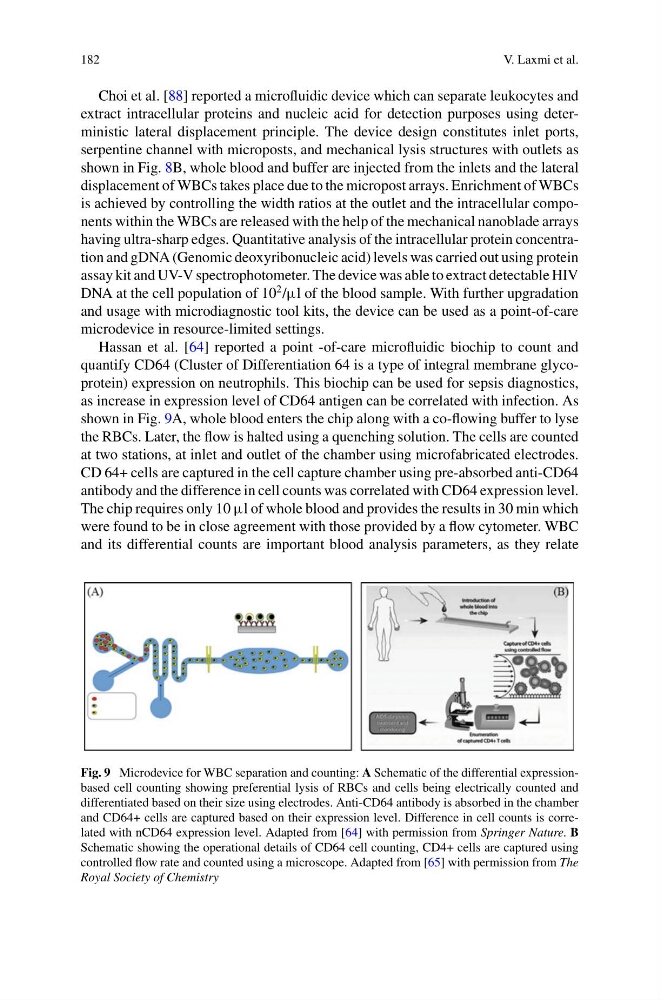
Hassan et al. [64] reported a point -of-care microfluidic biochip to count and
quantify CD64 (Cluster of Differentiation 64 is a type of integral membrane glycoprotein) expression on neutrophils. This biochip can be used for sepsis diagnostics,
as increase in expression level of CD64 antigen can be correlated with infection. As
shown in Fig. 9A, whole blood enters the chip along with a co-flowing buffer to lyse
the RBCs. Later, the flow is halted using a quenching solution. The cells are counted
at two stations, at inlet and outlet of the chamber using microfabricated electrodes.
CD 64+ cells are captured in the cell capture chamber using pre-absorbed anti-CD64
antibody and the difference in cell counts was correlated with CD64 expression level.
The chip requires only 10 μl of whole blood and provides the results in 30 min which
were found to be in close agreement with those provided by a flow cytometer. WBC
and its differential counts are important blood analysis parameters, as they relate
Fig. 9 Microdevice for WBC separation and counting: A Schematic of the differential expressionbased cell counting showing preferential lysis of RBCs and cells being electrically counted and
differentiated based on their size using electrodes. Anti-CD64 antibody is absorbed in the chamber
and CD64+ cells are captured based on their expression level. Difference in cell counts is correlated with nCD64 expression level. Adapted from [64] with permission from Springer Nature. B
Schematic showing the operational details of CD64 cell counting, CD4+ cells are captured using
controlled flow rate and counted using a microscope. Adapted from [65] with permission from The
Royal Society of Chemistry
V. Laxmi et al.
Choi et al. [88] reported a microfluidic device which can separate leukocytes and
extract intracellular proteins and nucleic acid for detection purposes using deterministic lateral displacement principle. The device design constitutes inlet ports,
serpentine channel with microposts, and mechanical lysis structures with outlets as
shown in Fig. 8B, whole blood and buffer are injected from the inlets and the lateral
displacement of WBCs takes place due to the micropost arrays. Enrichment of WBCs
is achieved by controlling the width ratios at the outlet and the intracellular components within the WBCs are released with the help of the mechanical nanoblade arrays
having ultra-sharp edges. Quantitative analysis of the intracellular protein concentration and gDNA (Genomic deoxyribonucleic acid) levels was carried out using protein
assay kit and UV-V spectrophotometer. The device was able to extract detectable HIV
DNA at the cell population of 10
2 /μl of the blood sample. With further upgradation
and usage with microdiagnostic tool kits, the device can be used as a point-of-care
microdevice in resource-limited settings.
Hassan et al. [64] reported a point -of-care microfluidic biochip to count and
quantify CD64 (Cluster of Differentiation 64 is a type of integral membrane glycoprotein) expression on neutrophils. This biochip can be used for sepsis diagnostics,
as increase in expression level of CD64 antigen can be correlated with infection. As
shown in Fig. 9A, whole blood enters the chip along with a co-flowing buffer to lyse
the RBCs. Later, the flow is halted using a quenching solution. The cells are counted
at two stations, at inlet and outlet of the chamber using microfabricated electrodes.
CD 64+ cells are captured in the cell capture chamber using pre-absorbed anti-CD64
antibody and the difference in cell counts was correlated with CD64 expression level.
The chip requires only 10 μl of whole blood and provides the results in 30 min which
were found to be in close agreement with those provided by a flow cytometer. WBC
and its differential counts are important blood analysis parameters, as they relate
Fig. 9 Microdevice for WBC separation and counting: A Schematic of the differential expressionbased cell counting showing preferential lysis of RBCs and cells being electrically counted and
differentiated based on their size using electrodes. Anti-CD64 antibody is absorbed in the chamber
and CD64+ cells are captured based on their expression level. Difference in cell counts is correlated with nCD64 expression level. Adapted from [64] with permission from Springer Nature. B
Schematic showing the operational details of CD64 cell counting, CD4+ cells are captured using
controlled flow rate and counted using a microscope. Adapted from [65] with permission from The
Royal Society of Chemistry