

Current Status of the Development of Blood-Based …
171
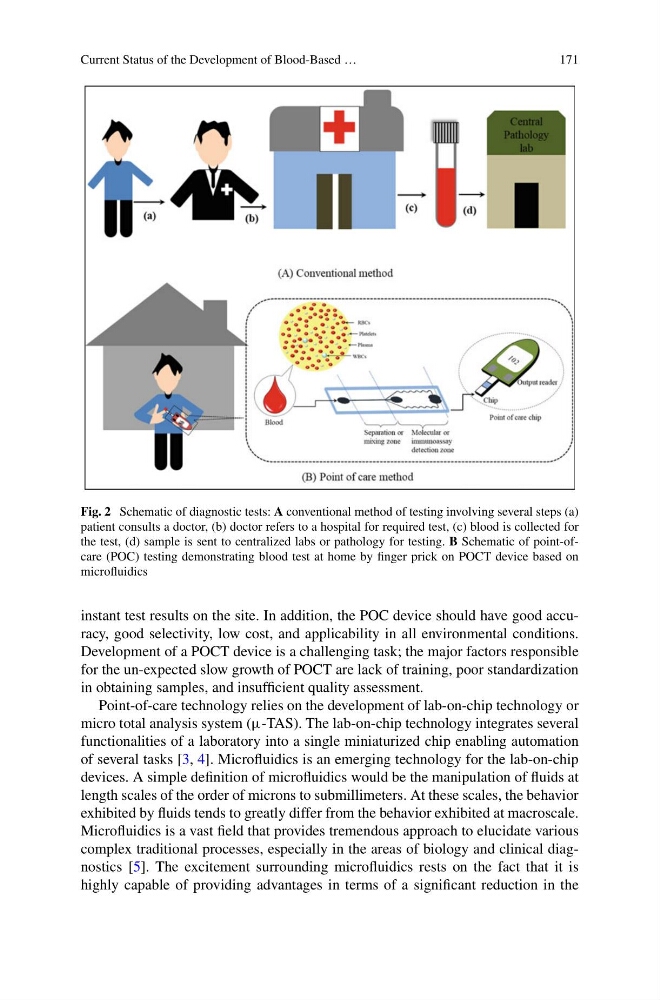
Fig. 2 Schematic of diagnostic tests: A conventional method of testing involving several steps (a)
patient consults a doctor, (b) doctor refers to a hospital for required test, (c) blood is collected for
the test, (d) sample is sent to centralized labs or pathology for testing. B Schematic of point-ofcare (POC) testing demonstrating blood test at home by finger prick on POCT device based on
microfluidics
instant test results on the site. In addition, the POC device should have good accuracy, good selectivity, low cost, and applicability in all environmental conditions.
Development of a POCT device is a challenging task; the major factors responsible
for the un-expected slow growth of POCT are lack of training, poor standardization
in obtaining samples, and insufficient quality assessment.
Point-of-care technology relies on the development of lab-on-chip technology or
micro total analysis system (μ-TAS). The lab-on-chip technology integrates several
functionalities of a laboratory into a single miniaturized chip enabling automation
of several tasks [3, 4]. Microfluidics is an emerging technology for the lab-on-chip
devices. A simple definition of microfluidics would be the manipulation of fluids at
length scales of the order of microns to submillimeters. At these scales, the behavior
exhibited by fluids tends to greatly differ from the behavior exhibited at macroscale.
Microfluidics is a vast field that provides tremendous approach to elucidate various
complex traditional processes, especially in the areas of biology and clinical diagnostics [5]. The excitement surrounding microfluidics rests on the fact that it is
highly capable of providing advantages in terms of a significant reduction in the
171
Fig. 2 Schematic of diagnostic tests: A conventional method of testing involving several steps (a)
patient consults a doctor, (b) doctor refers to a hospital for required test, (c) blood is collected for
the test, (d) sample is sent to centralized labs or pathology for testing. B Schematic of point-ofcare (POC) testing demonstrating blood test at home by finger prick on POCT device based on
microfluidics
instant test results on the site. In addition, the POC device should have good accuracy, good selectivity, low cost, and applicability in all environmental conditions.
Development of a POCT device is a challenging task; the major factors responsible
for the un-expected slow growth of POCT are lack of training, poor standardization
in obtaining samples, and insufficient quality assessment.
Point-of-care technology relies on the development of lab-on-chip technology or
micro total analysis system (μ-TAS). The lab-on-chip technology integrates several
functionalities of a laboratory into a single miniaturized chip enabling automation
of several tasks [3, 4]. Microfluidics is an emerging technology for the lab-on-chip
devices. A simple definition of microfluidics would be the manipulation of fluids at
length scales of the order of microns to submillimeters. At these scales, the behavior
exhibited by fluids tends to greatly differ from the behavior exhibited at macroscale.
Microfluidics is a vast field that provides tremendous approach to elucidate various
complex traditional processes, especially in the areas of biology and clinical diagnostics [5]. The excitement surrounding microfluidics rests on the fact that it is
highly capable of providing advantages in terms of a significant reduction in the