

Fluid Dynamics in Deformable Microchannels
161
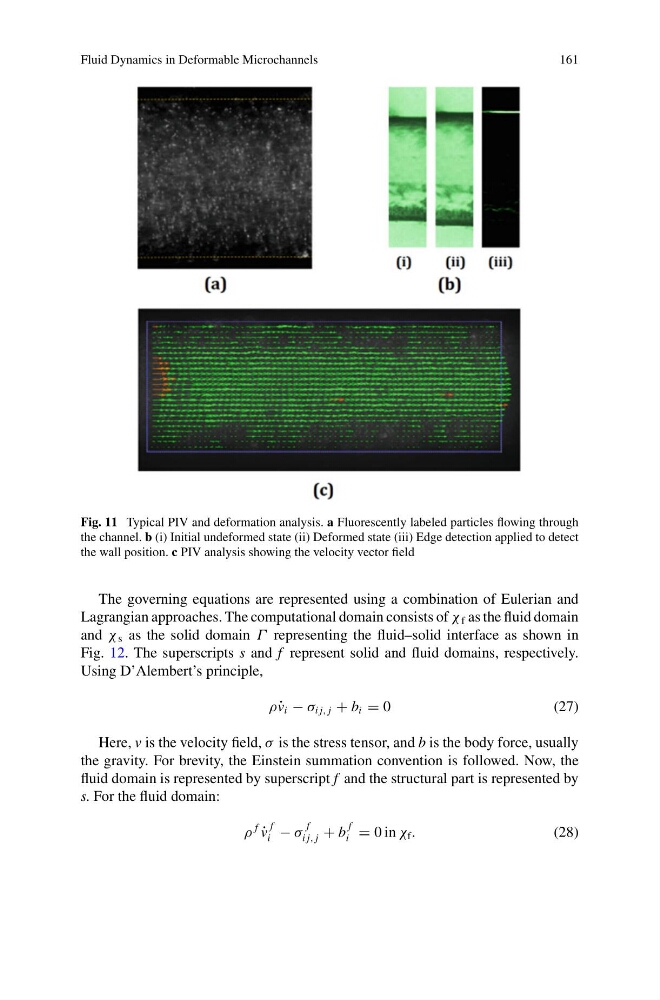
Fig. 11 Typical PIV and deformation analysis. a Fluorescently labeled particles flowing through
the channel. b (i) Initial undeformed state (ii) Deformed state (iii) Edge detection applied to detect
the wall position. c PIV analysis showing the velocity vector field
The governing equations are represented using a combination of Eulerian and
Lagrangian approaches. The computational domain consists of χ f as the fluid domain
and χ s as the solid domain Γ representing the fluid–solid interface as shown in
Fig. 12. The superscripts s and f represent solid and fluid domains, respectively.
Using D’Alembert’s principle,
ρ ˙
v i − σ i j, j + b i = 0
(27)
Here, v is the velocity field, σ is the stress tensor, and b is the body force, usually
the gravity. For brevity, the Einstein summation convention is followed. Now, the
fluid domain is represented by superscript f and the structural part is represented by
s. For the fluid domain:
ρ
f
˙
v
f
i − σ
f
i j, j + b
f
i = 0 in χ f .
(28)
161
Fig. 11 Typical PIV and deformation analysis. a Fluorescently labeled particles flowing through
the channel. b (i) Initial undeformed state (ii) Deformed state (iii) Edge detection applied to detect
the wall position. c PIV analysis showing the velocity vector field
The governing equations are represented using a combination of Eulerian and
Lagrangian approaches. The computational domain consists of χ f as the fluid domain
and χ s as the solid domain Γ representing the fluid–solid interface as shown in
Fig. 12. The superscripts s and f represent solid and fluid domains, respectively.
Using D’Alembert’s principle,
ρ ˙
v i − σ i j, j + b i = 0
(27)
Here, v is the velocity field, σ is the stress tensor, and b is the body force, usually
the gravity. For brevity, the Einstein summation convention is followed. Now, the
fluid domain is represented by superscript f and the structural part is represented by
s. For the fluid domain:
ρ
f
˙
v
f
i − σ
f
i j, j + b
f
i = 0 in χ f .
(28)