

Recent Advances in Free Surface Flows
139
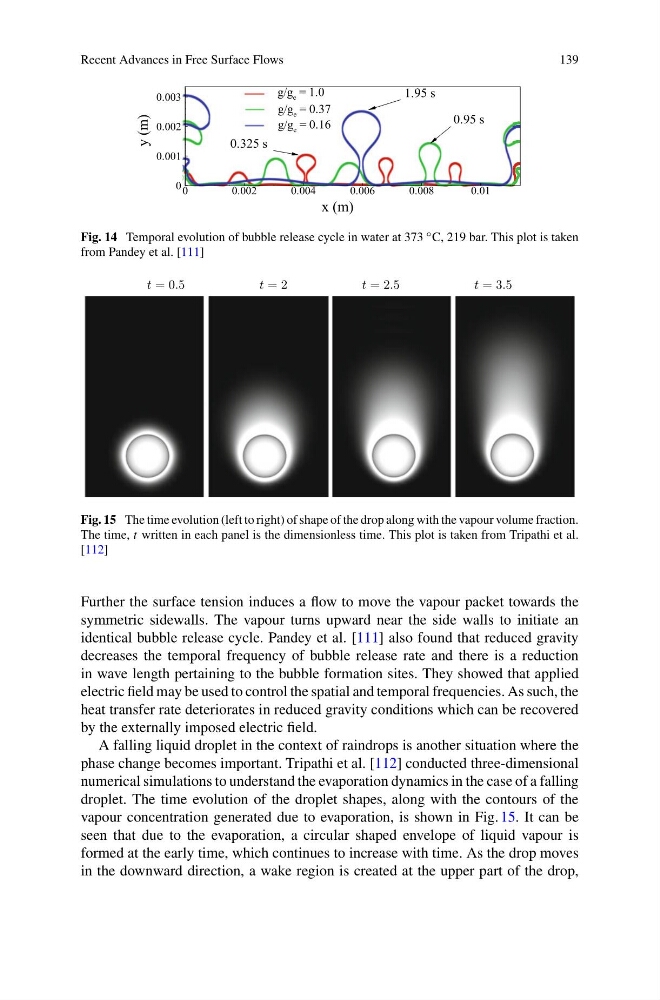
Fig. 14 Temporal evolution of bubble release cycle in water at 373 ◦ C, 219 bar. This plot is taken
from Pandey et al. [111]
t = 0.5
t = 2
t = 2.5
t = 3.5
Fig. 15 The time evolution (left to right) of shape of the drop along with the vapour volume fraction.
The time, t written in each panel is the dimensionless time. This plot is taken from Tripathi et al.
[112]
Further the surface tension induces a flow to move the vapour packet towards the
symmetric sidewalls. The vapour turns upward near the side walls to initiate an
identical bubble release cycle. Pandey et al. [111] also found that reduced gravity
decreases the temporal frequency of bubble release rate and there is a reduction
in wave length pertaining to the bubble formation sites. They showed that applied
electric field may be used to control the spatial and temporal frequencies. As such, the
heat transfer rate deteriorates in reduced gravity conditions which can be recovered
by the externally imposed electric field.
A falling liquid droplet in the context of raindrops is another situation where the
phase change becomes important. Tripathi et al. [112] conducted three-dimensional
numerical simulations to understand the evaporation dynamics in the case of a falling
droplet. The time evolution of the droplet shapes, along with the contours of the
vapour concentration generated due to evaporation, is shown in Fig. 15. It can be
seen that due to the evaporation, a circular shaped envelope of liquid vapour is
formed at the early time, which continues to increase with time. As the drop moves
in the downward direction, a wake region is created at the upper part of the drop,
139
Fig. 14 Temporal evolution of bubble release cycle in water at 373 ◦ C, 219 bar. This plot is taken
from Pandey et al. [111]
t = 0.5
t = 2
t = 2.5
t = 3.5
Fig. 15 The time evolution (left to right) of shape of the drop along with the vapour volume fraction.
The time, t written in each panel is the dimensionless time. This plot is taken from Tripathi et al.
[112]
Further the surface tension induces a flow to move the vapour packet towards the
symmetric sidewalls. The vapour turns upward near the side walls to initiate an
identical bubble release cycle. Pandey et al. [111] also found that reduced gravity
decreases the temporal frequency of bubble release rate and there is a reduction
in wave length pertaining to the bubble formation sites. They showed that applied
electric field may be used to control the spatial and temporal frequencies. As such, the
heat transfer rate deteriorates in reduced gravity conditions which can be recovered
by the externally imposed electric field.
A falling liquid droplet in the context of raindrops is another situation where the
phase change becomes important. Tripathi et al. [112] conducted three-dimensional
numerical simulations to understand the evaporation dynamics in the case of a falling
droplet. The time evolution of the droplet shapes, along with the contours of the
vapour concentration generated due to evaporation, is shown in Fig. 15. It can be
seen that due to the evaporation, a circular shaped envelope of liquid vapour is
formed at the early time, which continues to increase with time. As the drop moves
in the downward direction, a wake region is created at the upper part of the drop,