

Space Elevator—A Revolutionary Space Transportation System
119
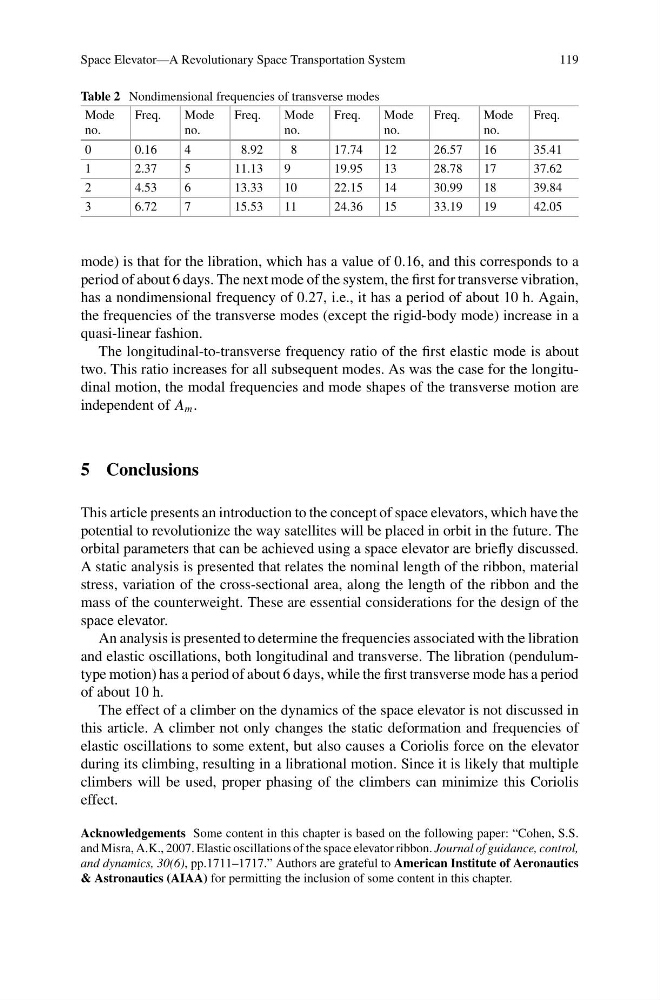
Table 2 Nondimensional frequencies of transverse modes
Mode
no.
Freq.
Mode
no.
Freq.
Mode
no.
Freq.
Mode
no.
Freq.
Mode
no.
Freq.
0
0.16
4
8.92
8
17.74
12
26.57
16
35.41
1
2.37
5
11.13
9
19.95
13
28.78
17
37.62
2
4.53
6
13.33
10
22.15
14
30.99
18
39.84
3
6.72
7
15.53
11
24.36
15
33.19
19
42.05
mode) is that for the libration, which has a value of 0.16, and this corresponds to a
period of about 6 days. The next mode of the system, the first for transverse vibration,
has a nondimensional frequency of 0.27, i.e., it has a period of about 10 h. Again,
the frequencies of the transverse modes (except the rigid-body mode) increase in a
quasi-linear fashion.
The longitudinal-to-transverse frequency ratio of the first elastic mode is about
two. This ratio increases for all subsequent modes. As was the case for the longitudinal motion, the modal frequencies and mode shapes of the transverse motion are
independent of A m .
5 Conclusions
This article presents an introduction to the concept of space elevators, which have the
potential to revolutionize the way satellites will be placed in orbit in the future. The
orbital parameters that can be achieved using a space elevator are briefly discussed.
A static analysis is presented that relates the nominal length of the ribbon, material
stress, variation of the cross-sectional area, along the length of the ribbon and the
mass of the counterweight. These are essential considerations for the design of the
space elevator.
An analysis is presented to determine the frequencies associated with the libration
and elastic oscillations, both longitudinal and transverse. The libration (pendulumtype motion) has a period of about 6 days, while the first transverse mode has a period
of about 10 h.
The effect of a climber on the dynamics of the space elevator is not discussed in
this article. A climber not only changes the static deformation and frequencies of
elastic oscillations to some extent, but also causes a Coriolis force on the elevator
during its climbing, resulting in a librational motion. Since it is likely that multiple
climbers will be used, proper phasing of the climbers can minimize this Coriolis
effect.
Acknowledgements Some content in this chapter is based on the following paper: “Cohen, S.S.
and Misra, A.K., 2007. Elastic oscillations of the space elevator ribbon. Journal of guidance, control,
and dynamics, 30(6), pp.1711–1717.” Authors are grateful to American Institute of Aeronautics
& Astronautics (AIAA) for permitting the inclusion of some content in this chapter.
119
Table 2 Nondimensional frequencies of transverse modes
Mode
no.
Freq.
Mode
no.
Freq.
Mode
no.
Freq.
Mode
no.
Freq.
Mode
no.
Freq.
0
0.16
4
8.92
8
17.74
12
26.57
16
35.41
1
2.37
5
11.13
9
19.95
13
28.78
17
37.62
2
4.53
6
13.33
10
22.15
14
30.99
18
39.84
3
6.72
7
15.53
11
24.36
15
33.19
19
42.05
mode) is that for the libration, which has a value of 0.16, and this corresponds to a
period of about 6 days. The next mode of the system, the first for transverse vibration,
has a nondimensional frequency of 0.27, i.e., it has a period of about 10 h. Again,
the frequencies of the transverse modes (except the rigid-body mode) increase in a
quasi-linear fashion.
The longitudinal-to-transverse frequency ratio of the first elastic mode is about
two. This ratio increases for all subsequent modes. As was the case for the longitudinal motion, the modal frequencies and mode shapes of the transverse motion are
independent of A m .
5 Conclusions
This article presents an introduction to the concept of space elevators, which have the
potential to revolutionize the way satellites will be placed in orbit in the future. The
orbital parameters that can be achieved using a space elevator are briefly discussed.
A static analysis is presented that relates the nominal length of the ribbon, material
stress, variation of the cross-sectional area, along the length of the ribbon and the
mass of the counterweight. These are essential considerations for the design of the
space elevator.
An analysis is presented to determine the frequencies associated with the libration
and elastic oscillations, both longitudinal and transverse. The libration (pendulumtype motion) has a period of about 6 days, while the first transverse mode has a period
of about 10 h.
The effect of a climber on the dynamics of the space elevator is not discussed in
this article. A climber not only changes the static deformation and frequencies of
elastic oscillations to some extent, but also causes a Coriolis force on the elevator
during its climbing, resulting in a librational motion. Since it is likely that multiple
climbers will be used, proper phasing of the climbers can minimize this Coriolis
effect.
Acknowledgements Some content in this chapter is based on the following paper: “Cohen, S.S.
and Misra, A.K., 2007. Elastic oscillations of the space elevator ribbon. Journal of guidance, control,
and dynamics, 30(6), pp.1711–1717.” Authors are grateful to American Institute of Aeronautics
& Astronautics (AIAA) for permitting the inclusion of some content in this chapter.