

Space Elevator—A Revolutionary Space Transportation System
117
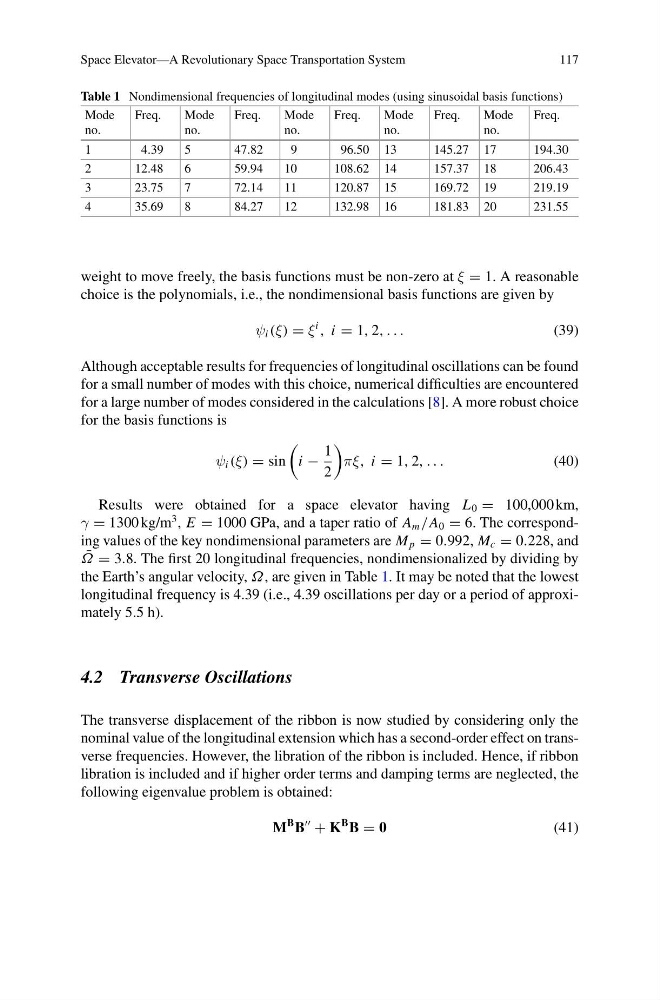
Table 1 Nondimensional frequencies of longitudinal modes (using sinusoidal basis functions)
Mode
no.
Freq.
Mode
no.
Freq.
Mode
no.
Freq.
Mode
no.
Freq.
Mode
no.
Freq.
1
4.39
5
47.82
9
96.50 13
145.27 17
194.30
2
12.48
6
59.94
10
108.62 14
157.37 18
206.43
3
23.75
7
72.14
11
120.87 15
169.72 19
219.19
4
35.69
8
84.27
12
132.98 16
181.83 20
231.55
weight to move freely, the basis functions must be non-zero at ξ = 1. A reasonable
choice is the polynomials, i.e., the nondimensional basis functions are given by
ψ i (ξ) = ξ
i
, i = 1, 2, . . .
(39)
Although acceptable results for frequencies of longitudinal oscillations can be found
for a small number of modes with this choice, numerical difficulties are encountered
for a large number of modes considered in the calculations [8]. A more robust choice
for the basis functions is
ψ i (ξ) = sin
i −
1
2
πξ, i = 1, 2, . . .
(40)
Results were obtained for a space elevator having L 0 = 100,000 km,
γ = 1300 kg/m
3 , E = 1000 GPa, and a taper ratio of A m /A 0 = 6. The corresponding values of the key nondimensional parameters are M p = 0.992, M c = 0.228, and
¯
Ω = 3.8. The first 20 longitudinal frequencies, nondimensionalized by dividing by
the Earth’s angular velocity, Ω, are given in Table 1. It may be noted that the lowest
longitudinal frequency is 4.39 (i.e., 4.39 oscillations per day or a period of approximately 5.5 h).
4.2 Transverse Oscillations
The transverse displacement of the ribbon is now studied by considering only the
nominal value of the longitudinal extension which has a second-order effect on transverse frequencies. However, the libration of the ribbon is included. Hence, if ribbon
libration is included and if higher order terms and damping terms are neglected, the
following eigenvalue problem is obtained:
M
B B
+ K
B B = 0
(41)
117
Table 1 Nondimensional frequencies of longitudinal modes (using sinusoidal basis functions)
Mode
no.
Freq.
Mode
no.
Freq.
Mode
no.
Freq.
Mode
no.
Freq.
Mode
no.
Freq.
1
4.39
5
47.82
9
96.50 13
145.27 17
194.30
2
12.48
6
59.94
10
108.62 14
157.37 18
206.43
3
23.75
7
72.14
11
120.87 15
169.72 19
219.19
4
35.69
8
84.27
12
132.98 16
181.83 20
231.55
weight to move freely, the basis functions must be non-zero at ξ = 1. A reasonable
choice is the polynomials, i.e., the nondimensional basis functions are given by
ψ i (ξ) = ξ
i
, i = 1, 2, . . .
(39)
Although acceptable results for frequencies of longitudinal oscillations can be found
for a small number of modes with this choice, numerical difficulties are encountered
for a large number of modes considered in the calculations [8]. A more robust choice
for the basis functions is
ψ i (ξ) = sin
i −
1
2
πξ, i = 1, 2, . . .
(40)
Results were obtained for a space elevator having L 0 = 100,000 km,
γ = 1300 kg/m
3 , E = 1000 GPa, and a taper ratio of A m /A 0 = 6. The corresponding values of the key nondimensional parameters are M p = 0.992, M c = 0.228, and
¯
Ω = 3.8. The first 20 longitudinal frequencies, nondimensionalized by dividing by
the Earth’s angular velocity, Ω, are given in Table 1. It may be noted that the lowest
longitudinal frequency is 4.39 (i.e., 4.39 oscillations per day or a period of approximately 5.5 h).
4.2 Transverse Oscillations
The transverse displacement of the ribbon is now studied by considering only the
nominal value of the longitudinal extension which has a second-order effect on transverse frequencies. However, the libration of the ribbon is included. Hence, if ribbon
libration is included and if higher order terms and damping terms are neglected, the
following eigenvalue problem is obtained:
M
B B
+ K
B B = 0
(41)