

112
A. K. Misra and S. Cohen
or, equivalently,
A(r ) = A m exp
R
2
E
¯
h R G (1 + ε 0 )
3
2
−
R G
r
−
r
2
2R
2
G
(16)
An almost identical solution as that given in Eq. (16) was obtained by Pearson [5].
The only difference is that the (1 + ε 0 ) term did not appear in his solution. This is
because the nominal strain was not considered in his taper function derivation. As
the nominal strain is not negligible, this modification to the profile of the area of
cross section is necessary. It is essential that there be a counterweight placed at the
free end, and, from Eq. (13), it is given by
m c =
σ 0 A m exp[F(s)]| s=L 0
Ω 2 [R E + L 0 (1 + ε)] −
μ
[R E +L o (1+ε)] 2
(17)
The resulting taper ratio of the ribbon, which is defined here as the quotient of
A m and the area of cross section at the Earth’s surface A 0 , is given by
A m
A 0
= exp
R E
( ¯
h + ε 0 )
1 −
R E
R G
2
1 +
R E
(2R G )
(18)
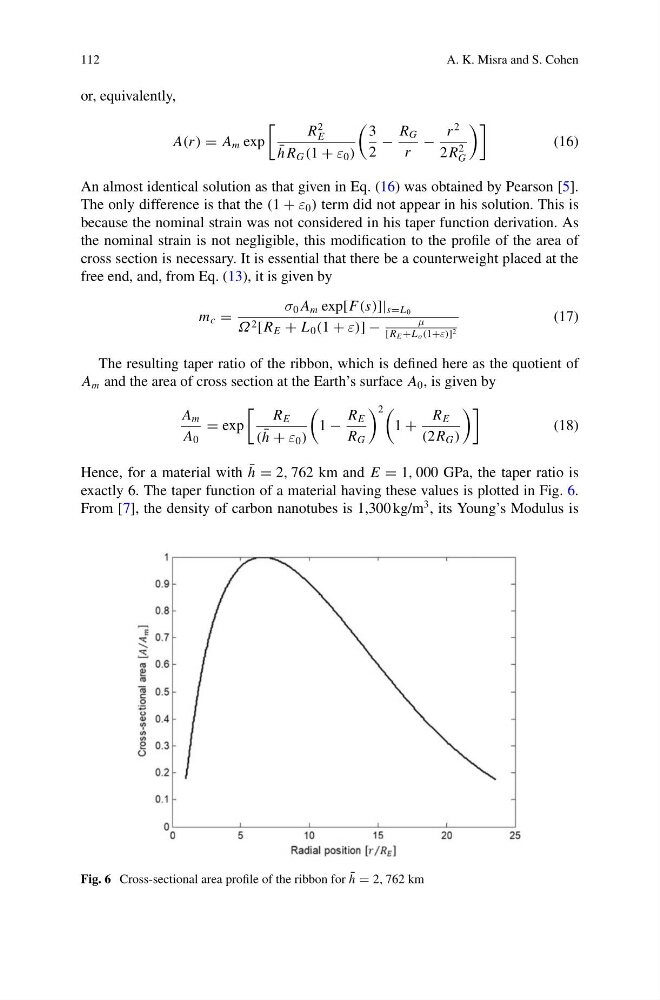
Hence, for a material with ¯
h = 2, 762 km and E = 1, 000 GPa, the taper ratio is
exactly 6. The taper function of a material having these values is plotted in Fig. 6.
From [7], the density of carbon nanotubes is 1,300 kg/m
3 , its Young’s Modulus is
Fig. 6 Cross-sectional area profile of the ribbon for ¯
h = 2, 762 km
A. K. Misra and S. Cohen
or, equivalently,
A(r ) = A m exp
R
2
E
¯
h R G (1 + ε 0 )
3
2
−
R G
r
−
r
2
2R
2
G
(16)
An almost identical solution as that given in Eq. (16) was obtained by Pearson [5].
The only difference is that the (1 + ε 0 ) term did not appear in his solution. This is
because the nominal strain was not considered in his taper function derivation. As
the nominal strain is not negligible, this modification to the profile of the area of
cross section is necessary. It is essential that there be a counterweight placed at the
free end, and, from Eq. (13), it is given by
m c =
σ 0 A m exp[F(s)]| s=L 0
Ω 2 [R E + L 0 (1 + ε)] −
μ
[R E +L o (1+ε)] 2
(17)
The resulting taper ratio of the ribbon, which is defined here as the quotient of
A m and the area of cross section at the Earth’s surface A 0 , is given by
A m
A 0
= exp
R E
( ¯
h + ε 0 )
1 −
R E
R G
2
1 +
R E
(2R G )
(18)
Hence, for a material with ¯
h = 2, 762 km and E = 1, 000 GPa, the taper ratio is
exactly 6. The taper function of a material having these values is plotted in Fig. 6.
From [7], the density of carbon nanotubes is 1,300 kg/m
3 , its Young’s Modulus is
Fig. 6 Cross-sectional area profile of the ribbon for ¯
h = 2, 762 km