

94
C. Ozoegwu and P. Eberhard
0
p c
5
10
10
5
p d
-10
0
5
-5
0
SR computation error
10
p c
5
0
0
5
p d
2
4
6
10
SR computation time [s]
(a) The beginning of tool pass
0
p c
5
10
10
5
p d
-10
-5
0
5
0
SR computation error
10
p c
5
0
0
5
p d
0
2
4
6
10
SR computation time [s]
(b) The end of tool pass
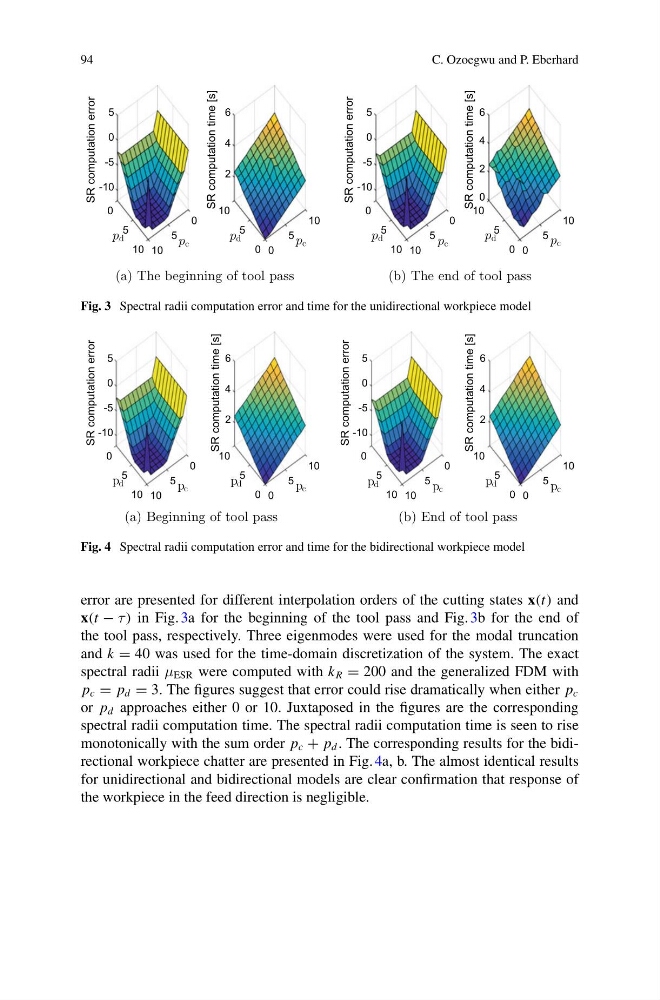
Fig. 3 Spectral radii computation error and time for the unidirectional workpiece model
0
p c
5
10
10
5
p d
-10
-5
0
5
0
SR computation error
10
p c
5
0
0
5
p d
2
4
6
10
SR computation time [s]
(a) Beginning of tool pass
0
p c
5
10
10
5
p d
-10
-5
0
5
0
SR computation error
10
p c
5
0
0
5
p d
4
6
2
10
SR computation time [s]
(b) End of tool pass
Fig. 4 Spectral radii computation error and time for the bidirectional workpiece model
error are presented for different interpolation orders of the cutting states x(t) and
x(t − τ ) in Fig. 3a for the beginning of the tool pass and Fig. 3b for the end of
the tool pass, respectively. Three eigenmodes were used for the modal truncation
and k = 40 was used for the time-domain discretization of the system. The exact
spectral radii μ ESR were computed with k R = 200 and the generalized FDM with
p c = p d = 3. The figures suggest that error could rise dramatically when either p c
or p d approaches either 0 or 10. Juxtaposed in the figures are the corresponding
spectral radii computation time. The spectral radii computation time is seen to rise
monotonically with the sum order p c + p d . The corresponding results for the bidirectional workpiece chatter are presented in Fig. 4a, b. The almost identical results
for unidirectional and bidirectional models are clear confirmation that response of
the workpiece in the feed direction is negligible.
C. Ozoegwu and P. Eberhard
0
p c
5
10
10
5
p d
-10
0
5
-5
0
SR computation error
10
p c
5
0
0
5
p d
2
4
6
10
SR computation time [s]
(a) The beginning of tool pass
0
p c
5
10
10
5
p d
-10
-5
0
5
0
SR computation error
10
p c
5
0
0
5
p d
0
2
4
6
10
SR computation time [s]
(b) The end of tool pass
Fig. 3 Spectral radii computation error and time for the unidirectional workpiece model
0
p c
5
10
10
5
p d
-10
-5
0
5
0
SR computation error
10
p c
5
0
0
5
p d
2
4
6
10
SR computation time [s]
(a) Beginning of tool pass
0
p c
5
10
10
5
p d
-10
-5
0
5
0
SR computation error
10
p c
5
0
0
5
p d
4
6
2
10
SR computation time [s]
(b) End of tool pass
Fig. 4 Spectral radii computation error and time for the bidirectional workpiece model
error are presented for different interpolation orders of the cutting states x(t) and
x(t − τ ) in Fig. 3a for the beginning of the tool pass and Fig. 3b for the end of
the tool pass, respectively. Three eigenmodes were used for the modal truncation
and k = 40 was used for the time-domain discretization of the system. The exact
spectral radii μ ESR were computed with k R = 200 and the generalized FDM with
p c = p d = 3. The figures suggest that error could rise dramatically when either p c
or p d approaches either 0 or 10. Juxtaposed in the figures are the corresponding
spectral radii computation time. The spectral radii computation time is seen to rise
monotonically with the sum order p c + p d . The corresponding results for the bidirectional workpiece chatter are presented in Fig. 4a, b. The almost identical results
for unidirectional and bidirectional models are clear confirmation that response of
the workpiece in the feed direction is negligible.