

92
C. Ozoegwu and P. Eberhard
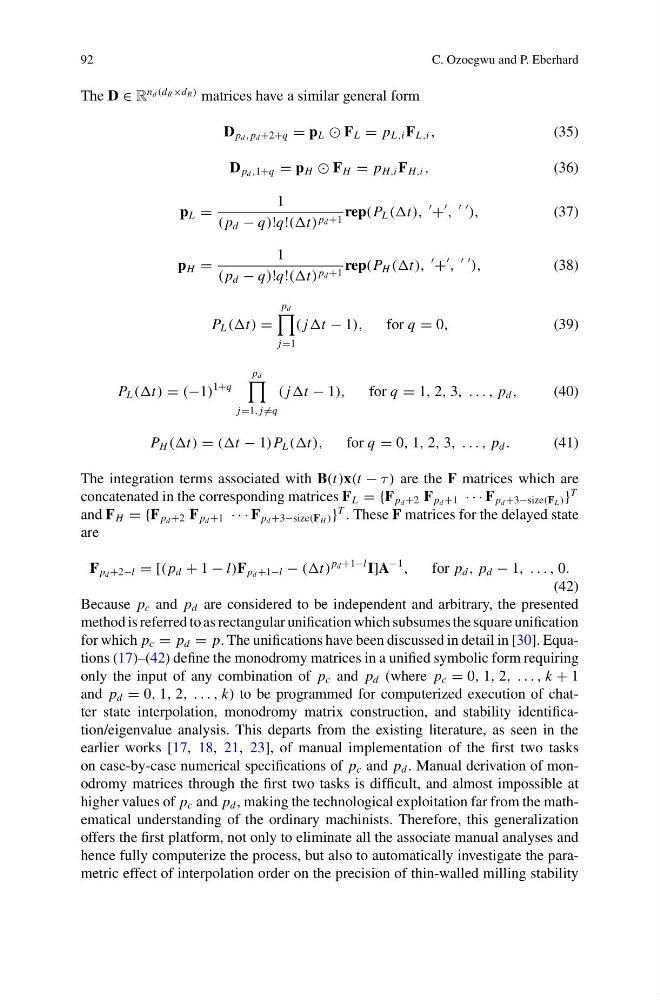
The D ∈ R
n d (d R ×d R ) matrices have a similar general form
D p d , p d +2+q = p L F L = p L ,i F L ,i ,
(35)
D p d ,1+q = p H F H = p H,i F H,i ,
(36)
p L =
1
( p d − q)!q!((t) p d +1 rep(P L ((t),
+
,
),
(37)
p H =
1
( p d − q)!q!((t) p d +1 rep(P H ((t),
+
,
),
(38)
P L ((t) =
p d
j=1
( jt − 1),
for q = 0,
(39)
P L ((t) = (−1)
1+q
p d
j=1, j =q
( jt − 1),
for q = 1, 2, 3, . . . , p d ,
(40)
P H ((t) = ((t − 1)P L ((t),
for q = 0, 1, 2, 3, . . . , p d .
(41)
The integration terms associated with B(t)x(t − τ ) are the F matrices which are
concatenated in the corresponding matrices F L = {F p d +2 F p d +1 · · · F p d +3−size(F L ) }
T
and F H = {F p d +2 F p d +1 · · · F p d +3−size(F H ) }
T . These F matrices for the delayed state
are
F p d +2−l = [( p d + 1 − l)F p d +1−l − ((t)
p d +1−l I]A
−1
,
for p d , p d − 1, . . . , 0.
(42)
Because p c and p d are considered to be independent and arbitrary, the presented
method is referred to as rectangular unification which subsumes the square unification
for which p c = p d = p. The unifications have been discussed in detail in [30]. Equations (17)–(42) define the monodromy matrices in a unified symbolic form requiring
only the input of any combination of p c and p d (where p c = 0, 1, 2, . . . , k + 1
and p d = 0, 1, 2, . . . , k) to be programmed for computerized execution of chatter state interpolation, monodromy matrix construction, and stability identification/eigenvalue analysis. This departs from the existing literature, as seen in the
earlier works [17, 18, 21, 23], of manual implementation of the first two tasks
on case-by-case numerical specifications of p c and p d . Manual derivation of monodromy matrices through the first two tasks is difficult, and almost impossible at
higher values of p c and p d , making the technological exploitation far from the mathematical understanding of the ordinary machinists. Therefore, this generalization
offers the first platform, not only to eliminate all the associate manual analyses and
hence fully computerize the process, but also to automatically investigate the parametric effect of interpolation order on the precision of thin-walled milling stability
C. Ozoegwu and P. Eberhard
The D ∈ R
n d (d R ×d R ) matrices have a similar general form
D p d , p d +2+q = p L F L = p L ,i F L ,i ,
(35)
D p d ,1+q = p H F H = p H,i F H,i ,
(36)
p L =
1
( p d − q)!q!((t) p d +1 rep(P L ((t),
+
,
),
(37)
p H =
1
( p d − q)!q!((t) p d +1 rep(P H ((t),
+
,
),
(38)
P L ((t) =
p d
j=1
( jt − 1),
for q = 0,
(39)
P L ((t) = (−1)
1+q
p d
j=1, j =q
( jt − 1),
for q = 1, 2, 3, . . . , p d ,
(40)
P H ((t) = ((t − 1)P L ((t),
for q = 0, 1, 2, 3, . . . , p d .
(41)
The integration terms associated with B(t)x(t − τ ) are the F matrices which are
concatenated in the corresponding matrices F L = {F p d +2 F p d +1 · · · F p d +3−size(F L ) }
T
and F H = {F p d +2 F p d +1 · · · F p d +3−size(F H ) }
T . These F matrices for the delayed state
are
F p d +2−l = [( p d + 1 − l)F p d +1−l − ((t)
p d +1−l I]A
−1
,
for p d , p d − 1, . . . , 0.
(42)
Because p c and p d are considered to be independent and arbitrary, the presented
method is referred to as rectangular unification which subsumes the square unification
for which p c = p d = p. The unifications have been discussed in detail in [30]. Equations (17)–(42) define the monodromy matrices in a unified symbolic form requiring
only the input of any combination of p c and p d (where p c = 0, 1, 2, . . . , k + 1
and p d = 0, 1, 2, . . . , k) to be programmed for computerized execution of chatter state interpolation, monodromy matrix construction, and stability identification/eigenvalue analysis. This departs from the existing literature, as seen in the
earlier works [17, 18, 21, 23], of manual implementation of the first two tasks
on case-by-case numerical specifications of p c and p d . Manual derivation of monodromy matrices through the first two tasks is difficult, and almost impossible at
higher values of p c and p d , making the technological exploitation far from the mathematical understanding of the ordinary machinists. Therefore, this generalization
offers the first platform, not only to eliminate all the associate manual analyses and
hence fully computerize the process, but also to automatically investigate the parametric effect of interpolation order on the precision of thin-walled milling stability