

2 The Smart “Things” in IoT
61
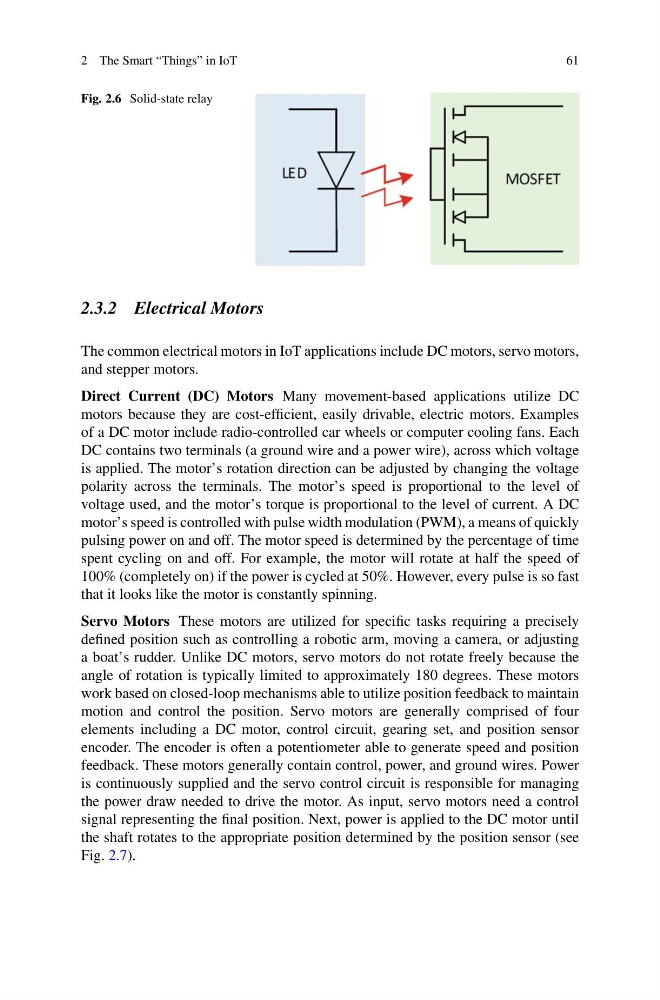
Fig. 2.6 Solid-state relay
2.3.2 Electrical Motors
The common electrical motors in IoT applications include DC motors, servo motors,
and stepper motors.
Direct Current (DC) Motors Many movement-based applications utilize DC
motors because they are cost-efficient, easily drivable, electric motors. Examples
of a DC motor include radio-controlled car wheels or computer cooling fans. Each
DC contains two terminals (a ground wire and a power wire), across which voltage
is applied. The motor’s rotation direction can be adjusted by changing the voltage
polarity across the terminals. The motor’s speed is proportional to the level of
voltage used, and the motor’s torque is proportional to the level of current. A DC
motor’s speed is controlled with pulse width modulation (PWM), a means of quickly
pulsing power on and off. The motor speed is determined by the percentage of time
spent cycling on and off. For example, the motor will rotate at half the speed of
100% (completely on) if the power is cycled at 50%. However, every pulse is so fast
that it looks like the motor is constantly spinning.
Servo Motors These motors are utilized for specific tasks requiring a precisely
defined position such as controlling a robotic arm, moving a camera, or adjusting
a boat’s rudder. Unlike DC motors, servo motors do not rotate freely because the
angle of rotation is typically limited to approximately 180 degrees. These motors
work based on closed-loop mechanisms able to utilize position feedback to maintain
motion and control the position. Servo motors are generally comprised of four
elements including a DC motor, control circuit, gearing set, and position sensor
encoder. The encoder is often a potentiometer able to generate speed and position
feedback. These motors generally contain control, power, and ground wires. Power
is continuously supplied and the servo control circuit is responsible for managing
the power draw needed to drive the motor. As input, servo motors need a control
signal representing the final position. Next, power is applied to the DC motor until
the shaft rotates to the appropriate position determined by the position sensor (see
Fig. 2.7).
61
Fig. 2.6 Solid-state relay
2.3.2 Electrical Motors
The common electrical motors in IoT applications include DC motors, servo motors,
and stepper motors.
Direct Current (DC) Motors Many movement-based applications utilize DC
motors because they are cost-efficient, easily drivable, electric motors. Examples
of a DC motor include radio-controlled car wheels or computer cooling fans. Each
DC contains two terminals (a ground wire and a power wire), across which voltage
is applied. The motor’s rotation direction can be adjusted by changing the voltage
polarity across the terminals. The motor’s speed is proportional to the level of
voltage used, and the motor’s torque is proportional to the level of current. A DC
motor’s speed is controlled with pulse width modulation (PWM), a means of quickly
pulsing power on and off. The motor speed is determined by the percentage of time
spent cycling on and off. For example, the motor will rotate at half the speed of
100% (completely on) if the power is cycled at 50%. However, every pulse is so fast
that it looks like the motor is constantly spinning.
Servo Motors These motors are utilized for specific tasks requiring a precisely
defined position such as controlling a robotic arm, moving a camera, or adjusting
a boat’s rudder. Unlike DC motors, servo motors do not rotate freely because the
angle of rotation is typically limited to approximately 180 degrees. These motors
work based on closed-loop mechanisms able to utilize position feedback to maintain
motion and control the position. Servo motors are generally comprised of four
elements including a DC motor, control circuit, gearing set, and position sensor
encoder. The encoder is often a potentiometer able to generate speed and position
feedback. These motors generally contain control, power, and ground wires. Power
is continuously supplied and the servo control circuit is responsible for managing
the power draw needed to drive the motor. As input, servo motors need a control
signal representing the final position. Next, power is applied to the DC motor until
the shaft rotates to the appropriate position determined by the position sensor (see
Fig. 2.7).