

618
P.-Y. S. Hsueh et al.
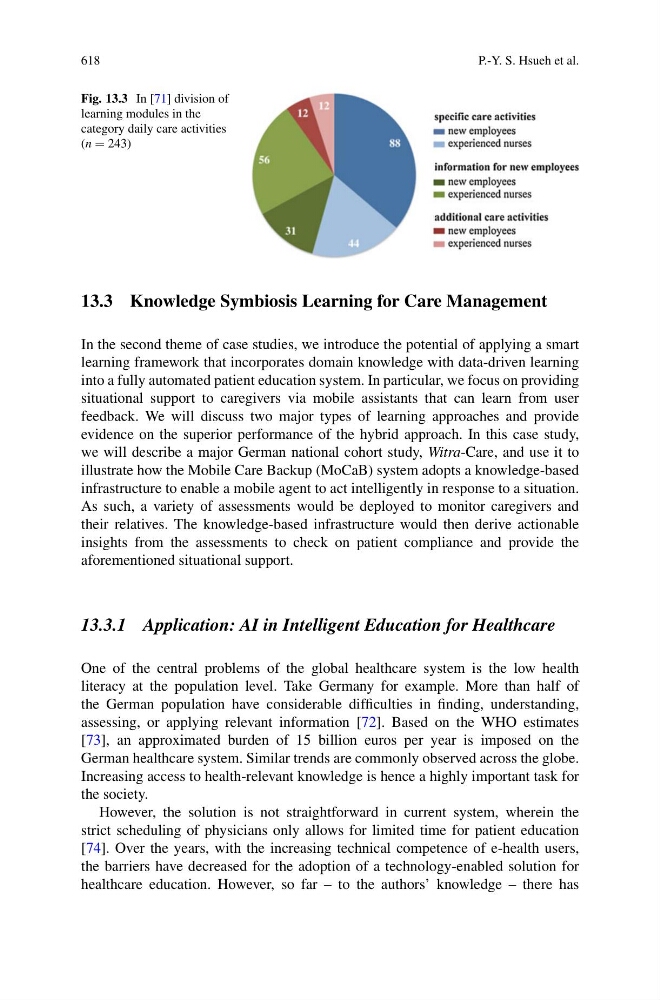
Fig. 13.3 In [71] division of
learning modules in the
category daily care activities
(n = 243)
13.3 Knowledge Symbiosis Learning for Care Management
In the second theme of case studies, we introduce the potential of applying a smart
learning framework that incorporates domain knowledge with data-driven learning
into a fully automated patient education system. In particular, we focus on providing
situational support to caregivers via mobile assistants that can learn from user
feedback. We will discuss two major types of learning approaches and provide
evidence on the superior performance of the hybrid approach. In this case study,
we will describe a major German national cohort study, Witra-Care, and use it to
illustrate how the Mobile Care Backup (MoCaB) system adopts a knowledge-based
infrastructure to enable a mobile agent to act intelligently in response to a situation.
As such, a variety of assessments would be deployed to monitor caregivers and
their relatives. The knowledge-based infrastructure would then derive actionable
insights from the assessments to check on patient compliance and provide the
aforementioned situational support.
13.3.1 Application: AI in Intelligent Education for Healthcare
One of the central problems of the global healthcare system is the low health
literacy at the population level. Take Germany for example. More than half of
the German population have considerable difficulties in finding, understanding,
assessing, or applying relevant information [72]. Based on the WHO estimates
[73], an approximated burden of 15 billion euros per year is imposed on the
German healthcare system. Similar trends are commonly observed across the globe.
Increasing access to health-relevant knowledge is hence a highly important task for
the society.
However, the solution is not straightforward in current system, wherein the
strict scheduling of physicians only allows for limited time for patient education
[74]. Over the years, with the increasing technical competence of e-health users,
the barriers have decreased for the adoption of a technology-enabled solution for
healthcare education. However, so far – to the authors’ knowledge – there has
P.-Y. S. Hsueh et al.
Fig. 13.3 In [71] division of
learning modules in the
category daily care activities
(n = 243)
13.3 Knowledge Symbiosis Learning for Care Management
In the second theme of case studies, we introduce the potential of applying a smart
learning framework that incorporates domain knowledge with data-driven learning
into a fully automated patient education system. In particular, we focus on providing
situational support to caregivers via mobile assistants that can learn from user
feedback. We will discuss two major types of learning approaches and provide
evidence on the superior performance of the hybrid approach. In this case study,
we will describe a major German national cohort study, Witra-Care, and use it to
illustrate how the Mobile Care Backup (MoCaB) system adopts a knowledge-based
infrastructure to enable a mobile agent to act intelligently in response to a situation.
As such, a variety of assessments would be deployed to monitor caregivers and
their relatives. The knowledge-based infrastructure would then derive actionable
insights from the assessments to check on patient compliance and provide the
aforementioned situational support.
13.3.1 Application: AI in Intelligent Education for Healthcare
One of the central problems of the global healthcare system is the low health
literacy at the population level. Take Germany for example. More than half of
the German population have considerable difficulties in finding, understanding,
assessing, or applying relevant information [72]. Based on the WHO estimates
[73], an approximated burden of 15 billion euros per year is imposed on the
German healthcare system. Similar trends are commonly observed across the globe.
Increasing access to health-relevant knowledge is hence a highly important task for
the society.
However, the solution is not straightforward in current system, wherein the
strict scheduling of physicians only allows for limited time for patient education
[74]. Over the years, with the increasing technical competence of e-health users,
the barriers have decreased for the adoption of a technology-enabled solution for
healthcare education. However, so far – to the authors’ knowledge – there has