

12 Biomedical Engineering Fundamentals
589
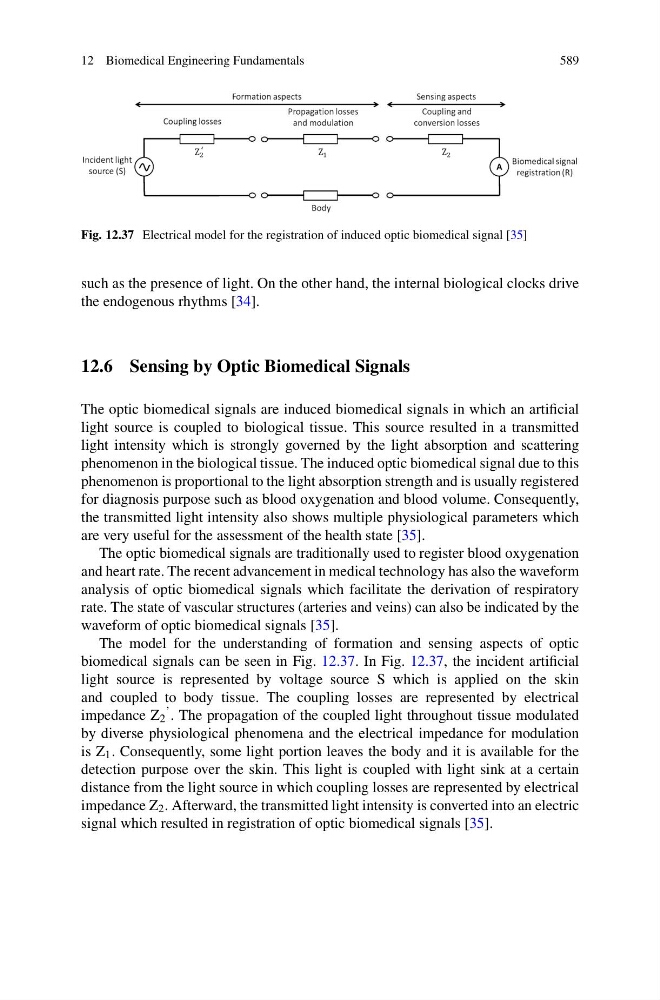
Fig. 12.37 Electrical model for the registration of induced optic biomedical signal [35]
such as the presence of light. On the other hand, the internal biological clocks drive
the endogenous rhythms [34].
12.6 Sensing by Optic Biomedical Signals
The optic biomedical signals are induced biomedical signals in which an artificial
light source is coupled to biological tissue. This source resulted in a transmitted
light intensity which is strongly governed by the light absorption and scattering
phenomenon in the biological tissue. The induced optic biomedical signal due to this
phenomenon is proportional to the light absorption strength and is usually registered
for diagnosis purpose such as blood oxygenation and blood volume. Consequently,
the transmitted light intensity also shows multiple physiological parameters which
are very useful for the assessment of the health state [35].
The optic biomedical signals are traditionally used to register blood oxygenation
and heart rate. The recent advancement in medical technology has also the waveform
analysis of optic biomedical signals which facilitate the derivation of respiratory
rate. The state of vascular structures (arteries and veins) can also be indicated by the
waveform of optic biomedical signals [35].
The model for the understanding of formation and sensing aspects of optic
biomedical signals can be seen in Fig. 12.37. In Fig. 12.37, the incident artificial
light source is represented by voltage source S which is applied on the skin
and coupled to body tissue. The coupling losses are represented by electrical
impedance Z 2
’ . The propagation of the coupled light throughout tissue modulated
by diverse physiological phenomena and the electrical impedance for modulation
is Z 1 . Consequently, some light portion leaves the body and it is available for the
detection purpose over the skin. This light is coupled with light sink at a certain
distance from the light source in which coupling losses are represented by electrical
impedance Z 2 . Afterward, the transmitted light intensity is converted into an electric
signal which resulted in registration of optic biomedical signals [35].
589
Fig. 12.37 Electrical model for the registration of induced optic biomedical signal [35]
such as the presence of light. On the other hand, the internal biological clocks drive
the endogenous rhythms [34].
12.6 Sensing by Optic Biomedical Signals
The optic biomedical signals are induced biomedical signals in which an artificial
light source is coupled to biological tissue. This source resulted in a transmitted
light intensity which is strongly governed by the light absorption and scattering
phenomenon in the biological tissue. The induced optic biomedical signal due to this
phenomenon is proportional to the light absorption strength and is usually registered
for diagnosis purpose such as blood oxygenation and blood volume. Consequently,
the transmitted light intensity also shows multiple physiological parameters which
are very useful for the assessment of the health state [35].
The optic biomedical signals are traditionally used to register blood oxygenation
and heart rate. The recent advancement in medical technology has also the waveform
analysis of optic biomedical signals which facilitate the derivation of respiratory
rate. The state of vascular structures (arteries and veins) can also be indicated by the
waveform of optic biomedical signals [35].
The model for the understanding of formation and sensing aspects of optic
biomedical signals can be seen in Fig. 12.37. In Fig. 12.37, the incident artificial
light source is represented by voltage source S which is applied on the skin
and coupled to body tissue. The coupling losses are represented by electrical
impedance Z 2
’ . The propagation of the coupled light throughout tissue modulated
by diverse physiological phenomena and the electrical impedance for modulation
is Z 1 . Consequently, some light portion leaves the body and it is available for the
detection purpose over the skin. This light is coupled with light sink at a certain
distance from the light source in which coupling losses are represented by electrical
impedance Z 2 . Afterward, the transmitted light intensity is converted into an electric
signal which resulted in registration of optic biomedical signals [35].