

580
R. B. Pachori and V. Gupta
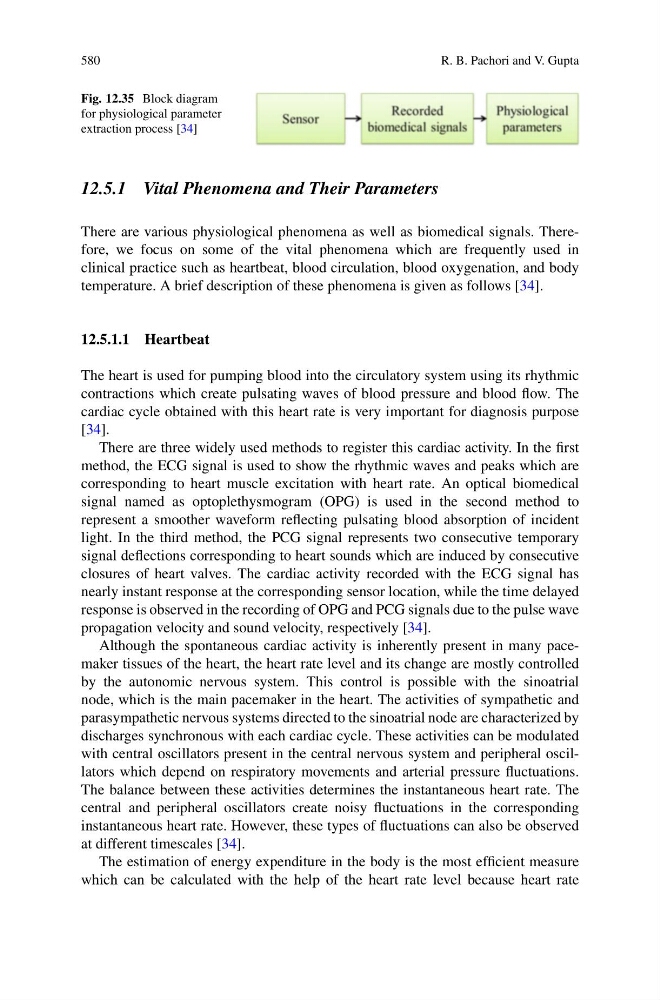
Fig. 12.35 Block diagram
for physiological parameter
extraction process [34]
12.5.1 Vital Phenomena and Their Parameters
There are various physiological phenomena as well as biomedical signals. Therefore, we focus on some of the vital phenomena which are frequently used in
clinical practice such as heartbeat, blood circulation, blood oxygenation, and body
temperature. A brief description of these phenomena is given as follows [34].
12.5.1.1 Heartbeat
The heart is used for pumping blood into the circulatory system using its rhythmic
contractions which create pulsating waves of blood pressure and blood flow. The
cardiac cycle obtained with this heart rate is very important for diagnosis purpose
[34].
There are three widely used methods to register this cardiac activity. In the first
method, the ECG signal is used to show the rhythmic waves and peaks which are
corresponding to heart muscle excitation with heart rate. An optical biomedical
signal named as optoplethysmogram (OPG) is used in the second method to
represent a smoother waveform reflecting pulsating blood absorption of incident
light. In the third method, the PCG signal represents two consecutive temporary
signal deflections corresponding to heart sounds which are induced by consecutive
closures of heart valves. The cardiac activity recorded with the ECG signal has
nearly instant response at the corresponding sensor location, while the time delayed
response is observed in the recording of OPG and PCG signals due to the pulse wave
propagation velocity and sound velocity, respectively [34].
Although the spontaneous cardiac activity is inherently present in many pacemaker tissues of the heart, the heart rate level and its change are mostly controlled
by the autonomic nervous system. This control is possible with the sinoatrial
node, which is the main pacemaker in the heart. The activities of sympathetic and
parasympathetic nervous systems directed to the sinoatrial node are characterized by
discharges synchronous with each cardiac cycle. These activities can be modulated
with central oscillators present in the central nervous system and peripheral oscillators which depend on respiratory movements and arterial pressure fluctuations.
The balance between these activities determines the instantaneous heart rate. The
central and peripheral oscillators create noisy fluctuations in the corresponding
instantaneous heart rate. However, these types of fluctuations can also be observed
at different timescales [34].
The estimation of energy expenditure in the body is the most efficient measure
which can be calculated with the help of the heart rate level because heart rate
R. B. Pachori and V. Gupta
Fig. 12.35 Block diagram
for physiological parameter
extraction process [34]
12.5.1 Vital Phenomena and Their Parameters
There are various physiological phenomena as well as biomedical signals. Therefore, we focus on some of the vital phenomena which are frequently used in
clinical practice such as heartbeat, blood circulation, blood oxygenation, and body
temperature. A brief description of these phenomena is given as follows [34].
12.5.1.1 Heartbeat
The heart is used for pumping blood into the circulatory system using its rhythmic
contractions which create pulsating waves of blood pressure and blood flow. The
cardiac cycle obtained with this heart rate is very important for diagnosis purpose
[34].
There are three widely used methods to register this cardiac activity. In the first
method, the ECG signal is used to show the rhythmic waves and peaks which are
corresponding to heart muscle excitation with heart rate. An optical biomedical
signal named as optoplethysmogram (OPG) is used in the second method to
represent a smoother waveform reflecting pulsating blood absorption of incident
light. In the third method, the PCG signal represents two consecutive temporary
signal deflections corresponding to heart sounds which are induced by consecutive
closures of heart valves. The cardiac activity recorded with the ECG signal has
nearly instant response at the corresponding sensor location, while the time delayed
response is observed in the recording of OPG and PCG signals due to the pulse wave
propagation velocity and sound velocity, respectively [34].
Although the spontaneous cardiac activity is inherently present in many pacemaker tissues of the heart, the heart rate level and its change are mostly controlled
by the autonomic nervous system. This control is possible with the sinoatrial
node, which is the main pacemaker in the heart. The activities of sympathetic and
parasympathetic nervous systems directed to the sinoatrial node are characterized by
discharges synchronous with each cardiac cycle. These activities can be modulated
with central oscillators present in the central nervous system and peripheral oscillators which depend on respiratory movements and arterial pressure fluctuations.
The balance between these activities determines the instantaneous heart rate. The
central and peripheral oscillators create noisy fluctuations in the corresponding
instantaneous heart rate. However, these types of fluctuations can also be observed
at different timescales [34].
The estimation of energy expenditure in the body is the most efficient measure
which can be calculated with the help of the heart rate level because heart rate