

12 Biomedical Engineering Fundamentals
567
It should be noted that k has only integer values and A k is a discrete function in
Eq. (12.28).
Fourier transform is a linear transform which plays a very important role in
digital signal processing applications, and fast Fourier transform (FFT) algorithm
is commonly used in analyzing the spectral content of any deterministic signal due
to less computational complexity.
The discrete Fourier transform (DFT) allows the decomposition of discretetime signals into sinusoidal components whose frequencies are multiples of a
fundamental frequency. The amplitudes and phases of the sinusoidal components
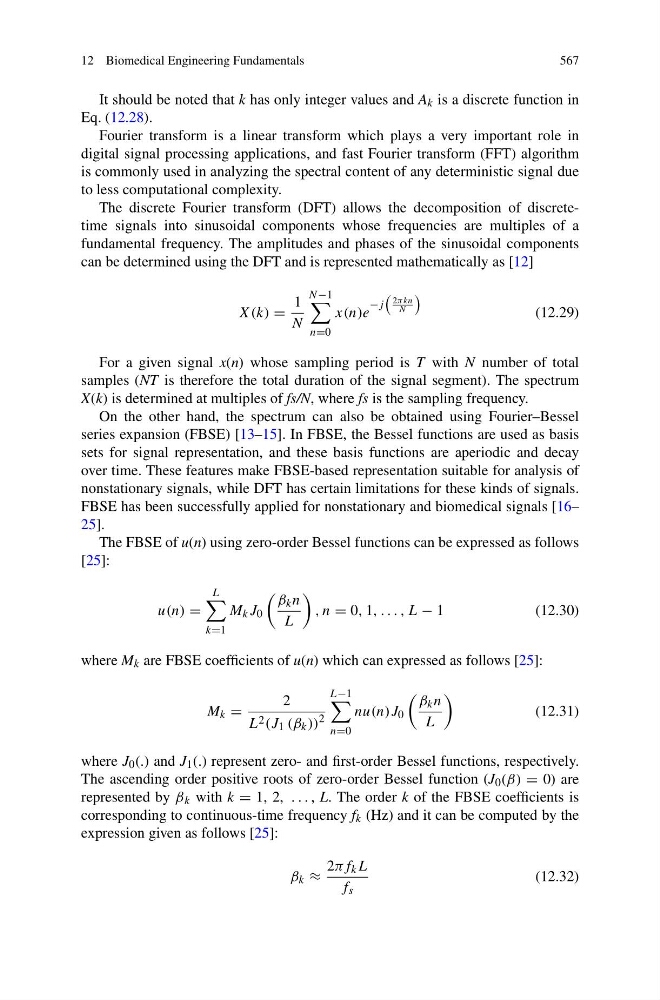
can be determined using the DFT and is represented mathematically as [12]
X(k) =
1
N
N −1
n=0
x(n)e
−j
2πkn
N
(12.29)
For a given signal x(n) whose sampling period is T with N number of total
samples (NT is therefore the total duration of the signal segment). The spectrum
X(k) is determined at multiples of fs/N, where fs is the sampling frequency.
On the other hand, the spectrum can also be obtained using Fourier–Bessel
series expansion (FBSE) [13–15]. In FBSE, the Bessel functions are used as basis
sets for signal representation, and these basis functions are aperiodic and decay
over time. These features make FBSE-based representation suitable for analysis of
nonstationary signals, while DFT has certain limitations for these kinds of signals.
FBSE has been successfully applied for nonstationary and biomedical signals [16–
25].
The FBSE of u(n) using zero-order Bessel functions can be expressed as follows
[25]:
u(n) =
L
k=1
M k J 0
β k n
L
, n = 0, 1, . . . , L − 1
(12.30)
where M k are FBSE coefficients of u(n) which can expressed as follows [25]:
M k =
2
L 2 (J 1 (β k ))
2
L−1
n=0
nu(n)J 0
β k n
L
(12.31)
where J 0 (.) and J 1 (.) represent zero- and first-order Bessel functions, respectively.
The ascending order positive roots of zero-order Bessel function (J 0 (β) = 0) are
represented by β k with k = 1, 2, . . . , L. The order k of the FBSE coefficients is
corresponding to continuous-time frequency f k (Hz) and it can be computed by the
expression given as follows [25]:
β k ≈
2πf k L
f s
(12.32)
567
It should be noted that k has only integer values and A k is a discrete function in
Eq. (12.28).
Fourier transform is a linear transform which plays a very important role in
digital signal processing applications, and fast Fourier transform (FFT) algorithm
is commonly used in analyzing the spectral content of any deterministic signal due
to less computational complexity.
The discrete Fourier transform (DFT) allows the decomposition of discretetime signals into sinusoidal components whose frequencies are multiples of a
fundamental frequency. The amplitudes and phases of the sinusoidal components
can be determined using the DFT and is represented mathematically as [12]
X(k) =
1
N
N −1
n=0
x(n)e
−j
2πkn
N
(12.29)
For a given signal x(n) whose sampling period is T with N number of total
samples (NT is therefore the total duration of the signal segment). The spectrum
X(k) is determined at multiples of fs/N, where fs is the sampling frequency.
On the other hand, the spectrum can also be obtained using Fourier–Bessel
series expansion (FBSE) [13–15]. In FBSE, the Bessel functions are used as basis
sets for signal representation, and these basis functions are aperiodic and decay
over time. These features make FBSE-based representation suitable for analysis of
nonstationary signals, while DFT has certain limitations for these kinds of signals.
FBSE has been successfully applied for nonstationary and biomedical signals [16–
25].
The FBSE of u(n) using zero-order Bessel functions can be expressed as follows
[25]:
u(n) =
L
k=1
M k J 0
β k n
L
, n = 0, 1, . . . , L − 1
(12.30)
where M k are FBSE coefficients of u(n) which can expressed as follows [25]:
M k =
2
L 2 (J 1 (β k ))
2
L−1
n=0
nu(n)J 0
β k n
L
(12.31)
where J 0 (.) and J 1 (.) represent zero- and first-order Bessel functions, respectively.
The ascending order positive roots of zero-order Bessel function (J 0 (β) = 0) are
represented by β k with k = 1, 2, . . . , L. The order k of the FBSE coefficients is
corresponding to continuous-time frequency f k (Hz) and it can be computed by the
expression given as follows [25]:
β k ≈
2πf k L
f s
(12.32)