

478
B. Russell
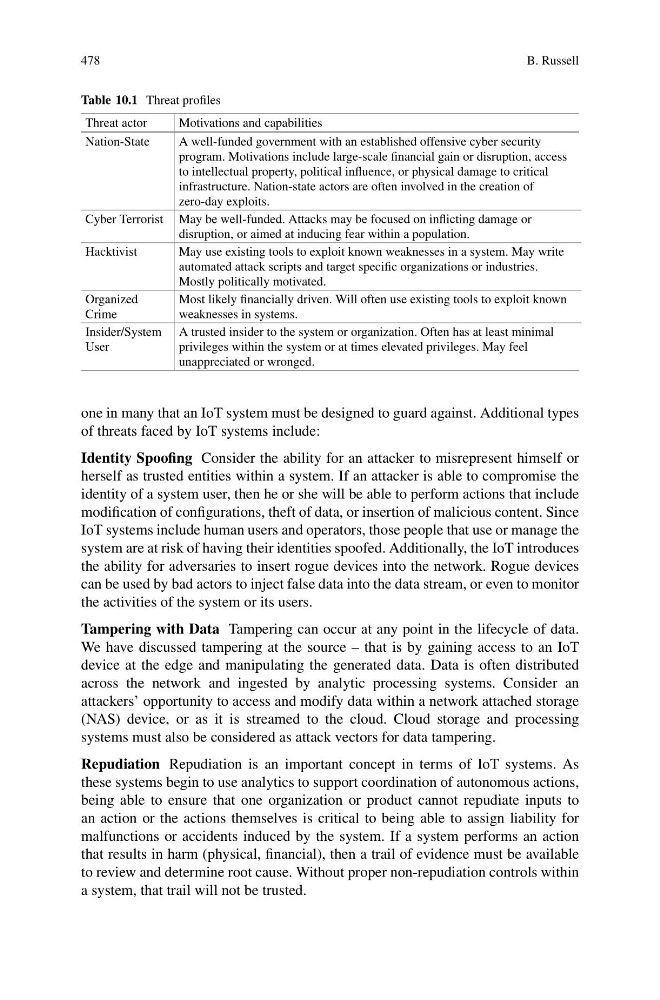
Table 10.1 Threat profiles
Threat actor
Motivations and capabilities
Nation-State
A well-funded government with an established offensive cyber security
program. Motivations include large-scale financial gain or disruption, access
to intellectual property, political influence, or physical damage to critical
infrastructure. Nation-state actors are often involved in the creation of
zero-day exploits.
Cyber Terrorist May be well-funded. Attacks may be focused on inflicting damage or
disruption, or aimed at inducing fear within a population.
Hacktivist
May use existing tools to exploit known weaknesses in a system. May write
automated attack scripts and target specific organizations or industries.
Mostly politically motivated.
Organized
Crime
Most likely financially driven. Will often use existing tools to exploit known
weaknesses in systems.
Insider/System
User
A trusted insider to the system or organization. Often has at least minimal
privileges within the system or at times elevated privileges. May feel
unappreciated or wronged.
one in many that an IoT system must be designed to guard against. Additional types
of threats faced by IoT systems include:
Identity Spoofing Consider the ability for an attacker to misrepresent himself or
herself as trusted entities within a system. If an attacker is able to compromise the
identity of a system user, then he or she will be able to perform actions that include
modification of configurations, theft of data, or insertion of malicious content. Since
IoT systems include human users and operators, those people that use or manage the
system are at risk of having their identities spoofed. Additionally, the IoT introduces
the ability for adversaries to insert rogue devices into the network. Rogue devices
can be used by bad actors to inject false data into the data stream, or even to monitor
the activities of the system or its users.
Tampering with Data Tampering can occur at any point in the lifecycle of data.
We have discussed tampering at the source – that is by gaining access to an IoT
device at the edge and manipulating the generated data. Data is often distributed
across the network and ingested by analytic processing systems. Consider an
attackers’ opportunity to access and modify data within a network attached storage
(NAS) device, or as it is streamed to the cloud. Cloud storage and processing
systems must also be considered as attack vectors for data tampering.
Repudiation Repudiation is an important concept in terms of IoT systems. As
these systems begin to use analytics to support coordination of autonomous actions,
being able to ensure that one organization or product cannot repudiate inputs to
an action or the actions themselves is critical to being able to assign liability for
malfunctions or accidents induced by the system. If a system performs an action
that results in harm (physical, financial), then a trail of evidence must be available
to review and determine root cause. Without proper non-repudiation controls within
a system, that trail will not be trusted.
B. Russell
Table 10.1 Threat profiles
Threat actor
Motivations and capabilities
Nation-State
A well-funded government with an established offensive cyber security
program. Motivations include large-scale financial gain or disruption, access
to intellectual property, political influence, or physical damage to critical
infrastructure. Nation-state actors are often involved in the creation of
zero-day exploits.
Cyber Terrorist May be well-funded. Attacks may be focused on inflicting damage or
disruption, or aimed at inducing fear within a population.
Hacktivist
May use existing tools to exploit known weaknesses in a system. May write
automated attack scripts and target specific organizations or industries.
Mostly politically motivated.
Organized
Crime
Most likely financially driven. Will often use existing tools to exploit known
weaknesses in systems.
Insider/System
User
A trusted insider to the system or organization. Often has at least minimal
privileges within the system or at times elevated privileges. May feel
unappreciated or wronged.
one in many that an IoT system must be designed to guard against. Additional types
of threats faced by IoT systems include:
Identity Spoofing Consider the ability for an attacker to misrepresent himself or
herself as trusted entities within a system. If an attacker is able to compromise the
identity of a system user, then he or she will be able to perform actions that include
modification of configurations, theft of data, or insertion of malicious content. Since
IoT systems include human users and operators, those people that use or manage the
system are at risk of having their identities spoofed. Additionally, the IoT introduces
the ability for adversaries to insert rogue devices into the network. Rogue devices
can be used by bad actors to inject false data into the data stream, or even to monitor
the activities of the system or its users.
Tampering with Data Tampering can occur at any point in the lifecycle of data.
We have discussed tampering at the source – that is by gaining access to an IoT
device at the edge and manipulating the generated data. Data is often distributed
across the network and ingested by analytic processing systems. Consider an
attackers’ opportunity to access and modify data within a network attached storage
(NAS) device, or as it is streamed to the cloud. Cloud storage and processing
systems must also be considered as attack vectors for data tampering.
Repudiation Repudiation is an important concept in terms of IoT systems. As
these systems begin to use analytics to support coordination of autonomous actions,
being able to ensure that one organization or product cannot repudiate inputs to
an action or the actions themselves is critical to being able to assign liability for
malfunctions or accidents induced by the system. If a system performs an action
that results in harm (physical, financial), then a trail of evidence must be available
to review and determine root cause. Without proper non-repudiation controls within
a system, that trail will not be trusted.