

10 IoT Cyber Security
477
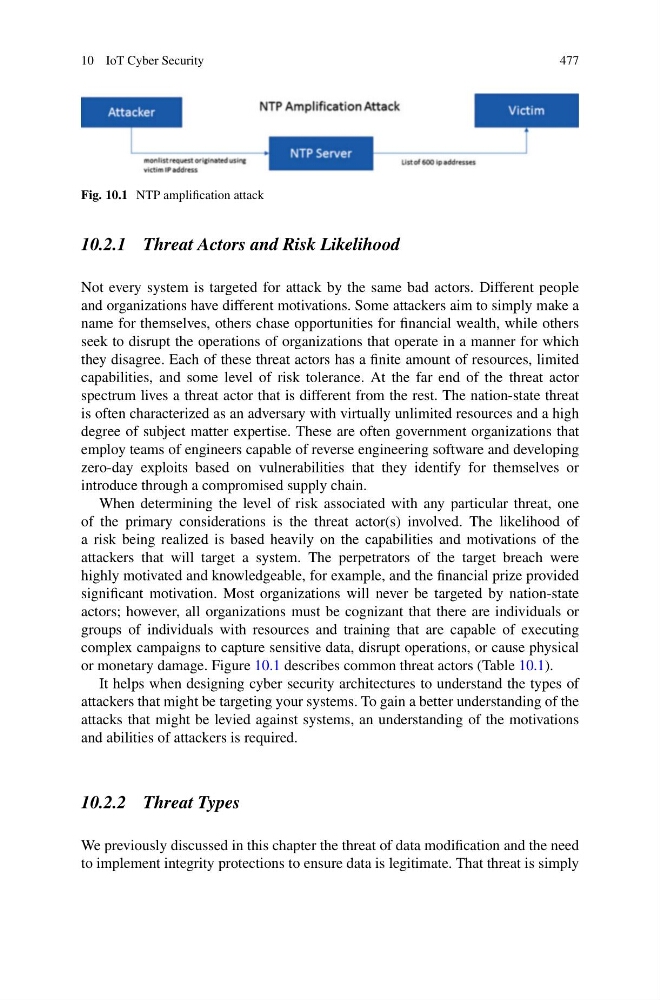
Fig. 10.1 NTP amplification attack
10.2.1 Threat Actors and Risk Likelihood
Not every system is targeted for attack by the same bad actors. Different people
and organizations have different motivations. Some attackers aim to simply make a
name for themselves, others chase opportunities for financial wealth, while others
seek to disrupt the operations of organizations that operate in a manner for which
they disagree. Each of these threat actors has a finite amount of resources, limited
capabilities, and some level of risk tolerance. At the far end of the threat actor
spectrum lives a threat actor that is different from the rest. The nation-state threat
is often characterized as an adversary with virtually unlimited resources and a high
degree of subject matter expertise. These are often government organizations that
employ teams of engineers capable of reverse engineering software and developing
zero-day exploits based on vulnerabilities that they identify for themselves or
introduce through a compromised supply chain.
When determining the level of risk associated with any particular threat, one
of the primary considerations is the threat actor(s) involved. The likelihood of
a risk being realized is based heavily on the capabilities and motivations of the
attackers that will target a system. The perpetrators of the target breach were
highly motivated and knowledgeable, for example, and the financial prize provided
significant motivation. Most organizations will never be targeted by nation-state
actors; however, all organizations must be cognizant that there are individuals or
groups of individuals with resources and training that are capable of executing
complex campaigns to capture sensitive data, disrupt operations, or cause physical
or monetary damage. Figure 10.1 describes common threat actors (Table 10.1).
It helps when designing cyber security architectures to understand the types of
attackers that might be targeting your systems. To gain a better understanding of the
attacks that might be levied against systems, an understanding of the motivations
and abilities of attackers is required.
10.2.2 Threat Types
We previously discussed in this chapter the threat of data modification and the need
to implement integrity protections to ensure data is legitimate. That threat is simply
477
Fig. 10.1 NTP amplification attack
10.2.1 Threat Actors and Risk Likelihood
Not every system is targeted for attack by the same bad actors. Different people
and organizations have different motivations. Some attackers aim to simply make a
name for themselves, others chase opportunities for financial wealth, while others
seek to disrupt the operations of organizations that operate in a manner for which
they disagree. Each of these threat actors has a finite amount of resources, limited
capabilities, and some level of risk tolerance. At the far end of the threat actor
spectrum lives a threat actor that is different from the rest. The nation-state threat
is often characterized as an adversary with virtually unlimited resources and a high
degree of subject matter expertise. These are often government organizations that
employ teams of engineers capable of reverse engineering software and developing
zero-day exploits based on vulnerabilities that they identify for themselves or
introduce through a compromised supply chain.
When determining the level of risk associated with any particular threat, one
of the primary considerations is the threat actor(s) involved. The likelihood of
a risk being realized is based heavily on the capabilities and motivations of the
attackers that will target a system. The perpetrators of the target breach were
highly motivated and knowledgeable, for example, and the financial prize provided
significant motivation. Most organizations will never be targeted by nation-state
actors; however, all organizations must be cognizant that there are individuals or
groups of individuals with resources and training that are capable of executing
complex campaigns to capture sensitive data, disrupt operations, or cause physical
or monetary damage. Figure 10.1 describes common threat actors (Table 10.1).
It helps when designing cyber security architectures to understand the types of
attackers that might be targeting your systems. To gain a better understanding of the
attacks that might be levied against systems, an understanding of the motivations
and abilities of attackers is required.
10.2.2 Threat Types
We previously discussed in this chapter the threat of data modification and the need
to implement integrity protections to ensure data is legitimate. That threat is simply