

8 Distributed Ledger Technology
427
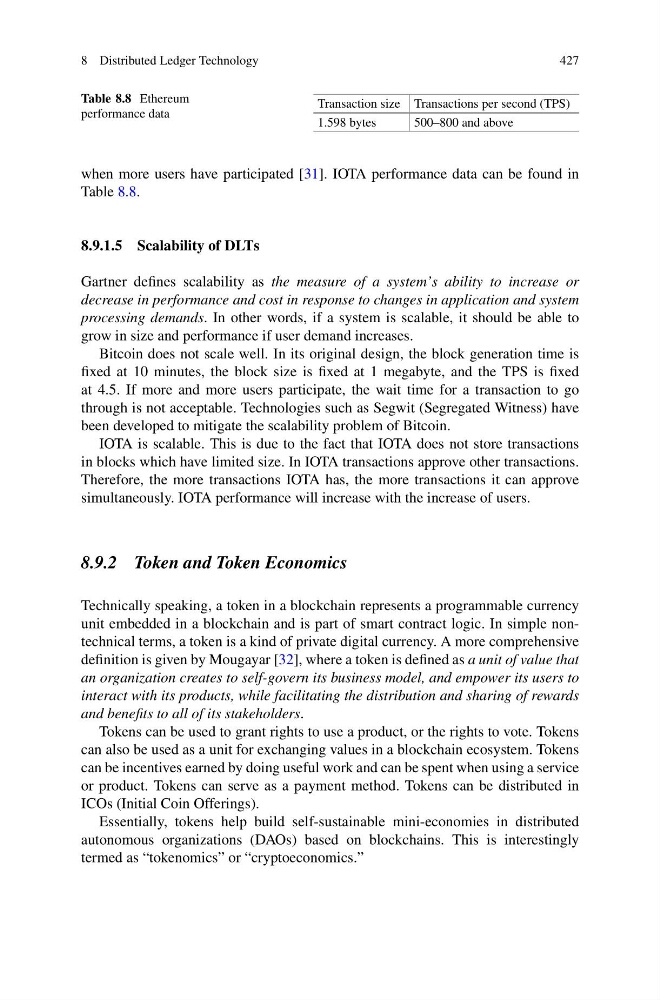
Table 8.8 Ethereum
performance data
Transaction size Transactions per second (TPS)
1.598 bytes
500–800 and above
when more users have participated [31]. IOTA performance data can be found in
Table 8.8.
8.9.1.5 Scalability of DLTs
Gartner defines scalability as the measure of a system’s ability to increase or
decrease in performance and cost in response to changes in application and system
processing demands. In other words, if a system is scalable, it should be able to
grow in size and performance if user demand increases.
Bitcoin does not scale well. In its original design, the block generation time is
fixed at 10 minutes, the block size is fixed at 1 megabyte, and the TPS is fixed
at 4.5. If more and more users participate, the wait time for a transaction to go
through is not acceptable. Technologies such as Segwit (Segregated Witness) have
been developed to mitigate the scalability problem of Bitcoin.
IOTA is scalable. This is due to the fact that IOTA does not store transactions
in blocks which have limited size. In IOTA transactions approve other transactions.
Therefore, the more transactions IOTA has, the more transactions it can approve
simultaneously. IOTA performance will increase with the increase of users.
8.9.2 Token and Token Economics
Technically speaking, a token in a blockchain represents a programmable currency
unit embedded in a blockchain and is part of smart contract logic. In simple nontechnical terms, a token is a kind of private digital currency. A more comprehensive
definition is given by Mougayar [32], where a token is defined as a unit of value that
an organization creates to self-govern its business model, and empower its users to
interact with its products, while facilitating the distribution and sharing of rewards
and benefits to all of its stakeholders.
Tokens can be used to grant rights to use a product, or the rights to vote. Tokens
can also be used as a unit for exchanging values in a blockchain ecosystem. Tokens
can be incentives earned by doing useful work and can be spent when using a service
or product. Tokens can serve as a payment method. Tokens can be distributed in
ICOs (Initial Coin Offerings).
Essentially, tokens help build self-sustainable mini-economies in distributed
autonomous organizations (DAOs) based on blockchains. This is interestingly
termed as “tokenomics” or “cryptoeconomics.”
427
Table 8.8 Ethereum
performance data
Transaction size Transactions per second (TPS)
1.598 bytes
500–800 and above
when more users have participated [31]. IOTA performance data can be found in
Table 8.8.
8.9.1.5 Scalability of DLTs
Gartner defines scalability as the measure of a system’s ability to increase or
decrease in performance and cost in response to changes in application and system
processing demands. In other words, if a system is scalable, it should be able to
grow in size and performance if user demand increases.
Bitcoin does not scale well. In its original design, the block generation time is
fixed at 10 minutes, the block size is fixed at 1 megabyte, and the TPS is fixed
at 4.5. If more and more users participate, the wait time for a transaction to go
through is not acceptable. Technologies such as Segwit (Segregated Witness) have
been developed to mitigate the scalability problem of Bitcoin.
IOTA is scalable. This is due to the fact that IOTA does not store transactions
in blocks which have limited size. In IOTA transactions approve other transactions.
Therefore, the more transactions IOTA has, the more transactions it can approve
simultaneously. IOTA performance will increase with the increase of users.
8.9.2 Token and Token Economics
Technically speaking, a token in a blockchain represents a programmable currency
unit embedded in a blockchain and is part of smart contract logic. In simple nontechnical terms, a token is a kind of private digital currency. A more comprehensive
definition is given by Mougayar [32], where a token is defined as a unit of value that
an organization creates to self-govern its business model, and empower its users to
interact with its products, while facilitating the distribution and sharing of rewards
and benefits to all of its stakeholders.
Tokens can be used to grant rights to use a product, or the rights to vote. Tokens
can also be used as a unit for exchanging values in a blockchain ecosystem. Tokens
can be incentives earned by doing useful work and can be spent when using a service
or product. Tokens can serve as a payment method. Tokens can be distributed in
ICOs (Initial Coin Offerings).
Essentially, tokens help build self-sustainable mini-economies in distributed
autonomous organizations (DAOs) based on blockchains. This is interestingly
termed as “tokenomics” or “cryptoeconomics.”