

426
X. Liu et al.
(i.e., block size and frequency), number of organizations, and ledger database
used. It is also to do with execution complexity of chaincode or smart contracts,
transaction sizes, use of mutual TLS security in network traffic, number of vCPUs,
memory allocation, disk type and speed, and network speed. Furthermore, it is to do
with data centers, CPU speed, and crypto acceleration. An experiment conducted by
[24] tested Hyperledger Fabric 1.3.0 in a single Kubernetes cluster running on the
IBM Container Service. The worker nodes were configured as 4vCPU and 16Gb
memory with SSDs. A two-organization cluster executed on a single channel and
2, 4, and 8 endorsers were used respectively. The corresponding throughput and
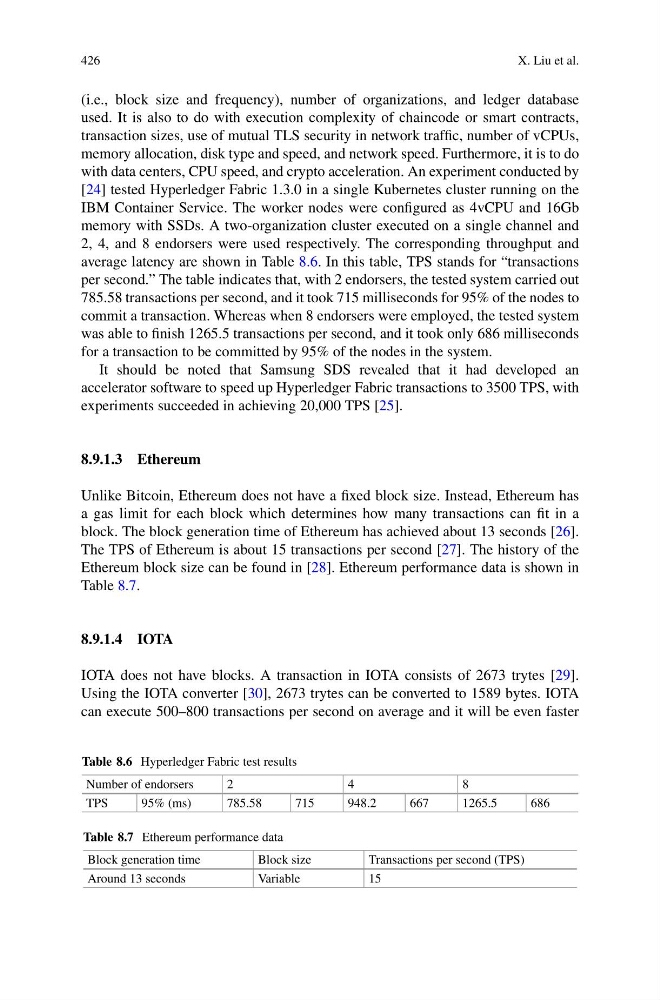
average latency are shown in Table 8.6. In this table, TPS stands for “transactions
per second.” The table indicates that, with 2 endorsers, the tested system carried out
785.58 transactions per second, and it took 715 milliseconds for 95% of the nodes to
commit a transaction. Whereas when 8 endorsers were employed, the tested system
was able to finish 1265.5 transactions per second, and it took only 686 milliseconds
for a transaction to be committed by 95% of the nodes in the system.
It should be noted that Samsung SDS revealed that it had developed an
accelerator software to speed up Hyperledger Fabric transactions to 3500 TPS, with
experiments succeeded in achieving 20,000 TPS [25].
8.9.1.3 Ethereum
Unlike Bitcoin, Ethereum does not have a fixed block size. Instead, Ethereum has
a gas limit for each block which determines how many transactions can fit in a
block. The block generation time of Ethereum has achieved about 13 seconds [26].
The TPS of Ethereum is about 15 transactions per second [27]. The history of the
Ethereum block size can be found in [28]. Ethereum performance data is shown in
Table 8.7.
8.9.1.4 IOTA
IOTA does not have blocks. A transaction in IOTA consists of 2673 trytes [29].
Using the IOTA converter [30], 2673 trytes can be converted to 1589 bytes. IOTA
can execute 500–800 transactions per second on average and it will be even faster
Table 8.6 Hyperledger Fabric test results
Number of endorsers
2
4
8
TPS
95% (ms)
785.58
715
948.2
667
1265.5
686
Table 8.7 Ethereum performance data
Block generation time
Block size
Transactions per second (TPS)
Around 13 seconds
Variable
15
X. Liu et al.
(i.e., block size and frequency), number of organizations, and ledger database
used. It is also to do with execution complexity of chaincode or smart contracts,
transaction sizes, use of mutual TLS security in network traffic, number of vCPUs,
memory allocation, disk type and speed, and network speed. Furthermore, it is to do
with data centers, CPU speed, and crypto acceleration. An experiment conducted by
[24] tested Hyperledger Fabric 1.3.0 in a single Kubernetes cluster running on the
IBM Container Service. The worker nodes were configured as 4vCPU and 16Gb
memory with SSDs. A two-organization cluster executed on a single channel and
2, 4, and 8 endorsers were used respectively. The corresponding throughput and
average latency are shown in Table 8.6. In this table, TPS stands for “transactions
per second.” The table indicates that, with 2 endorsers, the tested system carried out
785.58 transactions per second, and it took 715 milliseconds for 95% of the nodes to
commit a transaction. Whereas when 8 endorsers were employed, the tested system
was able to finish 1265.5 transactions per second, and it took only 686 milliseconds
for a transaction to be committed by 95% of the nodes in the system.
It should be noted that Samsung SDS revealed that it had developed an
accelerator software to speed up Hyperledger Fabric transactions to 3500 TPS, with
experiments succeeded in achieving 20,000 TPS [25].
8.9.1.3 Ethereum
Unlike Bitcoin, Ethereum does not have a fixed block size. Instead, Ethereum has
a gas limit for each block which determines how many transactions can fit in a
block. The block generation time of Ethereum has achieved about 13 seconds [26].
The TPS of Ethereum is about 15 transactions per second [27]. The history of the
Ethereum block size can be found in [28]. Ethereum performance data is shown in
Table 8.7.
8.9.1.4 IOTA
IOTA does not have blocks. A transaction in IOTA consists of 2673 trytes [29].
Using the IOTA converter [30], 2673 trytes can be converted to 1589 bytes. IOTA
can execute 500–800 transactions per second on average and it will be even faster
Table 8.6 Hyperledger Fabric test results
Number of endorsers
2
4
8
TPS
95% (ms)
785.58
715
948.2
667
1265.5
686
Table 8.7 Ethereum performance data
Block generation time
Block size
Transactions per second (TPS)
Around 13 seconds
Variable
15