

8 Distributed Ledger Technology
419
In Fig. 8.17, interactions between physical objects are not stored in the
blockchain. In this architecture, only IoT data are validated and only data records
are immutable. This is useful if IoT data are important for the application, but
interactions between physical objects are not critical. This architecture has less
latency, reduced bandwidth requirement for the communication network, and
reduced data flow on the network.
In addition, smart contracts can be employed in the blockchain to set up specific
requirements and agreements that govern data flow and usage, as well as monitor,
allow, or disallow interactions to occur.
8.7 Prominent Enterprise DLT Platforms
Although there are tens of DLT platforms introduced in the literature, so far at the
enterprise level, three of the platforms are most prominent. They are Hyperledger
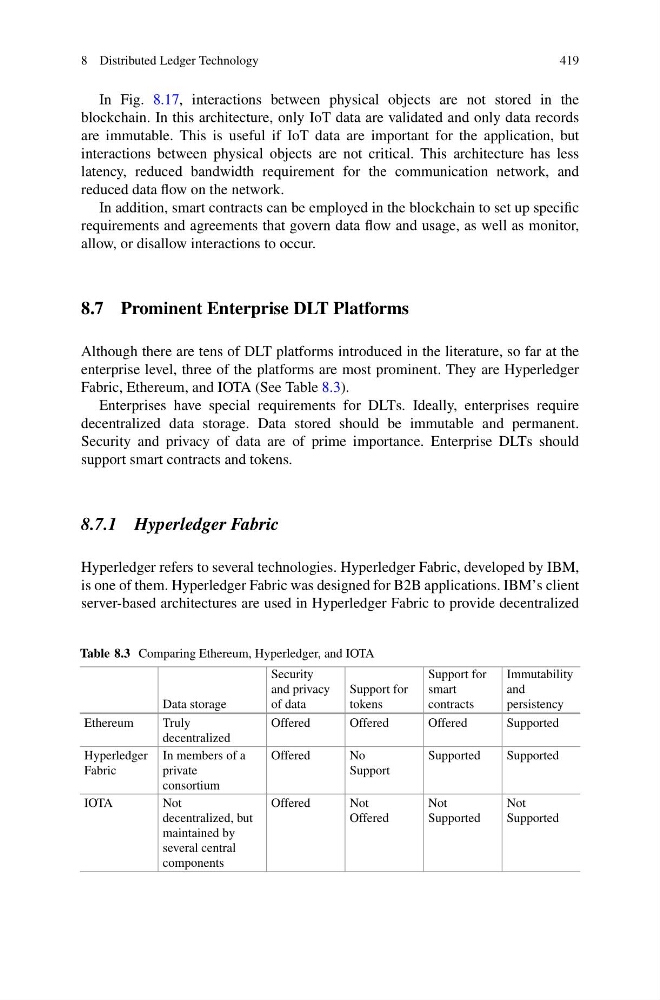
Fabric, Ethereum, and IOTA (See Table 8.3).
Enterprises have special requirements for DLTs. Ideally, enterprises require
decentralized data storage. Data stored should be immutable and permanent.
Security and privacy of data are of prime importance. Enterprise DLTs should
support smart contracts and tokens.
8.7.1 Hyperledger Fabric
Hyperledger refers to several technologies. Hyperledger Fabric, developed by IBM,
is one of them. Hyperledger Fabric was designed for B2B applications. IBM’s client
server-based architectures are used in Hyperledger Fabric to provide decentralized
Table 8.3 Comparing Ethereum, Hyperledger, and IOTA
Data storage
Security
and privacy
of data
Support for
tokens
Support for
smart
contracts
Immutability
and
persistency
Ethereum
Truly
decentralized
Offered
Offered
Offered
Supported
Hyperledger
Fabric
In members of a
private
consortium
Offered
No
Support
Supported
Supported
IOTA
Not
decentralized, but
maintained by
several central
components
Offered
Not
Offered
Not
Supported
Not
Supported
419
In Fig. 8.17, interactions between physical objects are not stored in the
blockchain. In this architecture, only IoT data are validated and only data records
are immutable. This is useful if IoT data are important for the application, but
interactions between physical objects are not critical. This architecture has less
latency, reduced bandwidth requirement for the communication network, and
reduced data flow on the network.
In addition, smart contracts can be employed in the blockchain to set up specific
requirements and agreements that govern data flow and usage, as well as monitor,
allow, or disallow interactions to occur.
8.7 Prominent Enterprise DLT Platforms
Although there are tens of DLT platforms introduced in the literature, so far at the
enterprise level, three of the platforms are most prominent. They are Hyperledger
Fabric, Ethereum, and IOTA (See Table 8.3).
Enterprises have special requirements for DLTs. Ideally, enterprises require
decentralized data storage. Data stored should be immutable and permanent.
Security and privacy of data are of prime importance. Enterprise DLTs should
support smart contracts and tokens.
8.7.1 Hyperledger Fabric
Hyperledger refers to several technologies. Hyperledger Fabric, developed by IBM,
is one of them. Hyperledger Fabric was designed for B2B applications. IBM’s client
server-based architectures are used in Hyperledger Fabric to provide decentralized
Table 8.3 Comparing Ethereum, Hyperledger, and IOTA
Data storage
Security
and privacy
of data
Support for
tokens
Support for
smart
contracts
Immutability
and
persistency
Ethereum
Truly
decentralized
Offered
Offered
Offered
Supported
Hyperledger
Fabric
In members of a
private
consortium
Offered
No
Support
Supported
Supported
IOTA
Not
decentralized, but
maintained by
several central
components
Offered
Not
Offered
Not
Supported
Not
Supported