

418
X. Liu et al.
With the support of blockchain technology, IoT systems will have the characteristics of decentralized resource management, robustness against threats and attacks,
fault tolerance, and improved trust.
8.6.4 How to Combine Blockchains and IoT
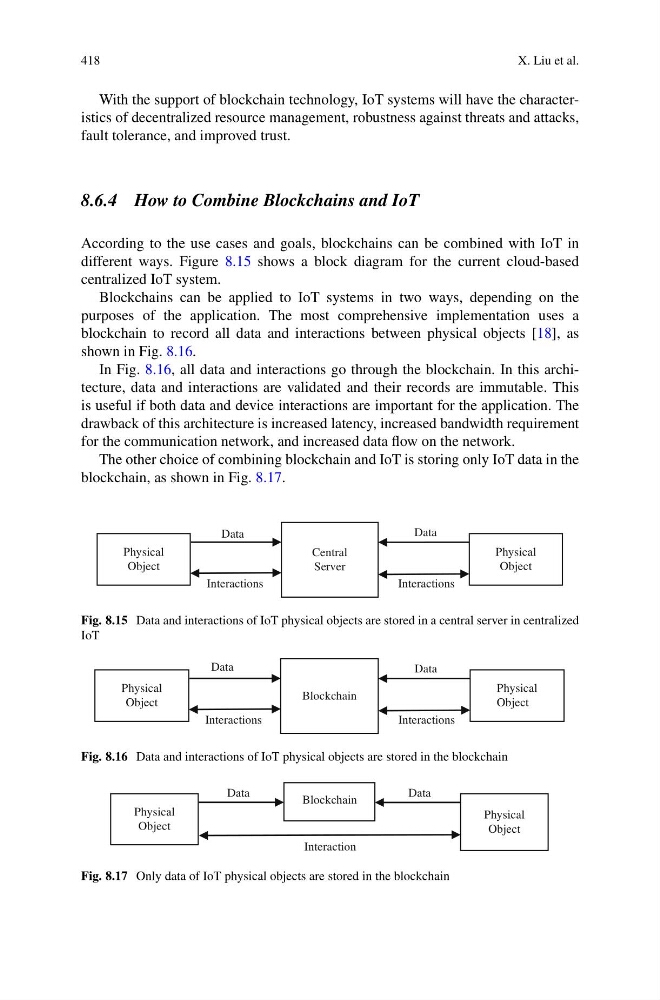
According to the use cases and goals, blockchains can be combined with IoT in
different ways. Figure 8.15 shows a block diagram for the current cloud-based
centralized IoT system.
Blockchains can be applied to IoT systems in two ways, depending on the
purposes of the application. The most comprehensive implementation uses a
blockchain to record all data and interactions between physical objects [18], as
shown in Fig. 8.16.
In Fig. 8.16, all data and interactions go through the blockchain. In this architecture, data and interactions are validated and their records are immutable. This
is useful if both data and device interactions are important for the application. The
drawback of this architecture is increased latency, increased bandwidth requirement
for the communication network, and increased data flow on the network.
The other choice of combining blockchain and IoT is storing only IoT data in the
blockchain, as shown in Fig. 8.17.
Interactions
Interactions
Data
Physical
Object
Central
Server
Physical
Object
Data
Fig. 8.15 Data and interactions of IoT physical objects are stored in a central server in centralized
IoT
Data
Interactions
Interactions
Physical
Object
Blockchain
Physical
Object
Data
Fig. 8.16 Data and interactions of IoT physical objects are stored in the blockchain
Interaction
Data
Data
Physical
Object
Blockchain
Physical
Object
Fig. 8.17 Only data of IoT physical objects are stored in the blockchain
X. Liu et al.
With the support of blockchain technology, IoT systems will have the characteristics of decentralized resource management, robustness against threats and attacks,
fault tolerance, and improved trust.
8.6.4 How to Combine Blockchains and IoT
According to the use cases and goals, blockchains can be combined with IoT in
different ways. Figure 8.15 shows a block diagram for the current cloud-based
centralized IoT system.
Blockchains can be applied to IoT systems in two ways, depending on the
purposes of the application. The most comprehensive implementation uses a
blockchain to record all data and interactions between physical objects [18], as
shown in Fig. 8.16.
In Fig. 8.16, all data and interactions go through the blockchain. In this architecture, data and interactions are validated and their records are immutable. This
is useful if both data and device interactions are important for the application. The
drawback of this architecture is increased latency, increased bandwidth requirement
for the communication network, and increased data flow on the network.
The other choice of combining blockchain and IoT is storing only IoT data in the
blockchain, as shown in Fig. 8.17.
Interactions
Interactions
Data
Physical
Object
Central
Server
Physical
Object
Data
Fig. 8.15 Data and interactions of IoT physical objects are stored in a central server in centralized
IoT
Data
Interactions
Interactions
Physical
Object
Blockchain
Physical
Object
Data
Fig. 8.16 Data and interactions of IoT physical objects are stored in the blockchain
Interaction
Data
Data
Physical
Object
Blockchain
Physical
Object
Fig. 8.17 Only data of IoT physical objects are stored in the blockchain