

364
W. Chang et al.
{i|C i runs on p}
L i ≤ 1.
Clearly, increasing the period of an application decreases its processor utilization
and thus potentially enables more applications to be integrated on the processor.
It is assumed that the set of available periods restricted by OSEK/VDX is φ.
As discussed in the introduction, a mixture of periods may achieve a better trade-off
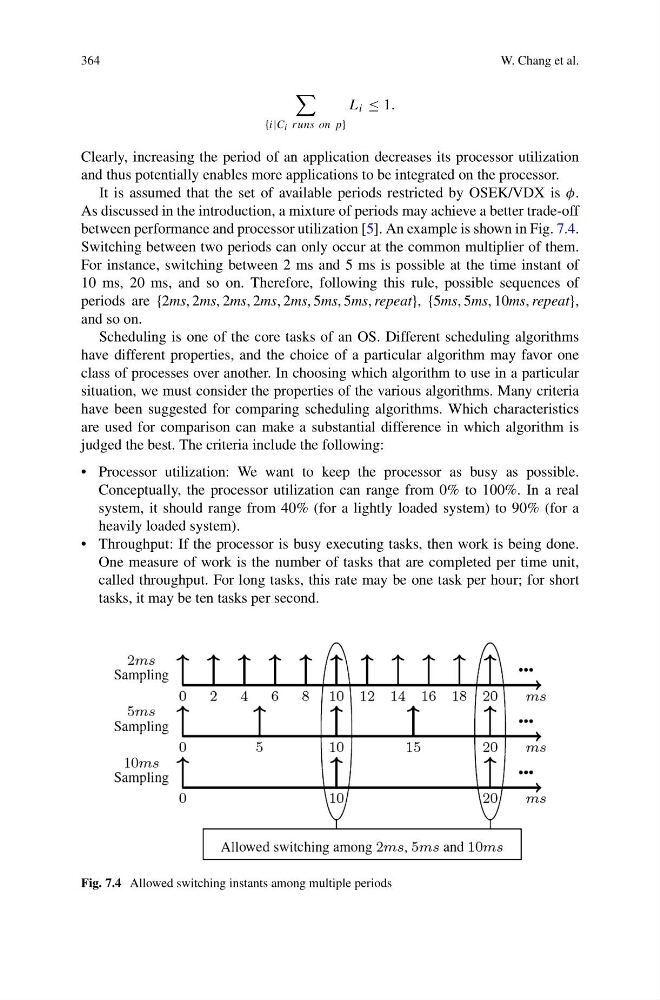
between performance and processor utilization [5]. An example is shown in Fig. 7.4.
Switching between two periods can only occur at the common multiplier of them.
For instance, switching between 2 ms and 5 ms is possible at the time instant of
10 ms, 20 ms, and so on. Therefore, following this rule, possible sequences of
periods are {2ms, 2ms, 2ms, 2ms, 2ms, 5ms, 5ms, repeat}, {5ms, 5ms, 10ms, repeat},
and so on.
Scheduling is one of the core tasks of an OS. Different scheduling algorithms
have different properties, and the choice of a particular algorithm may favor one
class of processes over another. In choosing which algorithm to use in a particular
situation, we must consider the properties of the various algorithms. Many criteria
have been suggested for comparing scheduling algorithms. Which characteristics
are used for comparison can make a substantial difference in which algorithm is
judged the best. The criteria include the following:
• Processor utilization: We want to keep the processor as busy as possible.
Conceptually, the processor utilization can range from 0% to 100%. In a real
system, it should range from 40% (for a lightly loaded system) to 90% (for a
heavily loaded system).
• Throughput: If the processor is busy executing tasks, then work is being done.
One measure of work is the number of tasks that are completed per time unit,
called throughput. For long tasks, this rate may be one task per hour; for short
tasks, it may be ten tasks per second.
Fig. 7.4 Allowed switching instants among multiple periods
W. Chang et al.
{i|C i runs on p}
L i ≤ 1.
Clearly, increasing the period of an application decreases its processor utilization
and thus potentially enables more applications to be integrated on the processor.
It is assumed that the set of available periods restricted by OSEK/VDX is φ.
As discussed in the introduction, a mixture of periods may achieve a better trade-off
between performance and processor utilization [5]. An example is shown in Fig. 7.4.
Switching between two periods can only occur at the common multiplier of them.
For instance, switching between 2 ms and 5 ms is possible at the time instant of
10 ms, 20 ms, and so on. Therefore, following this rule, possible sequences of
periods are {2ms, 2ms, 2ms, 2ms, 2ms, 5ms, 5ms, repeat}, {5ms, 5ms, 10ms, repeat},
and so on.
Scheduling is one of the core tasks of an OS. Different scheduling algorithms
have different properties, and the choice of a particular algorithm may favor one
class of processes over another. In choosing which algorithm to use in a particular
situation, we must consider the properties of the various algorithms. Many criteria
have been suggested for comparing scheduling algorithms. Which characteristics
are used for comparison can make a substantial difference in which algorithm is
judged the best. The criteria include the following:
• Processor utilization: We want to keep the processor as busy as possible.
Conceptually, the processor utilization can range from 0% to 100%. In a real
system, it should range from 40% (for a lightly loaded system) to 90% (for a
heavily loaded system).
• Throughput: If the processor is busy executing tasks, then work is being done.
One measure of work is the number of tasks that are completed per time unit,
called throughput. For long tasks, this rate may be one task per hour; for short
tasks, it may be ten tasks per second.
Fig. 7.4 Allowed switching instants among multiple periods