

7 Intelligent and Connected Cyber-Physical Systems: A Perspective. . .
363
application is assigned one. Different applications may have different periods. Every
time an application is released, its program gets the chance to be executed.
A timetable containing all the periodic release times within the alleged hyperperiod (i.e., the minimum common multiple of all periods) needs to be configured. An
example with a set of three periods 2 ms, 5 ms, and 10 ms is illustrated in Table 7.1.
The hyperperiod is equal to 10 ms and the timetable repeats itself every 10 ms by
resetting the timer. Independent of the triggering mode (i.e., be it ET or TT), the
assigned priority will still determine the execution order of applications. In the TT
scheme, a higher priority is typically assigned to the application released within a
shorter period, since this generally results in a more efficient use of the processor.
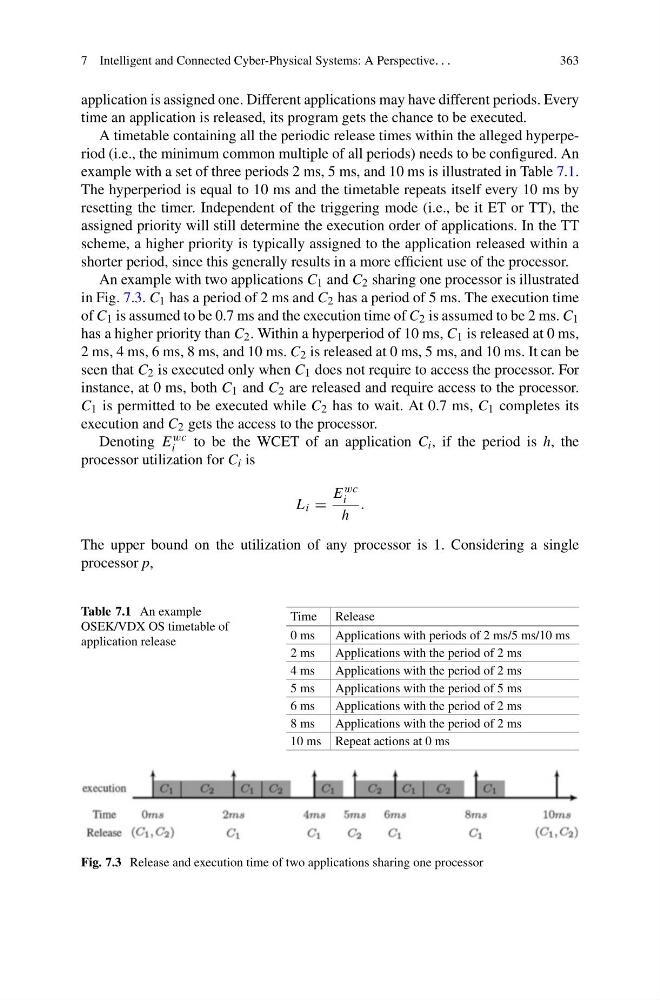
An example with two applications C 1 and C 2 sharing one processor is illustrated
in Fig. 7.3. C 1 has a period of 2 ms and C 2 has a period of 5 ms. The execution time
of C 1 is assumed to be 0.7 ms and the execution time of C 2 is assumed to be 2 ms. C 1
has a higher priority than C 2 . Within a hyperperiod of 10 ms, C 1 is released at 0 ms,
2 ms, 4 ms, 6 ms, 8 ms, and 10 ms. C 2 is released at 0 ms, 5 ms, and 10 ms. It can be
seen that C 2 is executed only when C 1 does not require to access the processor. For
instance, at 0 ms, both C 1 and C 2 are released and require access to the processor.
C 1 is permitted to be executed while C 2 has to wait. At 0.7 ms, C 1 completes its
execution and C 2 gets the access to the processor.
Denoting E wc
i
to be the WCET of an application C i , if the period is h, the
processor utilization for C i is
L i =
E wc
i
h
.
The upper bound on the utilization of any processor is 1. Considering a single
processor p,
Table 7.1 An example
OSEK/VDX OS timetable of
application release
Time Release
0 ms
Applications with periods of 2 ms/5 ms/10 ms
2 ms
Applications with the period of 2 ms
4 ms
Applications with the period of 2 ms
5 ms
Applications with the period of 5 ms
6 ms
Applications with the period of 2 ms
8 ms
Applications with the period of 2 ms
10 ms Repeat actions at 0 ms
Fig. 7.3 Release and execution time of two applications sharing one processor
363
application is assigned one. Different applications may have different periods. Every
time an application is released, its program gets the chance to be executed.
A timetable containing all the periodic release times within the alleged hyperperiod (i.e., the minimum common multiple of all periods) needs to be configured. An
example with a set of three periods 2 ms, 5 ms, and 10 ms is illustrated in Table 7.1.
The hyperperiod is equal to 10 ms and the timetable repeats itself every 10 ms by
resetting the timer. Independent of the triggering mode (i.e., be it ET or TT), the
assigned priority will still determine the execution order of applications. In the TT
scheme, a higher priority is typically assigned to the application released within a
shorter period, since this generally results in a more efficient use of the processor.
An example with two applications C 1 and C 2 sharing one processor is illustrated
in Fig. 7.3. C 1 has a period of 2 ms and C 2 has a period of 5 ms. The execution time
of C 1 is assumed to be 0.7 ms and the execution time of C 2 is assumed to be 2 ms. C 1
has a higher priority than C 2 . Within a hyperperiod of 10 ms, C 1 is released at 0 ms,
2 ms, 4 ms, 6 ms, 8 ms, and 10 ms. C 2 is released at 0 ms, 5 ms, and 10 ms. It can be
seen that C 2 is executed only when C 1 does not require to access the processor. For
instance, at 0 ms, both C 1 and C 2 are released and require access to the processor.
C 1 is permitted to be executed while C 2 has to wait. At 0.7 ms, C 1 completes its
execution and C 2 gets the access to the processor.
Denoting E wc
i
to be the WCET of an application C i , if the period is h, the
processor utilization for C i is
L i =
E wc
i
h
.
The upper bound on the utilization of any processor is 1. Considering a single
processor p,
Table 7.1 An example
OSEK/VDX OS timetable of
application release
Time Release
0 ms
Applications with periods of 2 ms/5 ms/10 ms
2 ms
Applications with the period of 2 ms
4 ms
Applications with the period of 2 ms
5 ms
Applications with the period of 5 ms
6 ms
Applications with the period of 2 ms
8 ms
Applications with the period of 2 ms
10 ms Repeat actions at 0 ms
Fig. 7.3 Release and execution time of two applications sharing one processor