

4 Architecting IoT Cloud
231
• Source IP Hash – A unique hash key is created using an algorithm that combines
destination and source IP addresses for the server and client. The key is then
used to send the client to a designated server. Because the key can be recreated if
a session is broken, the same client request will be sent to the same server it was
allocated to before the session was broken. This can be particularly important if
a client needs to connect to the same server after a disconnection.
• Layer 7 Content Switching (URL Rewriting) – This technique utilizes application
layer information to route/send incoming requests in real time to the most
appropriate server for processing.
• Software Defined Networking (SDN) Adaptive – In this approach, information
from layers 4 and 7 and information from layers 2 and 3 are combined to
determine how incoming requests should be apportioned and handled. This
holistic approach enables the load balancer to consider network congestion,
network infrastructure health, application status, and server status when making
decisions.
4.9 Orchestration Layer
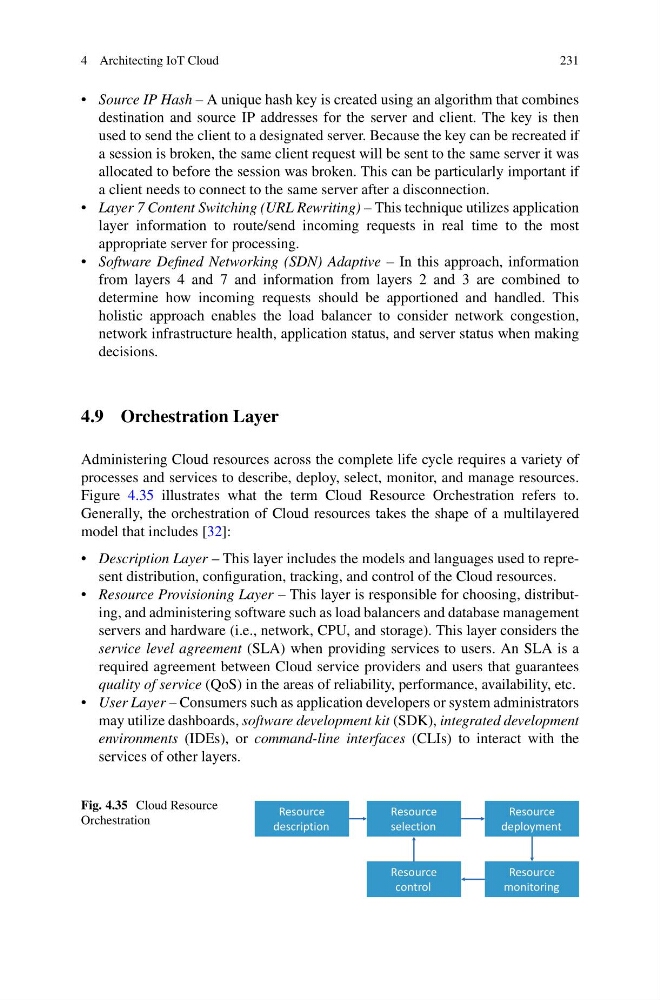
Administering Cloud resources across the complete life cycle requires a variety of
processes and services to describe, deploy, select, monitor, and manage resources.
Figure 4.35 illustrates what the term Cloud Resource Orchestration refers to.
Generally, the orchestration of Cloud resources takes the shape of a multilayered
model that includes [32]:
• Description Layer – This layer includes the models and languages used to represent distribution, configuration, tracking, and control of the Cloud resources.
• Resource Provisioning Layer – This layer is responsible for choosing, distributing, and administering software such as load balancers and database management
servers and hardware (i.e., network, CPU, and storage). This layer considers the
service level agreement (SLA) when providing services to users. An SLA is a
required agreement between Cloud service providers and users that guarantees
quality of service (QoS) in the areas of reliability, performance, availability, etc.
• User Layer – Consumers such as application developers or system administrators
may utilize dashboards, software development kit (SDK), integrated development
environments (IDEs), or command-line interfaces (CLIs) to interact with the
services of other layers.
Fig. 4.35 Cloud Resource
Orchestration
Resource
description
Resource
deployment
Resource
selection
Resource
monitoring
Resource
control
231
• Source IP Hash – A unique hash key is created using an algorithm that combines
destination and source IP addresses for the server and client. The key is then
used to send the client to a designated server. Because the key can be recreated if
a session is broken, the same client request will be sent to the same server it was
allocated to before the session was broken. This can be particularly important if
a client needs to connect to the same server after a disconnection.
• Layer 7 Content Switching (URL Rewriting) – This technique utilizes application
layer information to route/send incoming requests in real time to the most
appropriate server for processing.
• Software Defined Networking (SDN) Adaptive – In this approach, information
from layers 4 and 7 and information from layers 2 and 3 are combined to
determine how incoming requests should be apportioned and handled. This
holistic approach enables the load balancer to consider network congestion,
network infrastructure health, application status, and server status when making
decisions.
4.9 Orchestration Layer
Administering Cloud resources across the complete life cycle requires a variety of
processes and services to describe, deploy, select, monitor, and manage resources.
Figure 4.35 illustrates what the term Cloud Resource Orchestration refers to.
Generally, the orchestration of Cloud resources takes the shape of a multilayered
model that includes [32]:
• Description Layer – This layer includes the models and languages used to represent distribution, configuration, tracking, and control of the Cloud resources.
• Resource Provisioning Layer – This layer is responsible for choosing, distributing, and administering software such as load balancers and database management
servers and hardware (i.e., network, CPU, and storage). This layer considers the
service level agreement (SLA) when providing services to users. An SLA is a
required agreement between Cloud service providers and users that guarantees
quality of service (QoS) in the areas of reliability, performance, availability, etc.
• User Layer – Consumers such as application developers or system administrators
may utilize dashboards, software development kit (SDK), integrated development
environments (IDEs), or command-line interfaces (CLIs) to interact with the
services of other layers.
Fig. 4.35 Cloud Resource
Orchestration
Resource
description
Resource
deployment
Resource
selection
Resource
monitoring
Resource
control