

3 Engineering IoT Networks
157
Ver T
TKL
Code
Message ID
Token
Option
Payload Marker
Payload
0
8
16
24
32
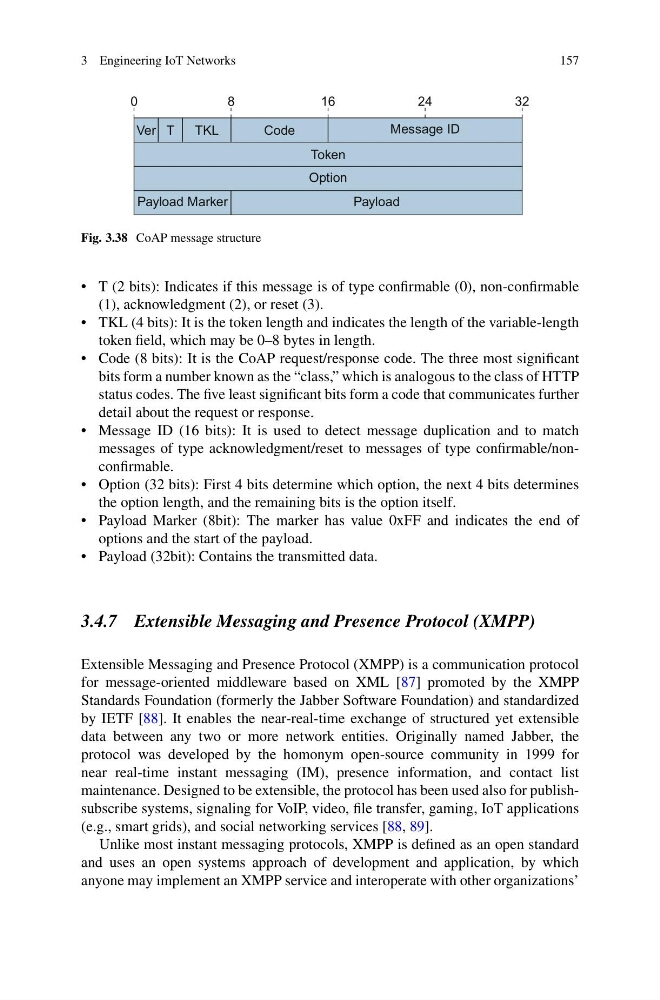
Fig. 3.38 CoAP message structure
• T (2 bits): Indicates if this message is of type confirmable (0), non-confirmable
(1), acknowledgment (2), or reset (3).
• TKL (4 bits): It is the token length and indicates the length of the variable-length
token field, which may be 0–8 bytes in length.
• Code (8 bits): It is the CoAP request/response code. The three most significant
bits form a number known as the “class,” which is analogous to the class of HTTP
status codes. The five least significant bits form a code that communicates further
detail about the request or response.
• Message ID (16 bits): It is used to detect message duplication and to match
messages of type acknowledgment/reset to messages of type confirmable/nonconfirmable.
• Option (32 bits): First 4 bits determine which option, the next 4 bits determines
the option length, and the remaining bits is the option itself.
• Payload Marker (8bit): The marker has value 0xFF and indicates the end of
options and the start of the payload.
• Payload (32bit): Contains the transmitted data.
3.4.7 Extensible Messaging and Presence Protocol (XMPP)
Extensible Messaging and Presence Protocol (XMPP) is a communication protocol
for message-oriented middleware based on XML [87] promoted by the XMPP
Standards Foundation (formerly the Jabber Software Foundation) and standardized
by IETF [88]. It enables the near-real-time exchange of structured yet extensible
data between any two or more network entities. Originally named Jabber, the
protocol was developed by the homonym open-source community in 1999 for
near real-time instant messaging (IM), presence information, and contact list
maintenance. Designed to be extensible, the protocol has been used also for publishsubscribe systems, signaling for VoIP, video, file transfer, gaming, IoT applications
(e.g., smart grids), and social networking services [88, 89].
Unlike most instant messaging protocols, XMPP is defined as an open standard
and uses an open systems approach of development and application, by which
anyone may implement an XMPP service and interoperate with other organizations’
157
Ver T
TKL
Code
Message ID
Token
Option
Payload Marker
Payload
0
8
16
24
32
Fig. 3.38 CoAP message structure
• T (2 bits): Indicates if this message is of type confirmable (0), non-confirmable
(1), acknowledgment (2), or reset (3).
• TKL (4 bits): It is the token length and indicates the length of the variable-length
token field, which may be 0–8 bytes in length.
• Code (8 bits): It is the CoAP request/response code. The three most significant
bits form a number known as the “class,” which is analogous to the class of HTTP
status codes. The five least significant bits form a code that communicates further
detail about the request or response.
• Message ID (16 bits): It is used to detect message duplication and to match
messages of type acknowledgment/reset to messages of type confirmable/nonconfirmable.
• Option (32 bits): First 4 bits determine which option, the next 4 bits determines
the option length, and the remaining bits is the option itself.
• Payload Marker (8bit): The marker has value 0xFF and indicates the end of
options and the start of the payload.
• Payload (32bit): Contains the transmitted data.
3.4.7 Extensible Messaging and Presence Protocol (XMPP)
Extensible Messaging and Presence Protocol (XMPP) is a communication protocol
for message-oriented middleware based on XML [87] promoted by the XMPP
Standards Foundation (formerly the Jabber Software Foundation) and standardized
by IETF [88]. It enables the near-real-time exchange of structured yet extensible
data between any two or more network entities. Originally named Jabber, the
protocol was developed by the homonym open-source community in 1999 for
near real-time instant messaging (IM), presence information, and contact list
maintenance. Designed to be extensible, the protocol has been used also for publishsubscribe systems, signaling for VoIP, video, file transfer, gaming, IoT applications
(e.g., smart grids), and social networking services [88, 89].
Unlike most instant messaging protocols, XMPP is defined as an open standard
and uses an open systems approach of development and application, by which
anyone may implement an XMPP service and interoperate with other organizations’