

3 Engineering IoT Networks
135
Table 3.4 Standard operation modes of Wireless M-Bus
Mode
Frequency (MHz)
Description
S (Stationary)
868
Meters that send data few times a day
T (Frequent transmit)
868
Meters that send data several times a day
C (Compact)
868
Higher data rate version of Mode T
N (Narrowband)
169
Long range, narrow band system
R (Frequent Receive)
868
Collector that reads multiple meters
on different frequency channels
F (Frequent Tx and Rx)
433
Frequent bi-directional communication
3.3.12 Wireless M-Bus
Wireless M-Bus or Wireless Meter-Bus is the European standard (EN 13757-4) that
specifies the communication between utility meters and data loggers, concentrators,
or smart meter gateways [46]. It was developed as the European standard for the
networking and remote reading of utility meters.
The Physical Layer derives from the Konnex industrial standard (KNX-RF) [47]
originally using frequency shift keying (FSK) modulation on 868 MHz unlicensed
frequency band with 25 mW max power. Then, several operation modes have been
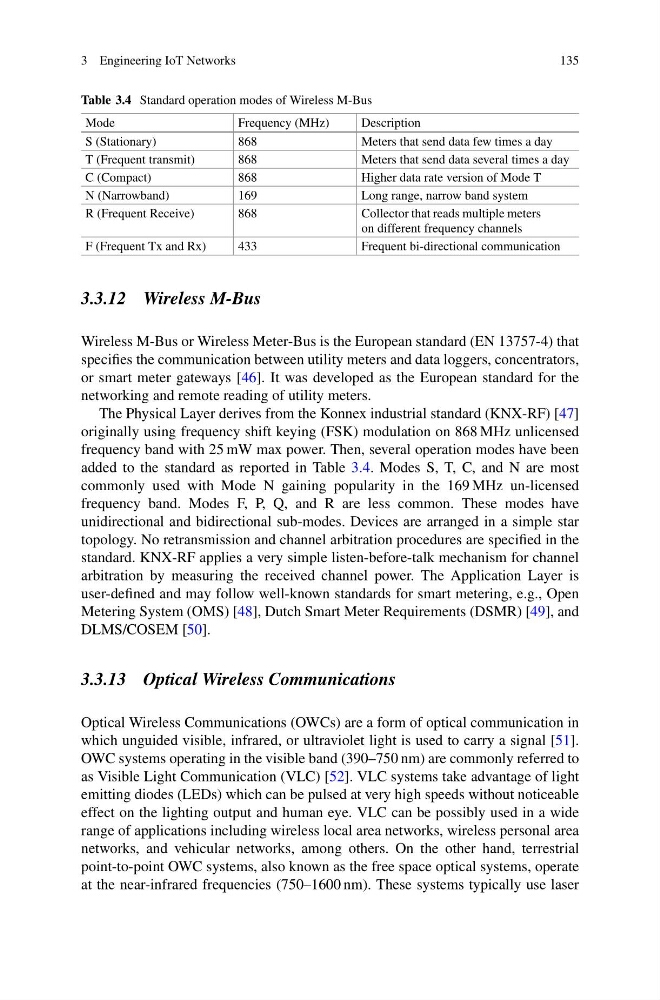
added to the standard as reported in Table 3.4. Modes S, T, C, and N are most
commonly used with Mode N gaining popularity in the 169 MHz un-licensed
frequency band. Modes F, P, Q, and R are less common. These modes have
unidirectional and bidirectional sub-modes. Devices are arranged in a simple star
topology. No retransmission and channel arbitration procedures are specified in the
standard. KNX-RF applies a very simple listen-before-talk mechanism for channel
arbitration by measuring the received channel power. The Application Layer is
user-defined and may follow well-known standards for smart metering, e.g., Open
Metering System (OMS) [48], Dutch Smart Meter Requirements (DSMR) [49], and
DLMS/COSEM [50].
3.3.13 Optical Wireless Communications
Optical Wireless Communications (OWCs) are a form of optical communication in
which unguided visible, infrared, or ultraviolet light is used to carry a signal [51].
OWC systems operating in the visible band (390–750 nm) are commonly referred to
as Visible Light Communication (VLC) [52]. VLC systems take advantage of light
emitting diodes (LEDs) which can be pulsed at very high speeds without noticeable
effect on the lighting output and human eye. VLC can be possibly used in a wide
range of applications including wireless local area networks, wireless personal area
networks, and vehicular networks, among others. On the other hand, terrestrial
point-to-point OWC systems, also known as the free space optical systems, operate
at the near-infrared frequencies (750–1600 nm). These systems typically use laser
135
Table 3.4 Standard operation modes of Wireless M-Bus
Mode
Frequency (MHz)
Description
S (Stationary)
868
Meters that send data few times a day
T (Frequent transmit)
868
Meters that send data several times a day
C (Compact)
868
Higher data rate version of Mode T
N (Narrowband)
169
Long range, narrow band system
R (Frequent Receive)
868
Collector that reads multiple meters
on different frequency channels
F (Frequent Tx and Rx)
433
Frequent bi-directional communication
3.3.12 Wireless M-Bus
Wireless M-Bus or Wireless Meter-Bus is the European standard (EN 13757-4) that
specifies the communication between utility meters and data loggers, concentrators,
or smart meter gateways [46]. It was developed as the European standard for the
networking and remote reading of utility meters.
The Physical Layer derives from the Konnex industrial standard (KNX-RF) [47]
originally using frequency shift keying (FSK) modulation on 868 MHz unlicensed
frequency band with 25 mW max power. Then, several operation modes have been
added to the standard as reported in Table 3.4. Modes S, T, C, and N are most
commonly used with Mode N gaining popularity in the 169 MHz un-licensed
frequency band. Modes F, P, Q, and R are less common. These modes have
unidirectional and bidirectional sub-modes. Devices are arranged in a simple star
topology. No retransmission and channel arbitration procedures are specified in the
standard. KNX-RF applies a very simple listen-before-talk mechanism for channel
arbitration by measuring the received channel power. The Application Layer is
user-defined and may follow well-known standards for smart metering, e.g., Open
Metering System (OMS) [48], Dutch Smart Meter Requirements (DSMR) [49], and
DLMS/COSEM [50].
3.3.13 Optical Wireless Communications
Optical Wireless Communications (OWCs) are a form of optical communication in
which unguided visible, infrared, or ultraviolet light is used to carry a signal [51].
OWC systems operating in the visible band (390–750 nm) are commonly referred to
as Visible Light Communication (VLC) [52]. VLC systems take advantage of light
emitting diodes (LEDs) which can be pulsed at very high speeds without noticeable
effect on the lighting output and human eye. VLC can be possibly used in a wide
range of applications including wireless local area networks, wireless personal area
networks, and vehicular networks, among others. On the other hand, terrestrial
point-to-point OWC systems, also known as the free space optical systems, operate
at the near-infrared frequencies (750–1600 nm). These systems typically use laser