

128
E. Fraccaroli and D. Quaglia
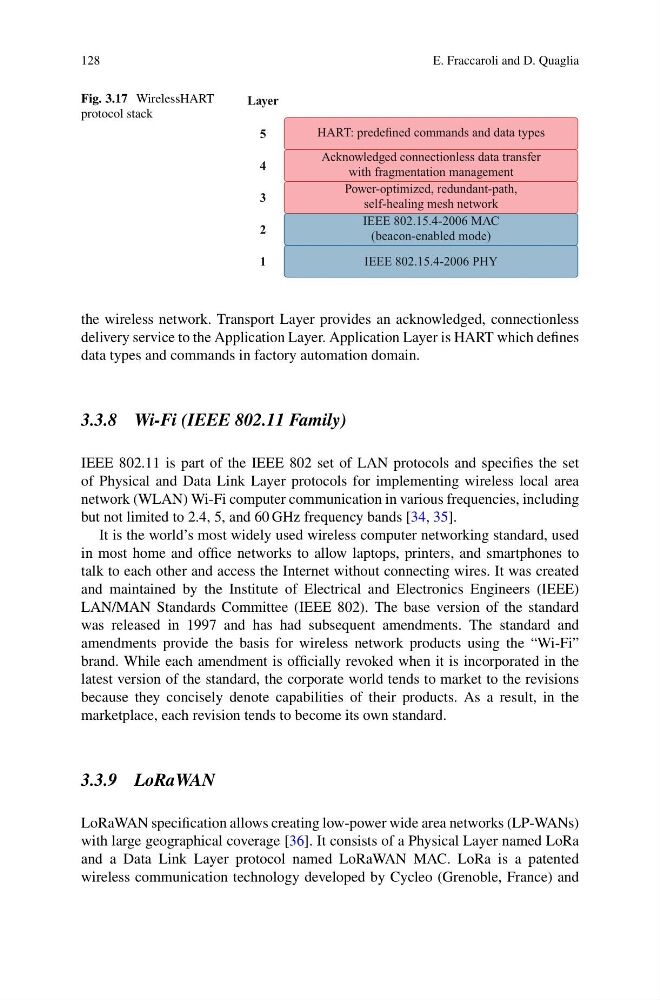
Fig. 3.17 WirelessHART
protocol stack
IEEE 802.15.4-2006 PHY
IEEE 802.15.4-2006 MAC
(beacon-enabled mode)
Power-optimized, redundant-path,
self-healing mesh network
Acknowledged connectionless data transfer
with fragmentation management
HART: predefined commands and data types
1
2
3
4
5
Layer
the wireless network. Transport Layer provides an acknowledged, connectionless
delivery service to the Application Layer. Application Layer is HART which defines
data types and commands in factory automation domain.
3.3.8 Wi-Fi (IEEE 802.11 Family)
IEEE 802.11 is part of the IEEE 802 set of LAN protocols and specifies the set
of Physical and Data Link Layer protocols for implementing wireless local area
network (WLAN) Wi-Fi computer communication in various frequencies, including
but not limited to 2.4, 5, and 60 GHz frequency bands [34, 35].
It is the world’s most widely used wireless computer networking standard, used
in most home and office networks to allow laptops, printers, and smartphones to
talk to each other and access the Internet without connecting wires. It was created
and maintained by the Institute of Electrical and Electronics Engineers (IEEE)
LAN/MAN Standards Committee (IEEE 802). The base version of the standard
was released in 1997 and has had subsequent amendments. The standard and
amendments provide the basis for wireless network products using the “Wi-Fi”
brand. While each amendment is officially revoked when it is incorporated in the
latest version of the standard, the corporate world tends to market to the revisions
because they concisely denote capabilities of their products. As a result, in the
marketplace, each revision tends to become its own standard.
3.3.9 LoRaWAN
LoRaWAN specification allows creating low-power wide area networks (LP-WANs)
with large geographical coverage [36]. It consists of a Physical Layer named LoRa
and a Data Link Layer protocol named LoRaWAN MAC. LoRa is a patented
wireless communication technology developed by Cycleo (Grenoble, France) and
E. Fraccaroli and D. Quaglia
Fig. 3.17 WirelessHART
protocol stack
IEEE 802.15.4-2006 PHY
IEEE 802.15.4-2006 MAC
(beacon-enabled mode)
Power-optimized, redundant-path,
self-healing mesh network
Acknowledged connectionless data transfer
with fragmentation management
HART: predefined commands and data types
1
2
3
4
5
Layer
the wireless network. Transport Layer provides an acknowledged, connectionless
delivery service to the Application Layer. Application Layer is HART which defines
data types and commands in factory automation domain.
3.3.8 Wi-Fi (IEEE 802.11 Family)
IEEE 802.11 is part of the IEEE 802 set of LAN protocols and specifies the set
of Physical and Data Link Layer protocols for implementing wireless local area
network (WLAN) Wi-Fi computer communication in various frequencies, including
but not limited to 2.4, 5, and 60 GHz frequency bands [34, 35].
It is the world’s most widely used wireless computer networking standard, used
in most home and office networks to allow laptops, printers, and smartphones to
talk to each other and access the Internet without connecting wires. It was created
and maintained by the Institute of Electrical and Electronics Engineers (IEEE)
LAN/MAN Standards Committee (IEEE 802). The base version of the standard
was released in 1997 and has had subsequent amendments. The standard and
amendments provide the basis for wireless network products using the “Wi-Fi”
brand. While each amendment is officially revoked when it is incorporated in the
latest version of the standard, the corporate world tends to market to the revisions
because they concisely denote capabilities of their products. As a result, in the
marketplace, each revision tends to become its own standard.
3.3.9 LoRaWAN
LoRaWAN specification allows creating low-power wide area networks (LP-WANs)
with large geographical coverage [36]. It consists of a Physical Layer named LoRa
and a Data Link Layer protocol named LoRaWAN MAC. LoRa is a patented
wireless communication technology developed by Cycleo (Grenoble, France) and