

3 Engineering IoT Networks
123
PAN
Coordinator
End
Device
PAN
Coordinator
End
Device
Data
Acknowledgment
(if requested)
Data Request
Acknowledgment
Data
Acknowledgment
a
b
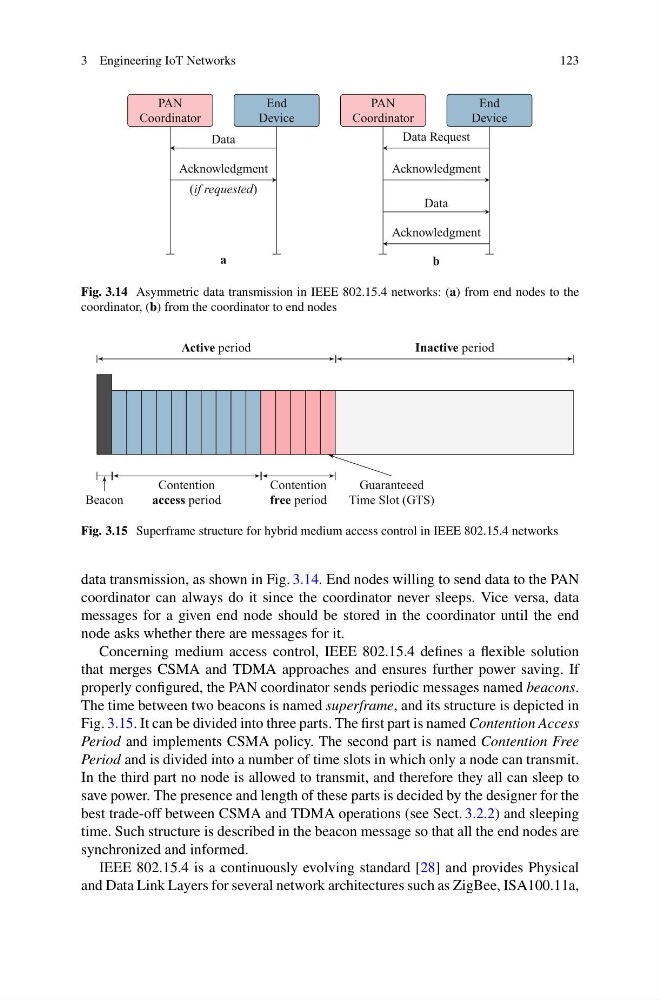
Fig. 3.14 Asymmetric data transmission in IEEE 802.15.4 networks: (a) from end nodes to the
coordinator, (b) from the coordinator to end nodes
Beacon
Active period
Inactive period
Contention
access period
Contention
free period
Guaranteeed
Time Slot (GTS)
Fig. 3.15 Superframe structure for hybrid medium access control in IEEE 802.15.4 networks
data transmission, as shown in Fig. 3.14. End nodes willing to send data to the PAN
coordinator can always do it since the coordinator never sleeps. Vice versa, data
messages for a given end node should be stored in the coordinator until the end
node asks whether there are messages for it.
Concerning medium access control, IEEE 802.15.4 defines a flexible solution
that merges CSMA and TDMA approaches and ensures further power saving. If
properly configured, the PAN coordinator sends periodic messages named beacons.
The time between two beacons is named superframe, and its structure is depicted in
Fig. 3.15. It can be divided into three parts. The first part is named Contention Access
Period and implements CSMA policy. The second part is named Contention Free
Period and is divided into a number of time slots in which only a node can transmit.
In the third part no node is allowed to transmit, and therefore they all can sleep to
save power. The presence and length of these parts is decided by the designer for the
best trade-off between CSMA and TDMA operations (see Sect. 3.2.2) and sleeping
time. Such structure is described in the beacon message so that all the end nodes are
synchronized and informed.
IEEE 802.15.4 is a continuously evolving standard [28] and provides Physical
and Data Link Layers for several network architectures such as ZigBee, ISA100.11a,
123
PAN
Coordinator
End
Device
PAN
Coordinator
End
Device
Data
Acknowledgment
(if requested)
Data Request
Acknowledgment
Data
Acknowledgment
a
b
Fig. 3.14 Asymmetric data transmission in IEEE 802.15.4 networks: (a) from end nodes to the
coordinator, (b) from the coordinator to end nodes
Beacon
Active period
Inactive period
Contention
access period
Contention
free period
Guaranteeed
Time Slot (GTS)
Fig. 3.15 Superframe structure for hybrid medium access control in IEEE 802.15.4 networks
data transmission, as shown in Fig. 3.14. End nodes willing to send data to the PAN
coordinator can always do it since the coordinator never sleeps. Vice versa, data
messages for a given end node should be stored in the coordinator until the end
node asks whether there are messages for it.
Concerning medium access control, IEEE 802.15.4 defines a flexible solution
that merges CSMA and TDMA approaches and ensures further power saving. If
properly configured, the PAN coordinator sends periodic messages named beacons.
The time between two beacons is named superframe, and its structure is depicted in
Fig. 3.15. It can be divided into three parts. The first part is named Contention Access
Period and implements CSMA policy. The second part is named Contention Free
Period and is divided into a number of time slots in which only a node can transmit.
In the third part no node is allowed to transmit, and therefore they all can sleep to
save power. The presence and length of these parts is decided by the designer for the
best trade-off between CSMA and TDMA operations (see Sect. 3.2.2) and sleeping
time. Such structure is described in the beacon message so that all the end nodes are
synchronized and informed.
IEEE 802.15.4 is a continuously evolving standard [28] and provides Physical
and Data Link Layers for several network architectures such as ZigBee, ISA100.11a,