

122
E. Fraccaroli and D. Quaglia
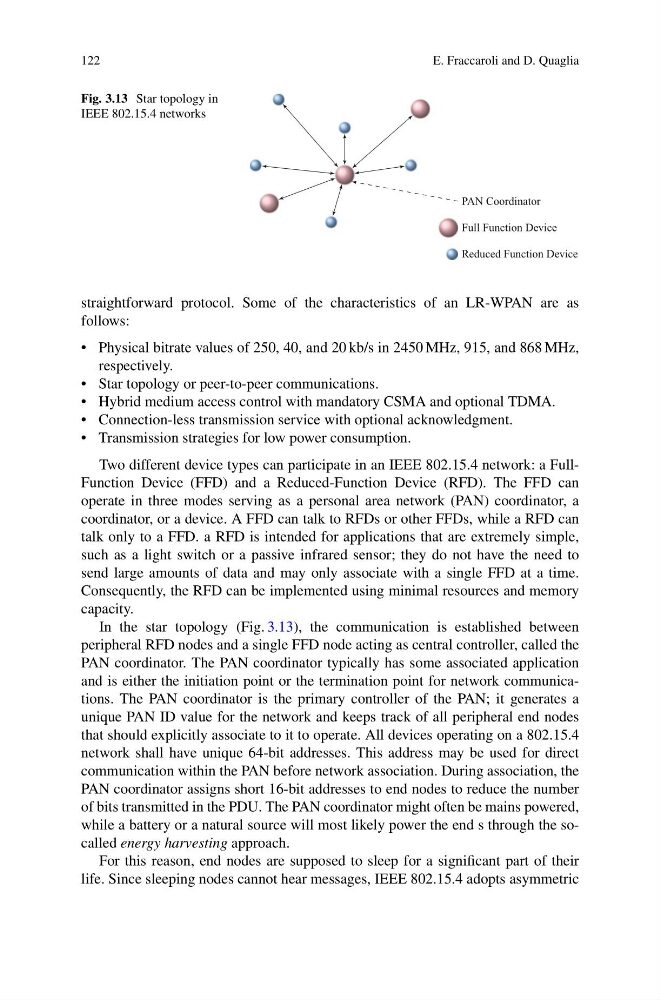
Fig. 3.13 Star topology in
IEEE 802.15.4 networks
PAN Coordinator
Full Function Device
Reduced Function Device
straightforward protocol. Some of the characteristics of an LR-WPAN are as
follows:
• Physical bitrate values of 250, 40, and 20 kb/s in 2450 MHz, 915, and 868 MHz,
respectively.
• Star topology or peer-to-peer communications.
• Hybrid medium access control with mandatory CSMA and optional TDMA.
• Connection-less transmission service with optional acknowledgment.
• Transmission strategies for low power consumption.
Two different device types can participate in an IEEE 802.15.4 network: a FullFunction Device (FFD) and a Reduced-Function Device (RFD). The FFD can
operate in three modes serving as a personal area network (PAN) coordinator, a
coordinator, or a device. A FFD can talk to RFDs or other FFDs, while a RFD can
talk only to a FFD. a RFD is intended for applications that are extremely simple,
such as a light switch or a passive infrared sensor; they do not have the need to
send large amounts of data and may only associate with a single FFD at a time.
Consequently, the RFD can be implemented using minimal resources and memory
capacity.
In the star topology (Fig. 3.13), the communication is established between
peripheral RFD nodes and a single FFD node acting as central controller, called the
PAN coordinator. The PAN coordinator typically has some associated application
and is either the initiation point or the termination point for network communications. The PAN coordinator is the primary controller of the PAN; it generates a
unique PAN ID value for the network and keeps track of all peripheral end nodes
that should explicitly associate to it to operate. All devices operating on a 802.15.4
network shall have unique 64-bit addresses. This address may be used for direct
communication within the PAN before network association. During association, the
PAN coordinator assigns short 16-bit addresses to end nodes to reduce the number
of bits transmitted in the PDU. The PAN coordinator might often be mains powered,
while a battery or a natural source will most likely power the end s through the socalled energy harvesting approach.
For this reason, end nodes are supposed to sleep for a significant part of their
life. Since sleeping nodes cannot hear messages, IEEE 802.15.4 adopts asymmetric
E. Fraccaroli and D. Quaglia
Fig. 3.13 Star topology in
IEEE 802.15.4 networks
PAN Coordinator
Full Function Device
Reduced Function Device
straightforward protocol. Some of the characteristics of an LR-WPAN are as
follows:
• Physical bitrate values of 250, 40, and 20 kb/s in 2450 MHz, 915, and 868 MHz,
respectively.
• Star topology or peer-to-peer communications.
• Hybrid medium access control with mandatory CSMA and optional TDMA.
• Connection-less transmission service with optional acknowledgment.
• Transmission strategies for low power consumption.
Two different device types can participate in an IEEE 802.15.4 network: a FullFunction Device (FFD) and a Reduced-Function Device (RFD). The FFD can
operate in three modes serving as a personal area network (PAN) coordinator, a
coordinator, or a device. A FFD can talk to RFDs or other FFDs, while a RFD can
talk only to a FFD. a RFD is intended for applications that are extremely simple,
such as a light switch or a passive infrared sensor; they do not have the need to
send large amounts of data and may only associate with a single FFD at a time.
Consequently, the RFD can be implemented using minimal resources and memory
capacity.
In the star topology (Fig. 3.13), the communication is established between
peripheral RFD nodes and a single FFD node acting as central controller, called the
PAN coordinator. The PAN coordinator typically has some associated application
and is either the initiation point or the termination point for network communications. The PAN coordinator is the primary controller of the PAN; it generates a
unique PAN ID value for the network and keeps track of all peripheral end nodes
that should explicitly associate to it to operate. All devices operating on a 802.15.4
network shall have unique 64-bit addresses. This address may be used for direct
communication within the PAN before network association. During association, the
PAN coordinator assigns short 16-bit addresses to end nodes to reduce the number
of bits transmitted in the PDU. The PAN coordinator might often be mains powered,
while a battery or a natural source will most likely power the end s through the socalled energy harvesting approach.
For this reason, end nodes are supposed to sleep for a significant part of their
life. Since sleeping nodes cannot hear messages, IEEE 802.15.4 adopts asymmetric