

118
E. Fraccaroli and D. Quaglia
M
M/S
S/S
M
S
S
S
S
S
S
S
Piconet 3
Piconet 1
Piconet 2
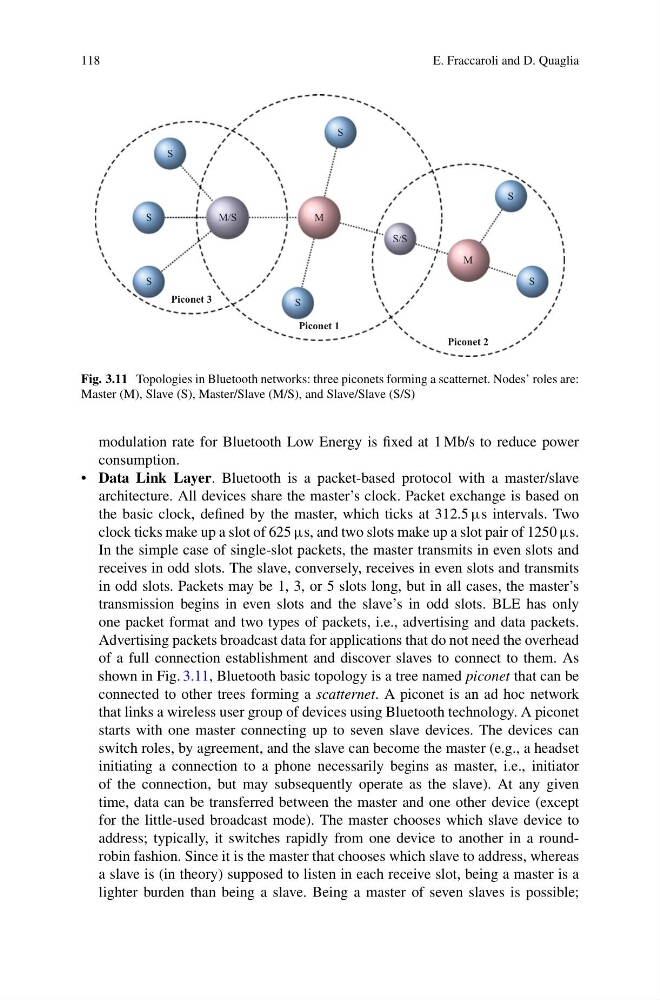
Fig. 3.11 Topologies in Bluetooth networks: three piconets forming a scatternet. Nodes’ roles are:
Master (M), Slave (S), Master/Slave (M/S), and Slave/Slave (S/S)
modulation rate for Bluetooth Low Energy is fixed at 1 Mb/s to reduce power
consumption.
• Data Link Layer. Bluetooth is a packet-based protocol with a master/slave
architecture. All devices share the master’s clock. Packet exchange is based on
the basic clock, defined by the master, which ticks at 312.5 μs intervals. Two
clock ticks make up a slot of 625 μs, and two slots make up a slot pair of 1250 μs.
In the simple case of single-slot packets, the master transmits in even slots and
receives in odd slots. The slave, conversely, receives in even slots and transmits
in odd slots. Packets may be 1, 3, or 5 slots long, but in all cases, the master’s
transmission begins in even slots and the slave’s in odd slots. BLE has only
one packet format and two types of packets, i.e., advertising and data packets.
Advertising packets broadcast data for applications that do not need the overhead
of a full connection establishment and discover slaves to connect to them. As
shown in Fig. 3.11, Bluetooth basic topology is a tree named piconet that can be
connected to other trees forming a scatternet. A piconet is an ad hoc network
that links a wireless user group of devices using Bluetooth technology. A piconet
starts with one master connecting up to seven slave devices. The devices can
switch roles, by agreement, and the slave can become the master (e.g., a headset
initiating a connection to a phone necessarily begins as master, i.e., initiator
of the connection, but may subsequently operate as the slave). At any given
time, data can be transferred between the master and one other device (except
for the little-used broadcast mode). The master chooses which slave device to
address; typically, it switches rapidly from one device to another in a roundrobin fashion. Since it is the master that chooses which slave to address, whereas
a slave is (in theory) supposed to listen in each receive slot, being a master is a
lighter burden than being a slave. Being a master of seven slaves is possible;
E. Fraccaroli and D. Quaglia
M
M/S
S/S
M
S
S
S
S
S
S
S
Piconet 3
Piconet 1
Piconet 2
Fig. 3.11 Topologies in Bluetooth networks: three piconets forming a scatternet. Nodes’ roles are:
Master (M), Slave (S), Master/Slave (M/S), and Slave/Slave (S/S)
modulation rate for Bluetooth Low Energy is fixed at 1 Mb/s to reduce power
consumption.
• Data Link Layer. Bluetooth is a packet-based protocol with a master/slave
architecture. All devices share the master’s clock. Packet exchange is based on
the basic clock, defined by the master, which ticks at 312.5 μs intervals. Two
clock ticks make up a slot of 625 μs, and two slots make up a slot pair of 1250 μs.
In the simple case of single-slot packets, the master transmits in even slots and
receives in odd slots. The slave, conversely, receives in even slots and transmits
in odd slots. Packets may be 1, 3, or 5 slots long, but in all cases, the master’s
transmission begins in even slots and the slave’s in odd slots. BLE has only
one packet format and two types of packets, i.e., advertising and data packets.
Advertising packets broadcast data for applications that do not need the overhead
of a full connection establishment and discover slaves to connect to them. As
shown in Fig. 3.11, Bluetooth basic topology is a tree named piconet that can be
connected to other trees forming a scatternet. A piconet is an ad hoc network
that links a wireless user group of devices using Bluetooth technology. A piconet
starts with one master connecting up to seven slave devices. The devices can
switch roles, by agreement, and the slave can become the master (e.g., a headset
initiating a connection to a phone necessarily begins as master, i.e., initiator
of the connection, but may subsequently operate as the slave). At any given
time, data can be transferred between the master and one other device (except
for the little-used broadcast mode). The master chooses which slave device to
address; typically, it switches rapidly from one device to another in a roundrobin fashion. Since it is the master that chooses which slave to address, whereas
a slave is (in theory) supposed to listen in each receive slot, being a master is a
lighter burden than being a slave. Being a master of seven slaves is possible;