

2 Ultrafast Laser Enabling Versatile Fabrication of Surface …
79
2.2.2 Micro-nano Structures on Metal Surfaces
for Antireflection
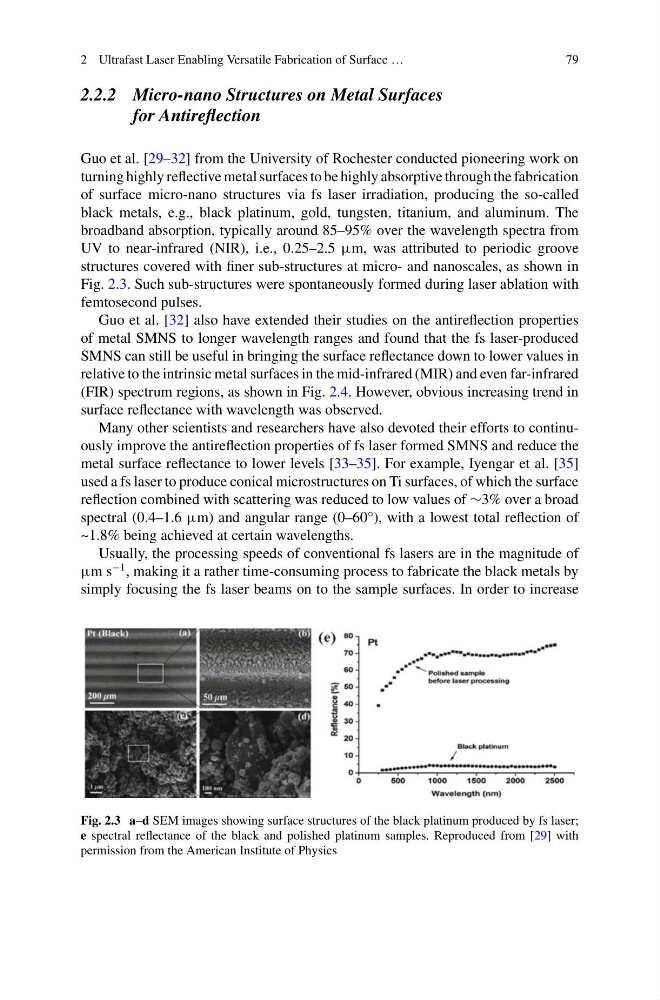
Guo et al. [29–32] from the University of Rochester conducted pioneering work on
turning highly reflective metal surfaces to be highly absorptive through the fabrication
of surface micro-nano structures via fs laser irradiation, producing the so-called
black metals, e.g., black platinum, gold, tungsten, titanium, and aluminum. The
broadband absorption, typically around 85–95% over the wavelength spectra from
UV to near-infrared (NIR), i.e., 0.25–2.5 µm, was attributed to periodic groove
structures covered with finer sub-structures at micro- and nanoscales, as shown in
Fig. 2.3. Such sub-structures were spontaneously formed during laser ablation with
femtosecond pulses.
Guo et al. [32] also have extended their studies on the antireflection properties
of metal SMNS to longer wavelength ranges and found that the fs laser-produced
SMNS can still be useful in bringing the surface reflectance down to lower values in
relative to the intrinsic metal surfaces in the mid-infrared (MIR) and even far-infrared
(FIR) spectrum regions, as shown in Fig. 2.4. However, obvious increasing trend in
surface reflectance with wavelength was observed.
Many other scientists and researchers have also devoted their efforts to continuously improve the antireflection properties of fs laser formed SMNS and reduce the
metal surface reflectance to lower levels [33–35]. For example, Iyengar et al. [35]
used a fs laser to produce conical microstructures on Ti surfaces, of which the surface
reflection combined with scattering was reduced to low values of ∼3% over a broad
spectral (0.4–1.6 µm) and angular range (0–60°), with a lowest total reflection of
~1.8% being achieved at certain wavelengths.
Usually, the processing speeds of conventional fs lasers are in the magnitude of
µm s
−1 , making it a rather time-consuming process to fabricate the black metals by
simply focusing the fs laser beams on to the sample surfaces. In order to increase
Fig. 2.3 a–d SEM images showing surface structures of the black platinum produced by fs laser;
e spectral reflectance of the black and polished platinum samples. Reproduced from [29] with
permission from the American Institute of Physics
79
2.2.2 Micro-nano Structures on Metal Surfaces
for Antireflection
Guo et al. [29–32] from the University of Rochester conducted pioneering work on
turning highly reflective metal surfaces to be highly absorptive through the fabrication
of surface micro-nano structures via fs laser irradiation, producing the so-called
black metals, e.g., black platinum, gold, tungsten, titanium, and aluminum. The
broadband absorption, typically around 85–95% over the wavelength spectra from
UV to near-infrared (NIR), i.e., 0.25–2.5 µm, was attributed to periodic groove
structures covered with finer sub-structures at micro- and nanoscales, as shown in
Fig. 2.3. Such sub-structures were spontaneously formed during laser ablation with
femtosecond pulses.
Guo et al. [32] also have extended their studies on the antireflection properties
of metal SMNS to longer wavelength ranges and found that the fs laser-produced
SMNS can still be useful in bringing the surface reflectance down to lower values in
relative to the intrinsic metal surfaces in the mid-infrared (MIR) and even far-infrared
(FIR) spectrum regions, as shown in Fig. 2.4. However, obvious increasing trend in
surface reflectance with wavelength was observed.
Many other scientists and researchers have also devoted their efforts to continuously improve the antireflection properties of fs laser formed SMNS and reduce the
metal surface reflectance to lower levels [33–35]. For example, Iyengar et al. [35]
used a fs laser to produce conical microstructures on Ti surfaces, of which the surface
reflection combined with scattering was reduced to low values of ∼3% over a broad
spectral (0.4–1.6 µm) and angular range (0–60°), with a lowest total reflection of
~1.8% being achieved at certain wavelengths.
Usually, the processing speeds of conventional fs lasers are in the magnitude of
µm s
−1 , making it a rather time-consuming process to fabricate the black metals by
simply focusing the fs laser beams on to the sample surfaces. In order to increase
Fig. 2.3 a–d SEM images showing surface structures of the black platinum produced by fs laser;
e spectral reflectance of the black and polished platinum samples. Reproduced from [29] with
permission from the American Institute of Physics