

2 Ultrafast Laser Enabling Versatile Fabrication of Surface …
77
of ultraviolet (UV) to infrared have been used in the fabrication of SMNS [15–17].
Laser-assisted surface micro-nano structuring has been increasingly investigated,
aiming at the tailoring of surface functionality of variety of materials [18–20], etc.
In comparison with the continuous wave and long pulse (ns ~ ms) lasers, ultrafast
lasers with pulse duration in the timescale of ps and fs ranges can induce a unique cold
processing effect, based on which the heat affect zone on processed materials can
be greatly reduced [21]. Attributing to this advantage, higher processing precision
down to the sub-microscale can be realized, and thus, fabrication of SMNS can be
conducted in a more controllable manner. The research on ultrafast laser can date
back to the 1980s. In the early stage, the mainstream ultrafast lasers are those with
narrow pulse durations in the range of 50–150 fs. However, the pulse repetition
rates as well as laser power of such kinds of ultrafast lasers are usually limited,
making them mainly suitable for fundamental research. Over the nearly past decade,
high repetition rate (up to MHz) and high power (up to 10
2 –10
3 W) ultrafast lasers
keep emerging out, which can fabricate the SMNS in a greatly increase processing
efficiency. Although the pulse durations of these kinds of ultrafast lasers are not so
narrow as the former types, they can indeed provide not only scientific instruments
for fundamental physical and chemical research, but also industrial tools for practical
engineering applications.
In recent years, based on these new generation high repetition rate high power
ultrafast lasers, we paid special research efforts on developing laser-assisted new
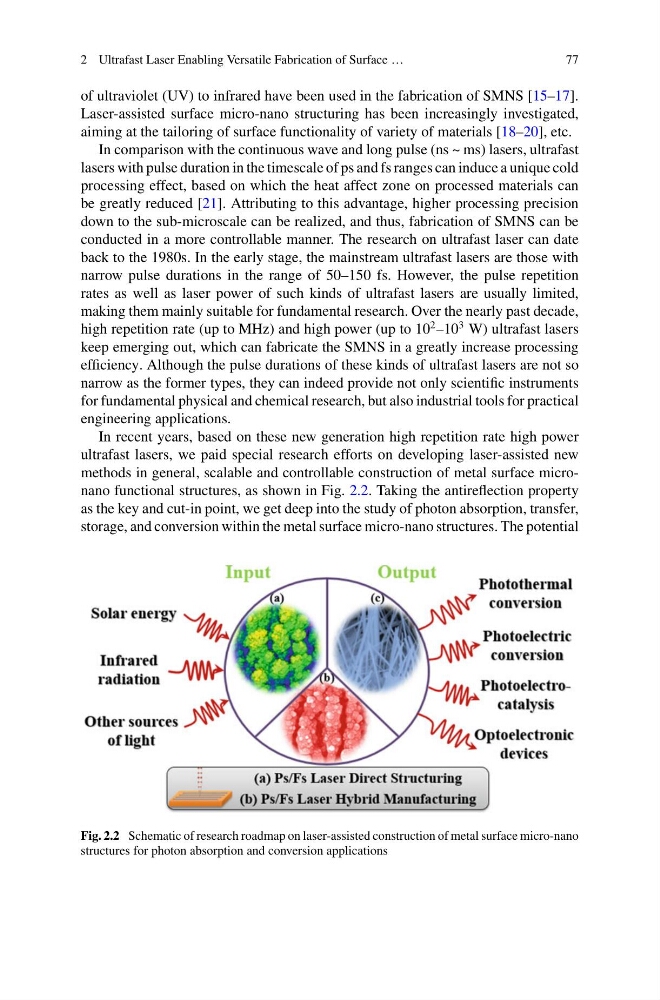
methods in general, scalable and controllable construction of metal surface micronano functional structures, as shown in Fig. 2.2. Taking the antireflection property
as the key and cut-in point, we get deep into the study of photon absorption, transfer,
storage, and conversion within the metal surface micro-nano structures. The potential
Fig. 2.2 Schematic of research roadmap on laser-assisted construction of metal surface micro-nano
structures for photon absorption and conversion applications
77
of ultraviolet (UV) to infrared have been used in the fabrication of SMNS [15–17].
Laser-assisted surface micro-nano structuring has been increasingly investigated,
aiming at the tailoring of surface functionality of variety of materials [18–20], etc.
In comparison with the continuous wave and long pulse (ns ~ ms) lasers, ultrafast
lasers with pulse duration in the timescale of ps and fs ranges can induce a unique cold
processing effect, based on which the heat affect zone on processed materials can
be greatly reduced [21]. Attributing to this advantage, higher processing precision
down to the sub-microscale can be realized, and thus, fabrication of SMNS can be
conducted in a more controllable manner. The research on ultrafast laser can date
back to the 1980s. In the early stage, the mainstream ultrafast lasers are those with
narrow pulse durations in the range of 50–150 fs. However, the pulse repetition
rates as well as laser power of such kinds of ultrafast lasers are usually limited,
making them mainly suitable for fundamental research. Over the nearly past decade,
high repetition rate (up to MHz) and high power (up to 10
2 –10
3 W) ultrafast lasers
keep emerging out, which can fabricate the SMNS in a greatly increase processing
efficiency. Although the pulse durations of these kinds of ultrafast lasers are not so
narrow as the former types, they can indeed provide not only scientific instruments
for fundamental physical and chemical research, but also industrial tools for practical
engineering applications.
In recent years, based on these new generation high repetition rate high power
ultrafast lasers, we paid special research efforts on developing laser-assisted new
methods in general, scalable and controllable construction of metal surface micronano functional structures, as shown in Fig. 2.2. Taking the antireflection property
as the key and cut-in point, we get deep into the study of photon absorption, transfer,
storage, and conversion within the metal surface micro-nano structures. The potential
Fig. 2.2 Schematic of research roadmap on laser-assisted construction of metal surface micro-nano
structures for photon absorption and conversion applications