

76
M. Zhong and P. Fan
microstructures [6, 7], and the antireflection (AR) performance of moth eyes by twodimensional sub-wavelength structures [7]. All of these amazing surface structures
have aroused devouring curiosity of scientists as well as engineers to learn from
nature and provided enormous inspiration for them to mimicking these unprecedented properties for the real-world applications. Currently, the research of SMNS
has involved multiple disciplines and provided an effective bridge connecting surface
engineering techniques to advanced materials, functional surfaces, and intelligent
devices, exhibiting great potentials in wide practical fields.
As a typical representative of the properties of SMNS, optical antireflection has
essential importance for a variety of critical applications like solar energy utilization, optoelectronic devices, infrared imaging, stealth, aerospace, etc. Thus, it has
been being one of the focuses of worldwide research on SMNS. Since there have
been many research and review articles introducing the physical fundamentals of
antireflection effect within the past few years [8–10], we will not go deep into the
details on that in this chapter. Instead, taking the AR properties as a main reference,
we pay special emphasis on the fabrication of various SMNS with different geometrical features, aiming to provide a general description on the relationships among
fabrication process, SMNS features, as well as their properties.
In order to fully explore the potential of SMNS, the primary research task is to
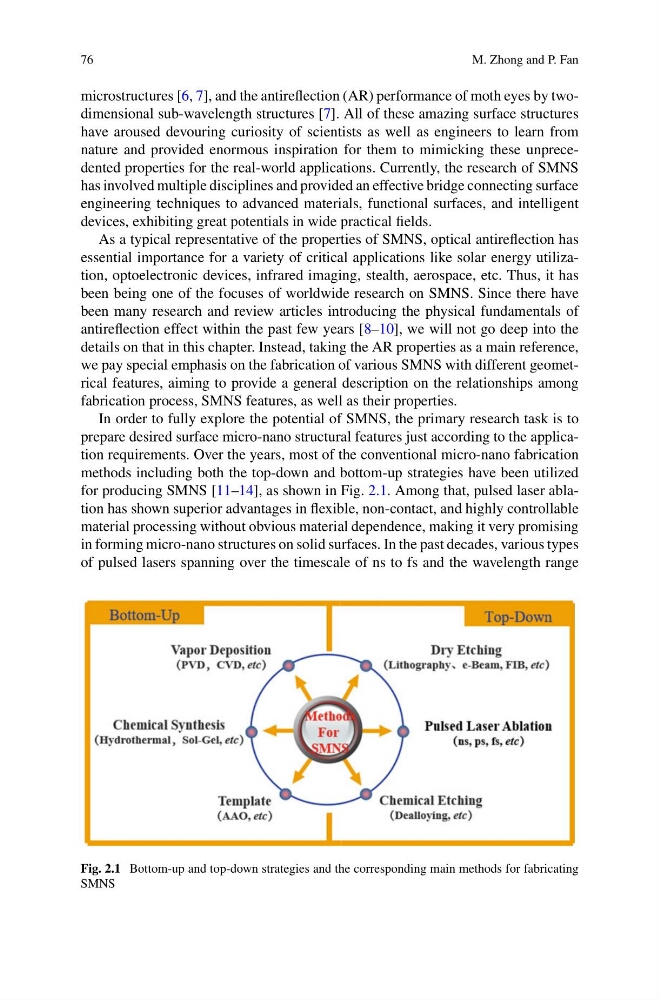
prepare desired surface micro-nano structural features just according to the application requirements. Over the years, most of the conventional micro-nano fabrication
methods including both the top-down and bottom-up strategies have been utilized
for producing SMNS [11–14], as shown in Fig. 2.1. Among that, pulsed laser ablation has shown superior advantages in flexible, non-contact, and highly controllable
material processing without obvious material dependence, making it very promising
in forming micro-nano structures on solid surfaces. In the past decades, various types
of pulsed lasers spanning over the timescale of ns to fs and the wavelength range
Fig. 2.1 Bottom-up and top-down strategies and the corresponding main methods for fabricating
SMNS
M. Zhong and P. Fan
microstructures [6, 7], and the antireflection (AR) performance of moth eyes by twodimensional sub-wavelength structures [7]. All of these amazing surface structures
have aroused devouring curiosity of scientists as well as engineers to learn from
nature and provided enormous inspiration for them to mimicking these unprecedented properties for the real-world applications. Currently, the research of SMNS
has involved multiple disciplines and provided an effective bridge connecting surface
engineering techniques to advanced materials, functional surfaces, and intelligent
devices, exhibiting great potentials in wide practical fields.
As a typical representative of the properties of SMNS, optical antireflection has
essential importance for a variety of critical applications like solar energy utilization, optoelectronic devices, infrared imaging, stealth, aerospace, etc. Thus, it has
been being one of the focuses of worldwide research on SMNS. Since there have
been many research and review articles introducing the physical fundamentals of
antireflection effect within the past few years [8–10], we will not go deep into the
details on that in this chapter. Instead, taking the AR properties as a main reference,
we pay special emphasis on the fabrication of various SMNS with different geometrical features, aiming to provide a general description on the relationships among
fabrication process, SMNS features, as well as their properties.
In order to fully explore the potential of SMNS, the primary research task is to
prepare desired surface micro-nano structural features just according to the application requirements. Over the years, most of the conventional micro-nano fabrication
methods including both the top-down and bottom-up strategies have been utilized
for producing SMNS [11–14], as shown in Fig. 2.1. Among that, pulsed laser ablation has shown superior advantages in flexible, non-contact, and highly controllable
material processing without obvious material dependence, making it very promising
in forming micro-nano structures on solid surfaces. In the past decades, various types
of pulsed lasers spanning over the timescale of ns to fs and the wavelength range
Fig. 2.1 Bottom-up and top-down strategies and the corresponding main methods for fabricating
SMNS